Clear Sky Science · en
Robust coexistence in competitive ecological communities
Why this matters for nature’s balance
From forests and grasslands to your own gut microbiome, countless species compete for space and resources. Ecologists have long wondered why these crowded communities so often look stable rather than chaotic. This study asks a simple but deep question: when many species compete, what makes long-term peaceful coexistence possible, and why do we so rarely see wild swings or chaos in such systems?
The tug-of-war within and between species
Species compete in two main ways: with others, and with themselves. Individuals of different species may fight over shared resources, but individuals of the same species also limit each other, for example by depleting their own favorite food or attracting specialized enemies. This self-limitation is called intraspecific competition. The authors explore how the balance between self-competition and between-species competition shapes whether many species can coexist at steady, reasonable population levels instead of exploding, crashing, or cycling forever.
Finding the sweet spot for steady communities
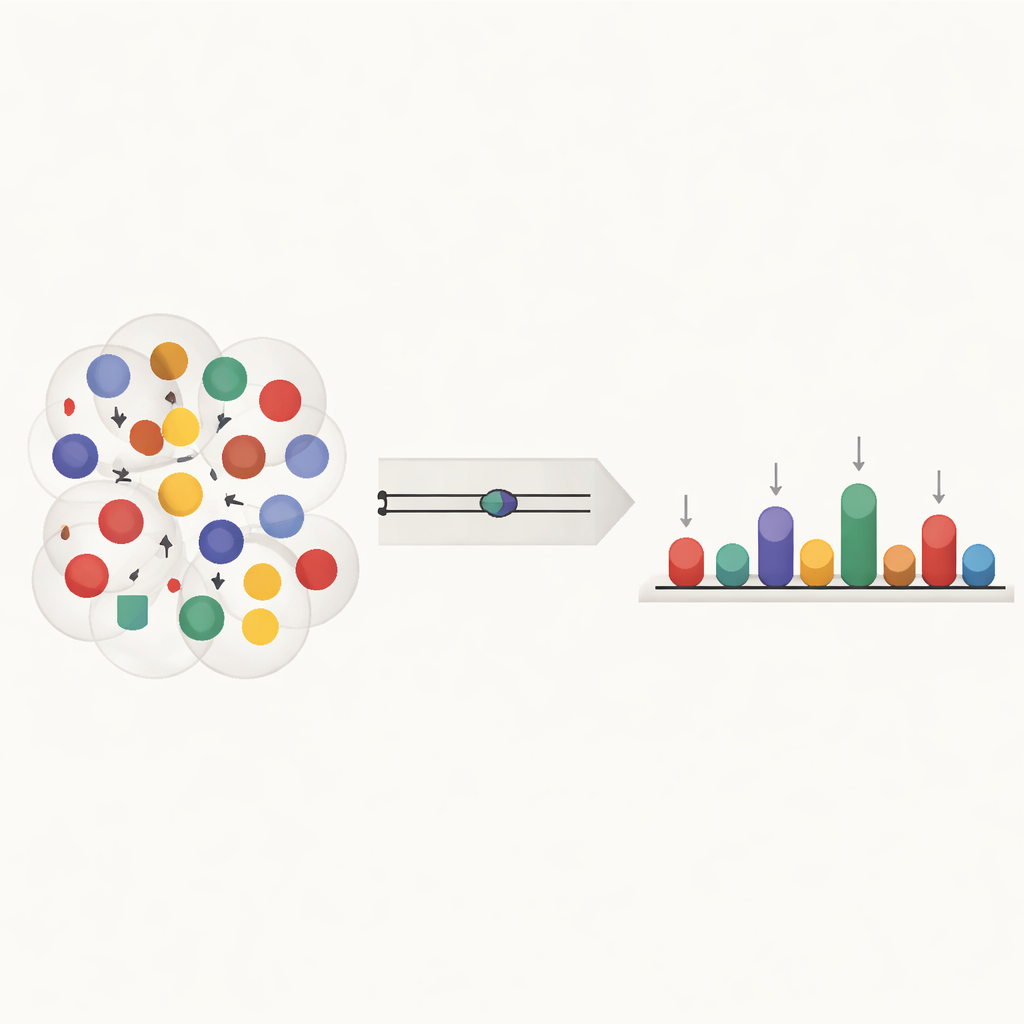
Using a standard mathematical framework for population dynamics, the researchers treat the web of competitive strengths among species as essentially random, reflecting the messy reality of nature. They then gradually dial up the strength of self-competition that each species experiences and track two questions: does there exist a combination of population sizes where all species can, in principle, persist with positive numbers (feasibility)? And if such a combination exists, will populations return to it after any disturbance short of outright extinction (stability)? Through theory and simulations, they show that there are critical levels of self-competition acting like thresholds. Above one threshold, any possible steady state is guaranteed to be stable. Above a higher threshold, a fully positive steady state is guaranteed to exist. In other words, as self-limitation grows, stability appears before guaranteed coexistence.
When coexistence is possible, it is also robust
A key finding is that in very large competitive communities, if the system manages to support a feasible steady state where all surviving species have positive populations, then that steady state is, with overwhelming probability, automatically stable and robust. The odds that a community could have a mathematically possible coexistence point that is nevertheless fragile or prone to chaotic swings shrink rapidly as the number of species increases. The authors capture this behavior in a general formula for the chance that a random competitive community is feasible at a given level of self-competition, and they show that this probability curve becomes almost universal, depending mainly on a few basic statistical features of the interaction strengths.
Extinctions that carve out a stable core
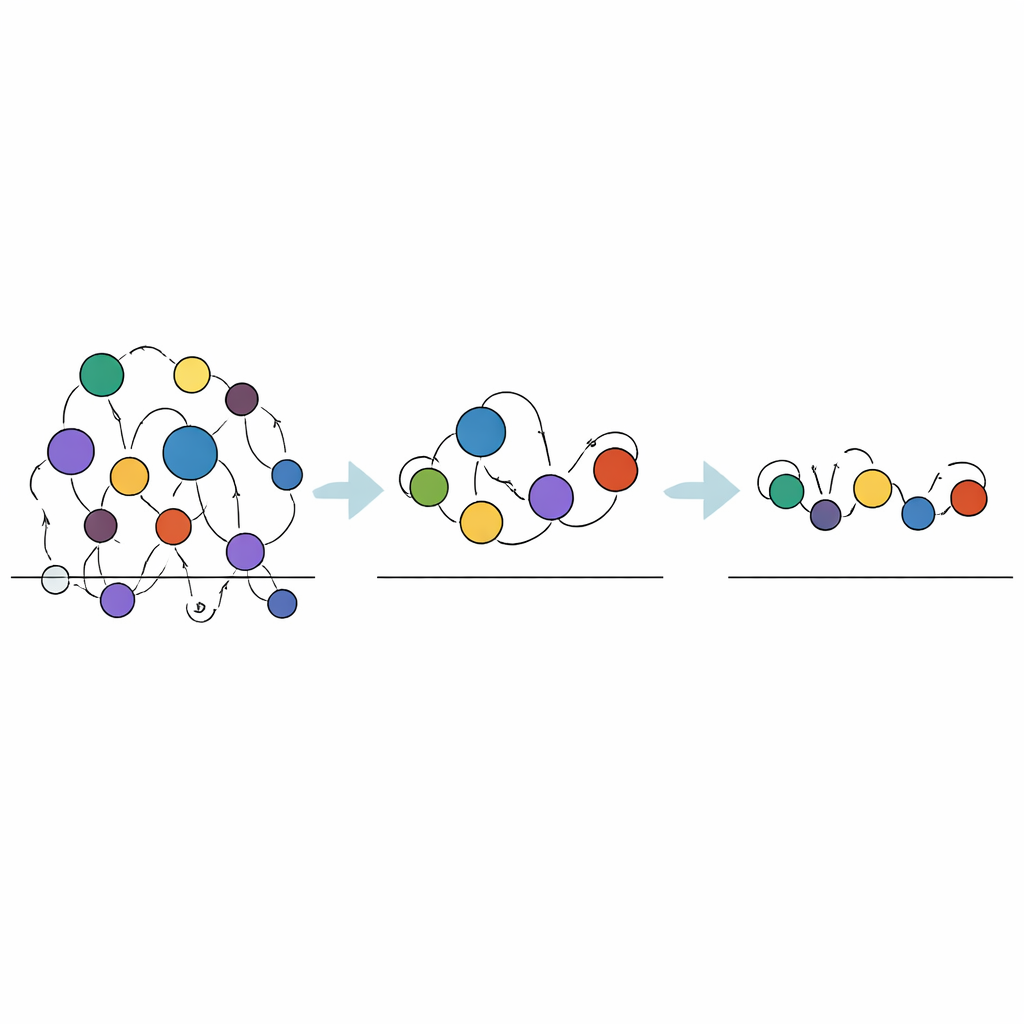
Real communities often start from a larger pool of potential species than can actually coexist. What happens then? The study shows that if self-competition is not yet strong enough to allow everyone to persist, some species will go extinct as the system evolves. These losses effectively trim the network of interactions down to a smaller community. Crucially, as this pruning unfolds, the ordering of the two thresholds is preserved: the level of self-competition needed for stability remains lower than the level needed to guarantee feasibility for the current set of species. As a result, the remaining subset of species almost always settles into a globally stable equilibrium. Once this state is reached, the species that disappeared cannot successfully re-enter, and any disturbance that does not wipe out a species outright will be damped out rather than amplified.
What this means for nature and experiments
Put in everyday terms, the study suggests that large competitive communities are naturally drawn toward calm, self-regulating configurations. Strong enough self-limitation within each species both makes coexistence possible and, almost automatically, makes it robust. Long-lasting cycles and chaos become highly unlikely outcomes when many competitors interact mainly through competition and can go extinct. This helps explain why experiments with competing species at the same feeding level so often end in steady, predictable abundances, while wilder behavior is more typical of predator–prey relationships or systems constantly replenished by immigration. In short, when competition dominates and species can disappear, the survivors tend to form a community that is both diverse and remarkably hard to knock off balance.
Citation: Lechón-Alonso, P., Kundu, S., Lemos-Costa, P. et al. Robust coexistence in competitive ecological communities. Nat Commun 17, 2637 (2026). https://doi.org/10.1038/s41467-026-69151-3
Keywords: ecological communities, species coexistence, competition, population stability, biodiversity dynamics