Clear Sky Science · en
Universal work extraction in quantum thermodynamics
Turning Random Quantum Heat into Useful Work
As our technology shrinks to the scale of atoms and individual particles, even simple tasks like charging a tiny battery become surprisingly tricky. Engineers would love to harvest useful work from quantum devices that jiggle and fluctuate at this scale, but existing theories often assume we already know everything about the quantum state we are given. This paper shows that, under broad conditions, we can reach the absolute theoretical limit of useful work without needing to know those microscopic details at all.
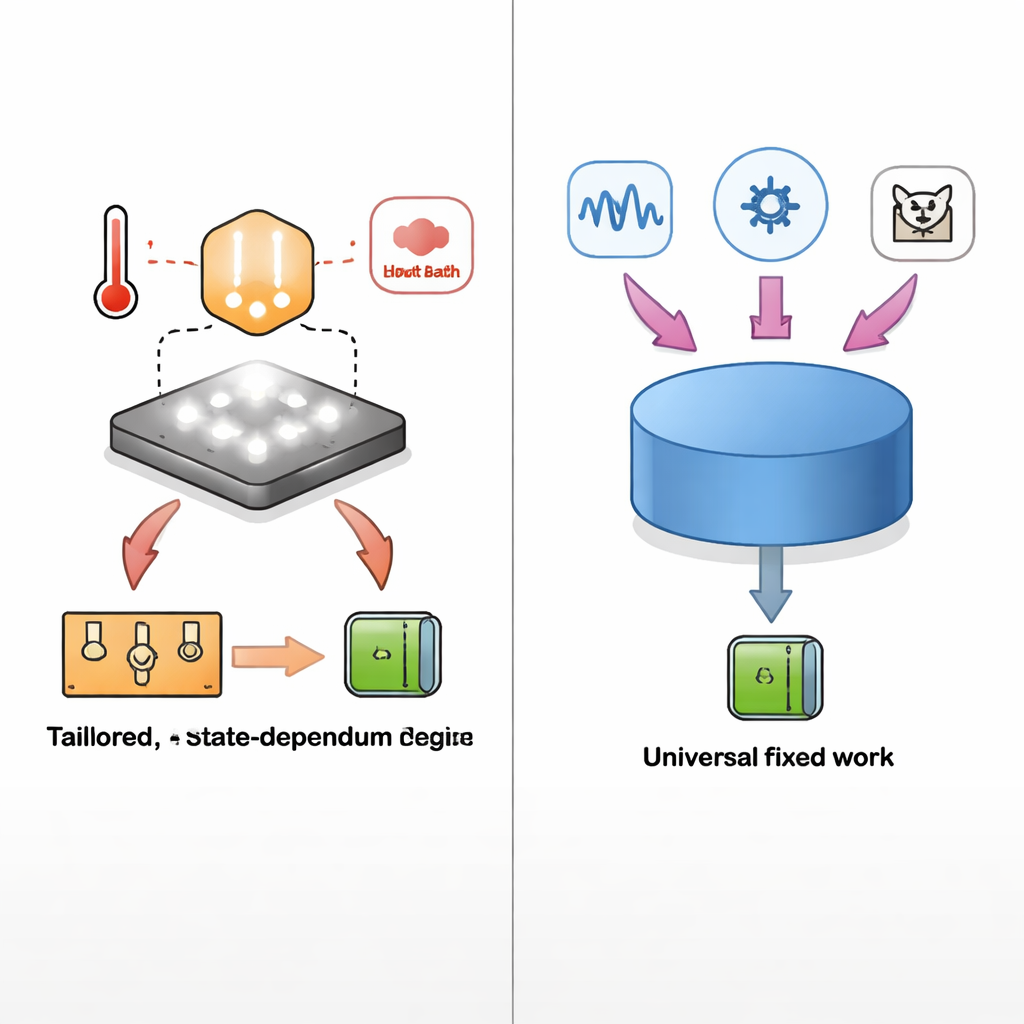
Why Tiny Engines Face a Big Information Problem
In ordinary thermodynamics, the amount of work you can extract from a system is governed by its free energy, which captures how far it is from thermal equilibrium. In the quantum world, a similar idea holds: if you are handed many identical copies of a quantum state and you know exactly what that state is, then previous work showed you can design a highly tuned protocol that converts its free energy into useful work in the most efficient possible way. The catch is that, in realistic laboratory settings, you rarely know the full quantum state. It may have been produced by a complicated quantum circuit, contaminated by noise, or simply be too costly to measure thoroughly without destroying many copies. Learning the state well enough can itself consume so many samples and so much thermodynamic cost that it negates the benefit of the work you hoped to gain.
Beating the Need to Know
Watanabe and Takagi overturn the expectation that this ignorance must severely limit performance. They construct a single, fixed quantum process—a universal work extractor—that does not depend on any prior knowledge of the incoming state, yet in the long run extracts just as much work per copy as the best state-specific protocol. Their result applies to any finite system in contact with a heat bath at a fixed temperature, under the standard physical rules known as thermal operations, where only one special state (the usual thermal equilibrium state) is freely available. Mathematically, they show that for every possible input state, the universal protocol reaches the same optimal rate of work extraction that would be achievable if an expert had tailored the protocol using the exact description of that state.
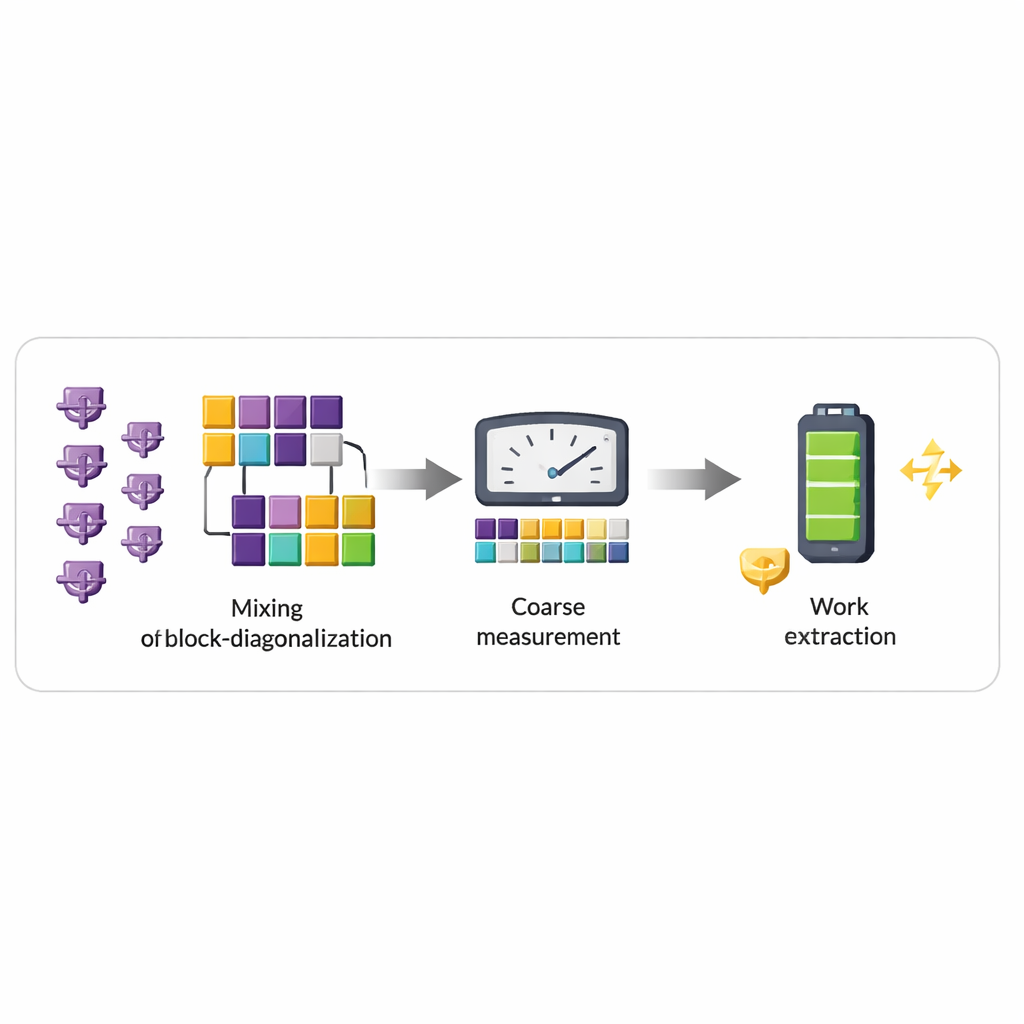
How a Universal Quantum Engine Works
The central idea is to exploit symmetry and to learn only the bare minimum needed, without ever fully identifying the input state. Given many identical copies, the authors first apply a special “pinching” procedure that respects the way energy is shared across the copies. This step removes delicate quantum coherences in a highly structured way, leaving behind an effective classical description that keeps almost all the relevant free energy. Next, rather than performing full tomography, the protocol measures only coarse features—essentially estimating how far, in an information-theoretic sense, the state is from thermal equilibrium—using a sublinear number of copies. With this rough estimate, the protocol then executes a standard work-extraction routine designed only around that distance. Cleverly, all of these operations can be realized within the allowed thermodynamic framework, so the overall process remains physically realistic.
Reaching into Infinite-Dimensional Systems
Many important quantum technologies, such as optical systems, live in an infinite-dimensional setting where energy levels stretch without bound; here, even the best state-dependent work limits were not fully established. The authors extend their ideas to this regime under natural conditions on the input states’ energies. For any finite set of candidate states with well-behaved energy tails, they prove that the optimal work rate is again given by the same free-energy measure, and they design a “semiuniversal” protocol that achieves this rate without needing to know exactly which state was supplied. The method uses a smart truncation to a growing finite subspace and a modest amount of state identification, still without reconstructing the full quantum state.
What This Means for Future Quantum Technologies
To a non-specialist, the message is striking: at least in the long run, ignorance about the microscopic details of a quantum system does not reduce how efficiently we can turn its disorder into useful work, as long as the system is prepared in a consistent way across many runs. Universal work extraction thus joins a growing family of “state-agnostic” protocols in quantum information theory, indicating that robust, plug-and-play quantum engines and thermodynamic modules may be possible without painstaking calibration at the level of individual quantum states.
Citation: Watanabe, K., Takagi, R. Universal work extraction in quantum thermodynamics. Nat Commun 17, 1857 (2026). https://doi.org/10.1038/s41467-026-69143-3
Keywords: quantum thermodynamics, work extraction, universal protocol, free energy, nanoscale engines