Clear Sky Science · en
Dual Janus foam for directional thermal management
Why shaping heat flow matters
From keeping buildings comfortable to capturing waste heat from factories, managing temperature efficiently is central to our energy future. Yet most materials let heat wander about in all directions. This study introduces a new kind of lightweight foam that lets heat pass much more easily one way than the other, a bit like an electrical diode for warmth. By combining clever control of sunlight with one‑way heat conduction, the material can help smooth out daily temperature swings and harvest otherwise wasted thermal energy.
A foam with two very different faces
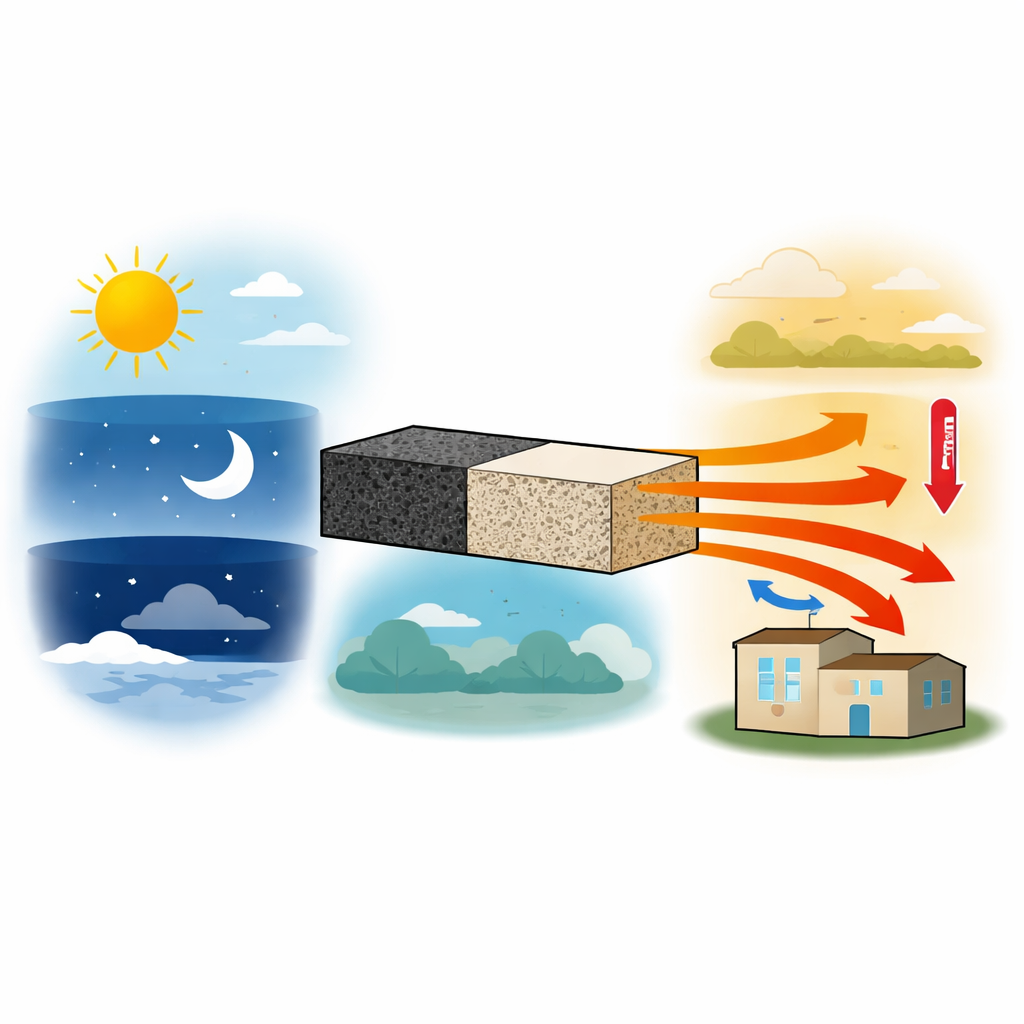
The researchers built their material as a "Janus" foam, named after the two‑faced Roman god. One side of the foam is dark and strongly absorbs sunlight, turning light into heat. The other side is pale and mostly reflects sunlight, staying much cooler. Inside, the foam is full of pores, but the two layers have different pore sizes and slightly different ingredients. This dual design was achieved using specially made "Janus" particles that like both oil and water, allowing the team to create stacked liquid emulsions that solidify into a rigid, two‑layer sponge.
Turning light into one‑way warmth
Adding a small amount of black carbon‑based filler to just one layer dramatically changes how the foam behaves under sunlight. The dark, filler‑rich side soaks up most of the incoming solar energy and heats quickly, while the opposite side reflects most of the light and stays comparatively cool. Measurements show that in the most extreme version, one face of the foam reflects only a few percent of sunlight whereas the other reflects nearly ninety percent. As a result, the same piece of foam can either act as a solar heater or as a sunshade, depending on which face is turned toward the sky.
Guiding heat like a one‑way street
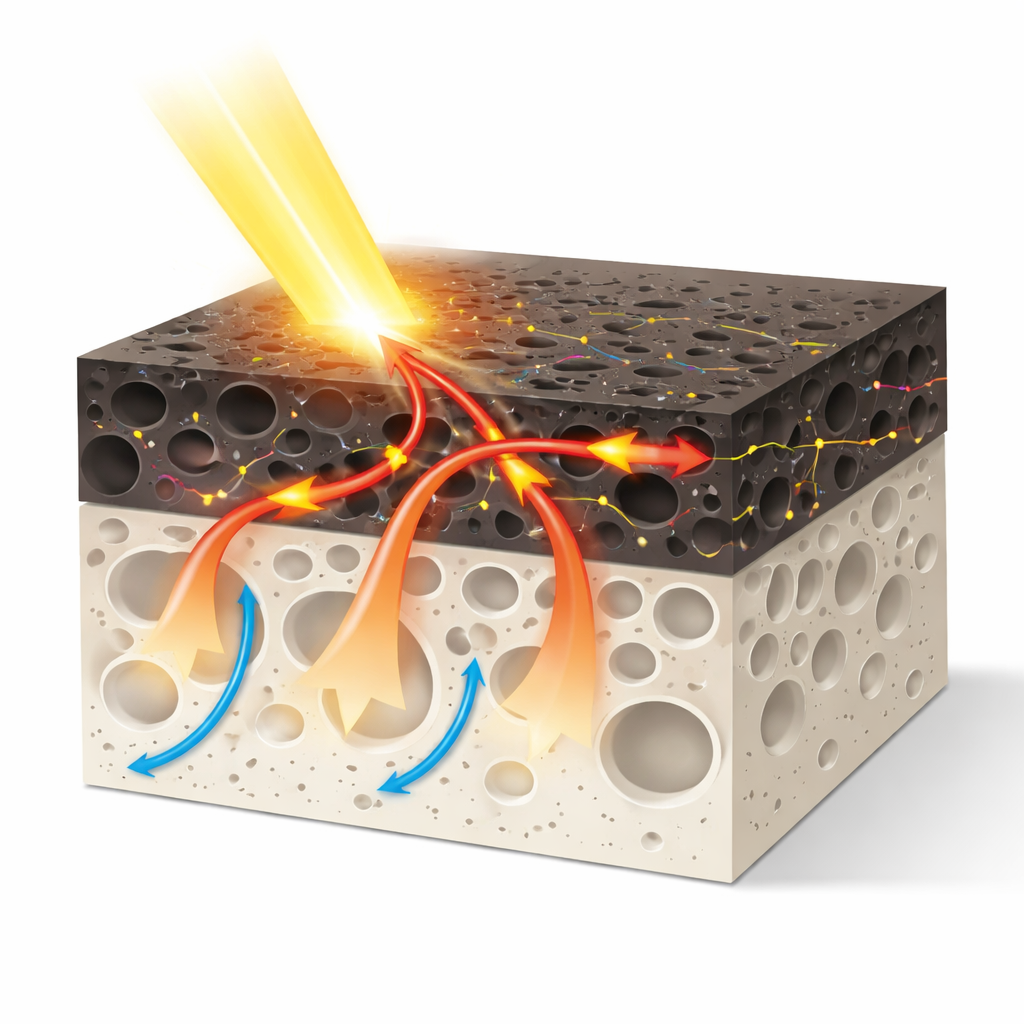
Beyond its interaction with light, the foam also conducts heat asymmetrically. Because the two layers have different pore structures—and because only one layer is loaded with a thermally conductive filler—heat travels faster when it enters from the high‑conductivity, small‑pore side than when it comes from the opposite direction. Experiments using a tiny heater and sensor sandwiched between two pieces of foam show that the effective heat flow in the “easy” direction is more than twice that in the “hard” direction, a very strong rectifying effect for a solid, bulk material.
From lab samples to real‑world settings
To see how this dual behavior plays out in practice, the team exposed foam panels to simulated sunlight and monitored temperatures on both the sunlit and shaded sides. When the dark, absorbing face was on top, the bottom side—representing a protected object—became noticeably warmer than when the reflective face was on top. Compared with a simpler single‑layer design, the dual Janus foam amplified the temperature difference between the two directions more than twentyfold. The researchers then scaled the foam up to panels tens of centimeters across and placed them over small house models outdoors. Over sunny, cloudy, and even misty or rainy conditions, houses covered with the foam in the "heating" orientation stayed consistently warmer inside than those with the foam flipped, while still benefiting from the foam’s general insulating properties.
What this means for everyday energy use
In plain terms, the dual Janus foam behaves like a thin, flexible surface that can decide when to welcome heat and when to block it—and does so more effectively in one direction than the other. By combining strong sunlight absorption on one face with one‑way heat flow through its interior, the material can turn natural temperature swings, such as day–night cycles or periodic heating of industrial equipment, into steady, useful heat gradients. That makes it a promising building block for future systems that passively stabilize indoor temperatures, preserve heat when and where it is needed, or drive devices that convert waste warmth into electricity, all without consuming extra power.
Citation: Jiang, C., He, X., Zheng, X. et al. Dual Janus foam for directional thermal management. Nat Commun 17, 2251 (2026). https://doi.org/10.1038/s41467-026-69140-6
Keywords: thermal management, Janus foam, passive cooling and heating, thermal rectifier, energy harvesting