Clear Sky Science · en
Bio-orthogonal functionalization of bacterial cellulose combining metabolic glycoengineering and click chemistry
Turning Nature’s Bandage into a Smart Healer
Bacterial cellulose is already used as a gentle, skin-friendly "bio-bandage" because it is pure, strong, and holds water well. But on its own it is mostly a passive material: it covers wounds but does not actively fight infection, control inflammation, or help cells grow. This paper describes a way to turn this natural scaffold into a programmable healing platform that can carry many different helpful molecules—such as antibiotics, cell-adhesion signals, and enzymes—without damaging the underlying cellulose. The authors then use this upgraded material to build a dressing that helps chronic diabetic wounds heal faster in mice.
A Better Way to Upgrade a Natural Material
Bacterial cellulose is made by harmless microbes that spin out an ultrastrong, sponge-like sheet of pure fibers. This sheet is ideal for contact with the body, but it lacks the biological functions that modern medicine often needs, such as killing germs or calming inflammation. Existing ways to "decorate" cellulose—like soaking it in drugs or chemically attacking its surface—either wash out quickly or rely on harsh treatments that can weaken the material and hurt its biocompatibility. The researchers set out to solve this by building the desired chemical handles directly into the cellulose as it is being made, then using gentle, highly selective reactions to attach almost any chosen payload.
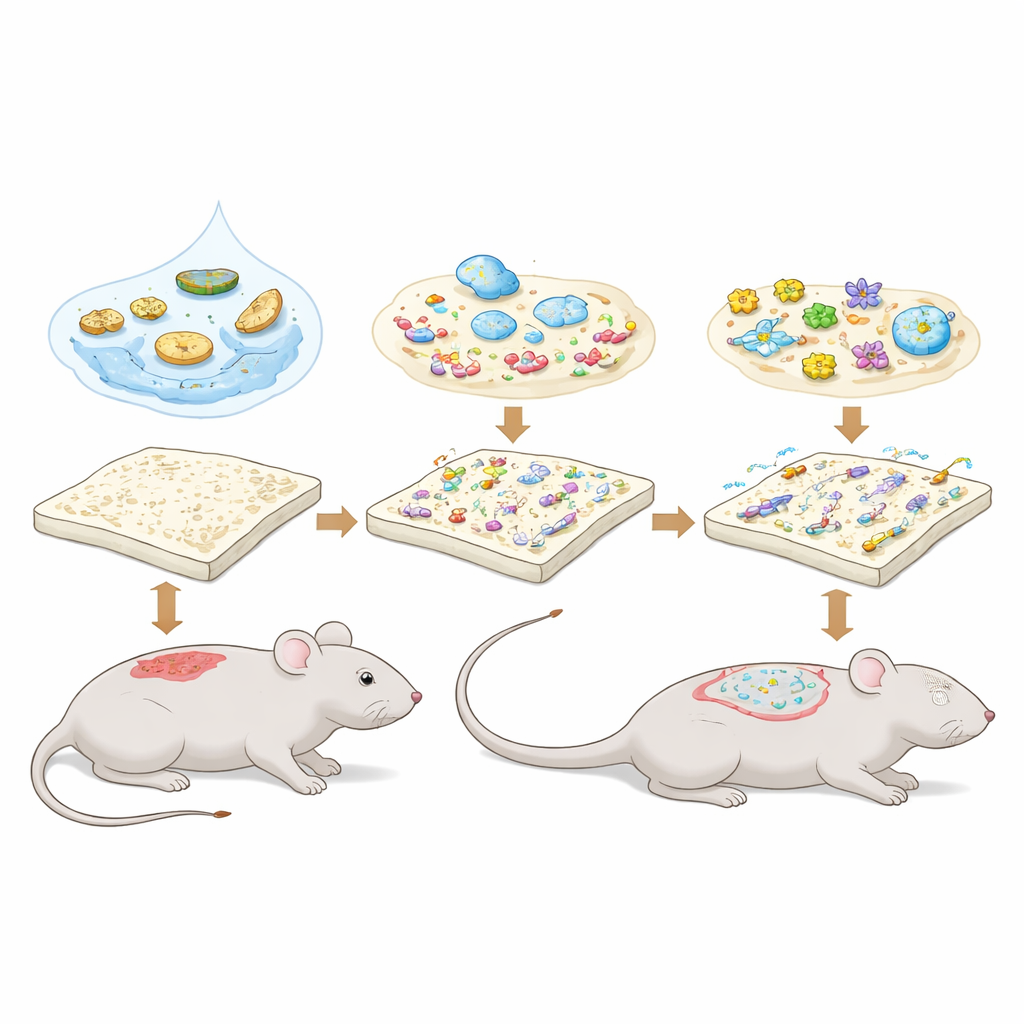
Giving Cellulose Invisible Connection Points
The team discovered that cellulose-producing bacteria can tolerate and use a specially designed sugar called GlcNAz, which carries a tiny azide group. When the microbes are fed both normal sugar and GlcNAz, they weave azide-bearing units into the growing cellulose network, creating a sheet that looks and behaves like ordinary bacterial cellulose but is peppered with these invisible connection points. Careful imaging and spectroscopy show that the azides are spread evenly throughout the material and do not harm its strength, stability, or compatibility with cells. Multiple bacterial species accept this modified sugar, suggesting the method can be scaled and generalized.
Clicking On Antibacterial Dyes, Cell Hooks, and Proteins
Once these azide hooks are in place, the authors use "click chemistry"—a family of simple, water-friendly reactions—to snap on molecules that carry a matching alkyne group. Because azides and alkynes mostly ignore other biological structures, this process is both precise and mild. The researchers attach three kinds of components to showcase the platform’s versatility. First, they graft light-activated porphyrin dyes that, under illumination, damage and kill microbes on the surface of the material. Second, they add short RGD peptides that act as hooks for mammalian cells, greatly improving how well skin cells spread and attach. Third, they develop a gentle method to add alkynes to fragile proteins at specific amino acids, then click these proteins—such as fluorescent markers and enzymes—onto the cellulose without destroying their activity.
Building a Smart Dressing for Diabetic Wounds
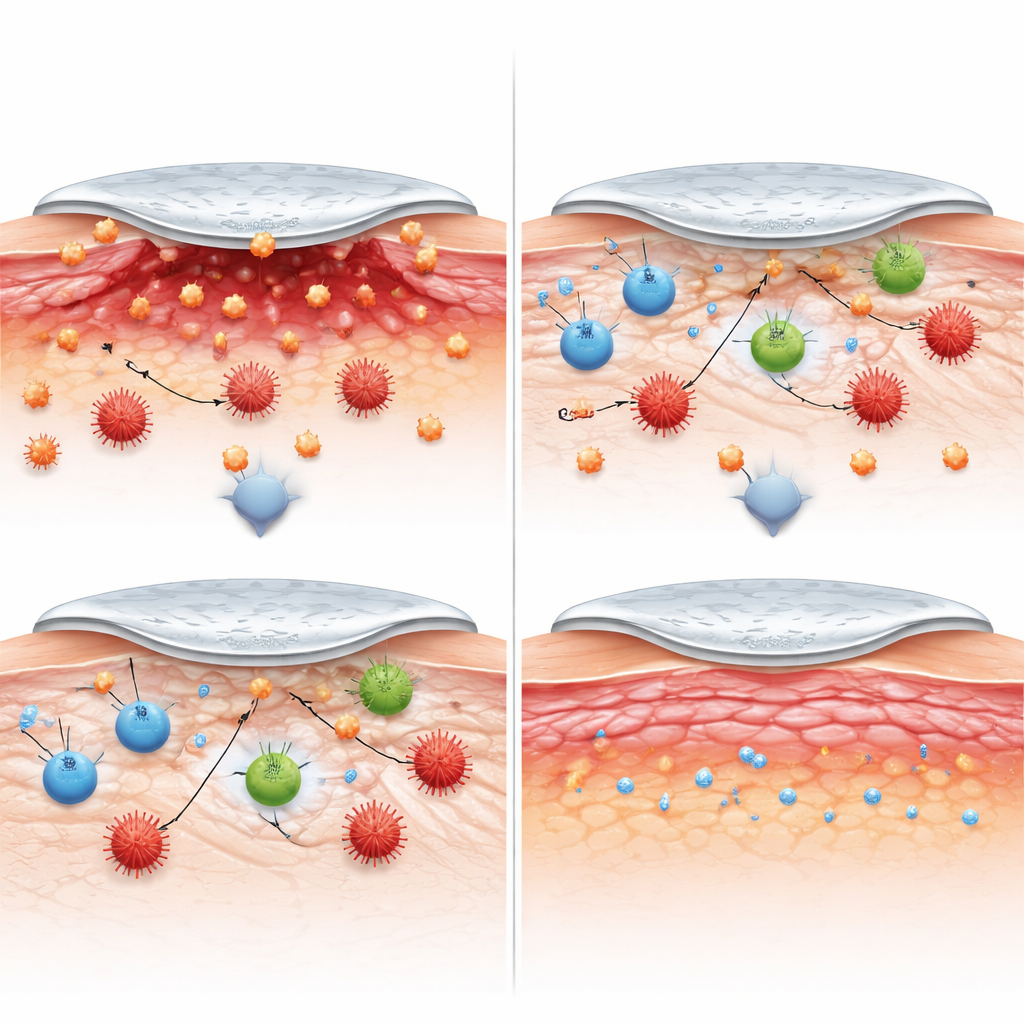
With this toolbox in hand, the team designs a multifunctional dressing for the notoriously difficult problem of diabetic skin ulcers. They attach two enzymes to the azide‑bearing cellulose: glucose oxidase, which consumes excess sugar around the wound, and superoxide dismutase, which helps neutralize harmful reactive oxygen species that drive inflammation. Laboratory tests show that these enzymes stay firmly attached and remain active, outperforming simple physical adsorption. In cell culture, the dressing reduces markers of oxidative stress. In diabetic mice with large skin wounds, the dual-enzyme bandage speeds healing dramatically: after 14 days, wounds covered with the engineered dressing are over 90% closed, compared with roughly 45–77% for untreated, gauze-covered, or plain cellulose-treated wounds. Tissue analysis reveals thicker, better-organized skin, more blood vessels, and lower levels of pro-inflammatory signals.
From Passive Patch to Programmable Platform
This work shows that bacterial cellulose can be turned from a passive cover into an active, customizable healing platform by quietly installing chemical connection points during its growth and then using click chemistry to add chosen functions. Because the underlying material remains strong, biocompatible, and low in contaminants, and because the linking chemistry is modular, the same strategy could be used to attach many different therapeutic agents for wounds, implants, or even environmental uses. For a lay reader, the key message is that we can now grow a natural bandage that can later be "programmed" like a circuit board—with antibacterial, cell-guiding, or enzyme-based functions—opening the door to smarter, more effective biomaterials.
Citation: Chen, S., Tang, H., Fan, X. et al. Bio-orthogonal functionalization of bacterial cellulose combining metabolic glycoengineering and click chemistry. Nat Commun 17, 2304 (2026). https://doi.org/10.1038/s41467-026-69130-8
Keywords: bacterial cellulose, wound healing, click chemistry, bioactive materials, enzymatic dressings