Clear Sky Science · en
Self-cleaning hierarchical thermal cloak
Keeping Heat Hidden in Plain Sight
From search-and-rescue cameras to military sensors, many modern eyes “see” in invisible heat rays rather than visible light. Hiding hot objects from this infrared vision is difficult, because anything warm naturally glows. This paper describes a new coating that can make hot surfaces far harder to spot, while also keeping them cool and clean in harsh outdoor conditions. It borrows ideas from both advanced optics and the self-cleaning surface of lotus leaves to create a heat cloak that is not only effective, but also tough enough for the real world.
Why Hiding Heat Is So Hard
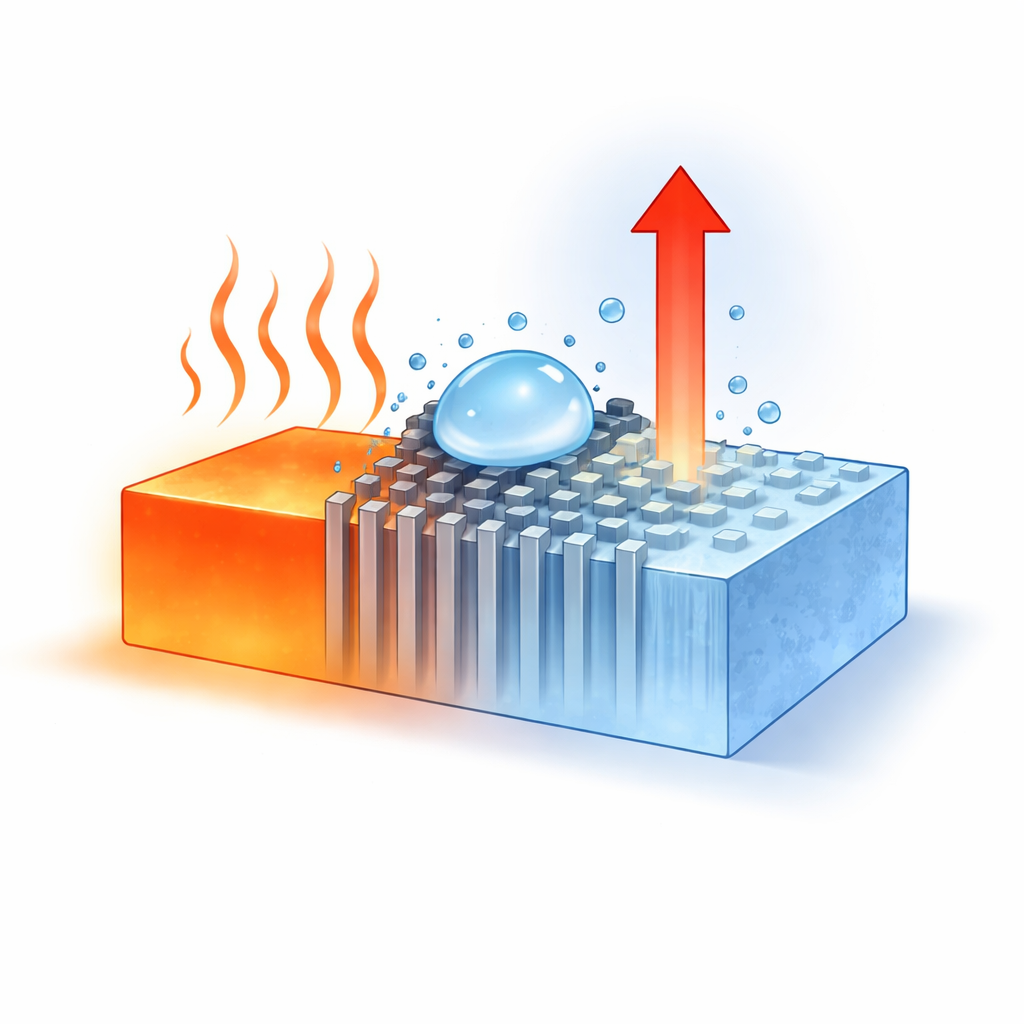
Every object emits invisible infrared radiation, and thermal cameras pick up that glow. A simple way to dim this glow is to cover a surface with shiny metals such as gold or platinum, which emit very little infrared light. But this approach has a catch: by blocking radiation in all directions, it also traps heat. As the object warms up, it ultimately glows more strongly, undoing the camouflage. A more clever strategy is to let heat escape at wavelengths where the atmosphere is opaque to sensors, while staying dark in the “viewing window” where cameras are most sensitive. Engineers have tried to achieve this selective behavior with stacks of ultra-thin films, photonic crystals, and tiny antennas carved into metals, but these delicate structures are hard to manufacture over large areas and are easily ruined by dust, erosion, and high temperature.
A Layered Forest That Cools and Cleans Itself
The authors designed a “hierarchical” coating that tackles several problems at once. At the bottom is a grid of microscopic pillars etched into silicon. Their shape and spacing trap pockets of air, making the surface extremely water-repellent, like a lotus leaf. On top of the pillars, the team laid down carefully chosen metal and ceramic nanofilms that emit little infrared light where cameras see best. Finally, they used ultra-short laser pulses to carve the top platinum layer on each pillar into square patches that act as tiny antennas. These antennas are tuned so that they strongly emit heat in a band of wavelengths where the atmosphere blocks most infrared sensors, allowing the surface to shed heat efficiently without becoming easier to detect.
Precision Laser Sculpting at the Nanoscale
Shaping these nano-antennas is like engraving a postage stamp with hair-thin details while avoiding the layer underneath. The researchers used femtosecond laser direct writing, a technique that fires bursts of light lasting only a quadrillionth of a second. By carefully balancing how much each laser spot overlaps with its neighbors and how much energy each pulse carries, they could strip away platinum in clean lines only about a micrometer wide—roughly one-hundredth the thickness of a human hair—while leaving the supporting layers intact. They also showed that this process can be scaled up across square centimeters, and in principle adapted to curved or larger surfaces, which is essential if such cloaks are to cover real devices or vehicle skins.
Lotus-Leaf Cleaning and Rugged Performance
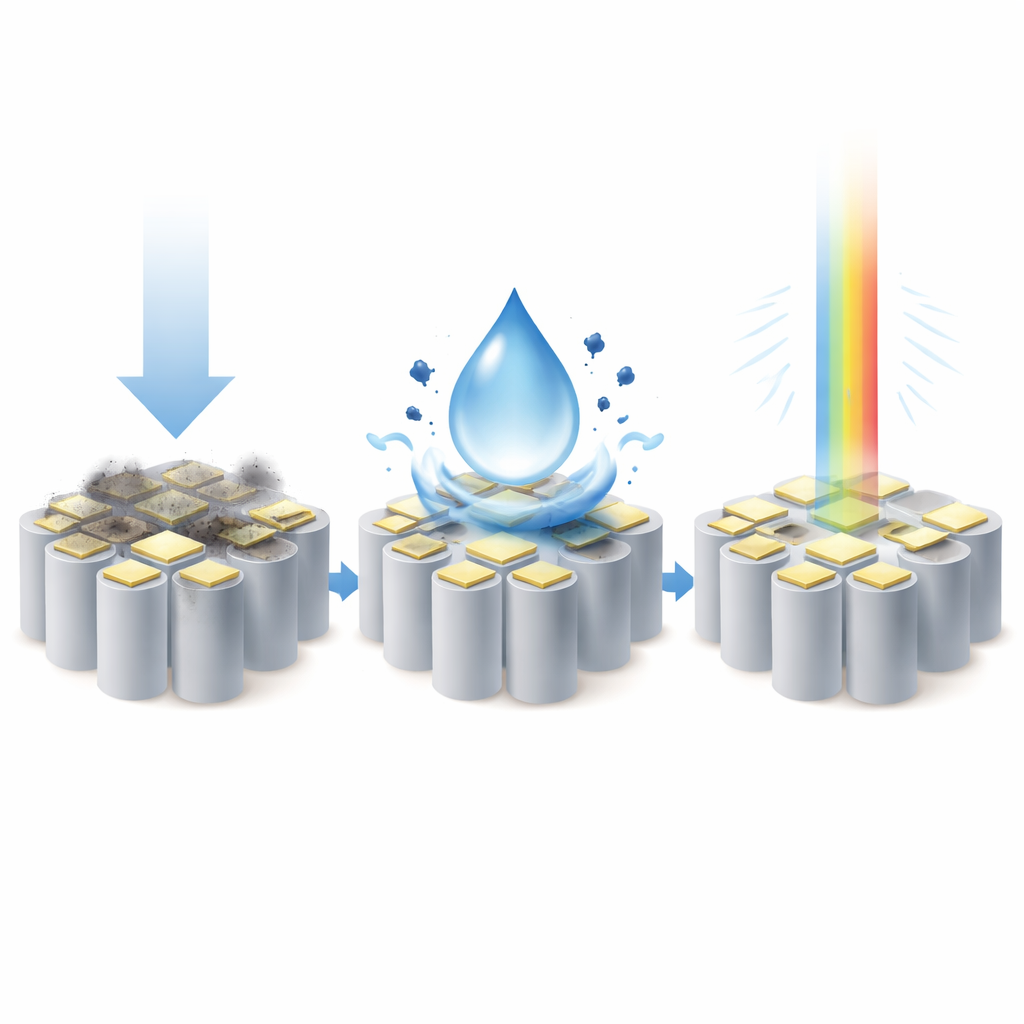
Dust and soot normally doom advanced coatings, because most common particles glow strongly in the infrared and erase any careful spectral tuning. On the new micropillar surface, however, water drops do not spread or soak in. Instead, when a droplet hits and rolls off, it skims across the pillar tops, dragging along clinging particles and sweeping the surface clean. Experiments with dark manganese oxide dust showed that a single impacting droplet could restore the low infrared visibility of a fouled sample, while a conventional metal-coated surface only became more contaminated. The same structure also enhances convective cooling by increasing the surface area touched by air, but measurements showed that the main temperature drop—up to 23 °C compared with a bare heater and tens of degrees compared with ordinary coatings—comes from the engineered infrared emission of the antennas.
Built to Survive Heat, Wind, and Wear
To test durability, the team exposed their coated samples to temperatures up to about 627 °C, blasts of hot air at highway-like speeds, continuous water jets, strong ultraviolet light, and repeated heating and cooling cycles. Across these trials, the special emission peak that enables “invisible” cooling largely remained, and the surface stayed highly water-repellent; droplets still bounced and rolled, removing dirt. Even after day-long harsh treatments, the coating preserved both its thermal cloaking and self-cleaning abilities, and it did not weaken the underlying metal parts. Compared with earlier thermal cloaks, which often excel only under gentle lab conditions, this design offers a more balanced package of cooling power, low detectability, and real-world robustness.
What This Means for Future Heat Cloaks
In plain terms, the researchers have built a smart outer skin that helps hot objects shed heat in a way that is hard for infrared cameras to see, and that can clean and protect itself in dirty, windy, high-temperature environments. By co-designing the materials, tiny structures, and manufacturing method, they show a path toward large-area “thermal invisibility cloaks” that are not just scientifically impressive but also practical. Such coatings could be useful for stealth technologies, protective skins for high-temperature machinery, or sensors that must work reliably in extreme conditions.
Citation: Guo, H., Li, W., Jing, L. et al. Self-cleaning hierarchical thermal cloak. Nat Commun 17, 2670 (2026). https://doi.org/10.1038/s41467-026-69122-8
Keywords: thermal cloaking, infrared camouflage, radiative cooling, superhydrophobic surfaces, nanostructured coatings