Clear Sky Science · en
An all-in-one Ag2Se-based flexible solar-thermoelectric generator with photothermal integration
Turning Sunlight into Wearable Power
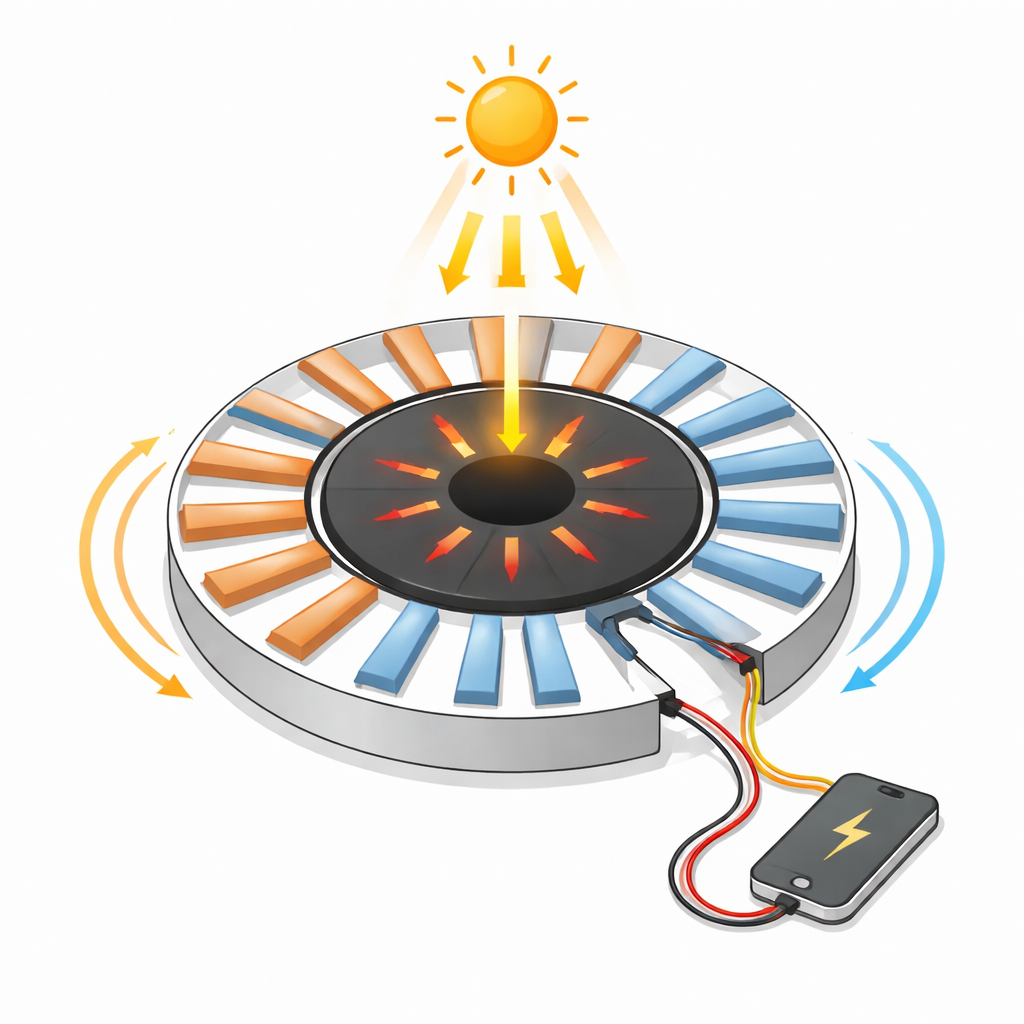
Imagine if your hat or backpack could quietly turn sunshine into electricity, powering health sensors or small gadgets without any batteries. This study describes a new kind of thin, bendable device that does just that. By cleverly stacking ultra-thin layers of materials, the researchers created a ring-shaped strip that both soaks up sunlight as heat and converts that heat directly into electricity, all in one compact film.
Why Flexible Sun-Powered Films Matter
Conventional solar technologies often chase maximum efficiency and usually rely on rigid panels or complex combinations of parts. But low-power electronics on the body—such as fitness trackers or environmental sensors—care more about steady, reliable output and comfort than about record-breaking performance. Solar–thermoelectric generators, which turn sunlight into heat and then into electrical power, can operate when regular solar cells struggle, such as in variable light or at modest temperatures. Making these generators thin, flexible, and simple enough to integrate into clothing or accessories could open the door to self-powered wearable electronics.
Combining Light Capture and Power Generation
Most existing solar–thermoelectric devices are built from separate pieces: one set of materials absorbs sunlight and heats up, while another set converts the temperature difference into electricity. This multi-part approach adds bulk and wastes heat at the interfaces. The team instead designed an “all-in-one” structure based on a silver selenide (Ag2Se) film that both absorbs light and serves as the active thermoelectric material. They optimized the film so that charge carriers move easily through it, preserving strong electrical performance even at room temperature and under bending. On its own, however, the bare film could not reach very high temperatures under sunlight, so the researchers needed a smarter way to trap and manage heat.
A Heat-Trapping Stack of Invisible Layers
To boost heating, the researchers built a carefully engineered stack underneath and above the Ag2Se film. At the bottom sits a metallic mirror made of silver and tungsten that reflects infrared light back into the absorber and blocks heat from radiating away. On top, they added two ultra-thin transparent layers of aluminum oxide and silicon dioxide that act like an invisible anti-glare coating, reducing reflections and letting more sunlight enter the dark Ag2Se layer. Electron microscope images showed sharp, clean boundaries between layers, which helps keep electrical and thermal behavior predictable. Optical measurements confirmed that this stacked film absorbs a much larger fraction of the solar spectrum while reflecting waste infrared light away from the environment.

From Hot Films to Working Wearable Generators
When tested under simulated sunlight, the multilayer film heated up to about 85 degrees Celsius at standard solar intensity—far hotter than the plain Ag2Se film and comparable to advanced commercial solar absorber coatings. The heat rose quickly and responded linearly as light intensity increased, which is useful for both stable power output and light sensing. The film maintained its performance even after thousands of bending cycles, showing that it can survive the flexing expected in real wearables. The team then built a ring-shaped generator with alternating “n-type” Ag2Se and “p-type” antimony telluride legs around a central heated region. Under one-sun conditions, this flexible ring produced a temperature difference of roughly 20 degrees across its legs and a power density that surpasses most other reported flexible solar–thermoelectric devices.
Real-World Sunlight on Hats and Backpacks
To see how the device behaves outside the lab, the researchers exposed the films and ring generator to natural sunlight over full days. The structured film consistently ran hotter than the unmodified film, reaching more than 90 degrees Celsius at midday. The ring generator produced around one microwatt of power and millivolt-level voltages that tracked sunlight throughout the day. When sewn onto a sun hat or backpack, it continued to generate usable voltage under everyday outdoor conditions, though wind could cool the device and slightly reduce output. The authors note that simple packaging and insulation improvements could help tame such weather-related effects.
What This Means for Everyday Technology
In plain terms, this work shows a practical recipe for turning very thin, bendable films into self-contained sunlight-to-electricity generators suitable for wearables. By stacking a light-absorbing thermoelectric film with reflective and anti-reflective layers, the device captures more of the sun’s energy as heat and then efficiently turns that heat into electrical power, all while remaining flexible and durable. Although the absolute power is modest, it is well matched to tiny sensors and low-power electronics. The strategy can also be applied to other similar materials, suggesting a broad path toward clothing and accessories that quietly harvest energy from the sun during everyday use.
Citation: Hou, S., Wang, J., Zhang, G. et al. An all-in-one Ag2Se-based flexible solar-thermoelectric generator with photothermal integration. Nat Commun 17, 2268 (2026). https://doi.org/10.1038/s41467-026-69120-w
Keywords: flexible thermoelectric, solar energy harvesting, wearable electronics, photothermal conversion, thin-film generators