Clear Sky Science · en
Devaluation of response-produced safety signals reveals circuits for goal-directed versus habitual avoidance in dorsal striatum
Why our brains care about learning to avoid danger
Most of us regularly take small actions to dodge harm—buckling a seatbelt, slowing for a yellow light, or backing away from a growling dog. These behaviors feel purposeful, not reflexive, yet scientists have long struggled to explain what exactly teaches the brain that such avoidance is worth repeating. This study in rats reveals that the key "reward" for avoidance is not simply the absence of pain, but an active feeling of safety carried by brief sensory cues—and that different brain circuits control thoughtful, flexible avoidance versus rigid habits. 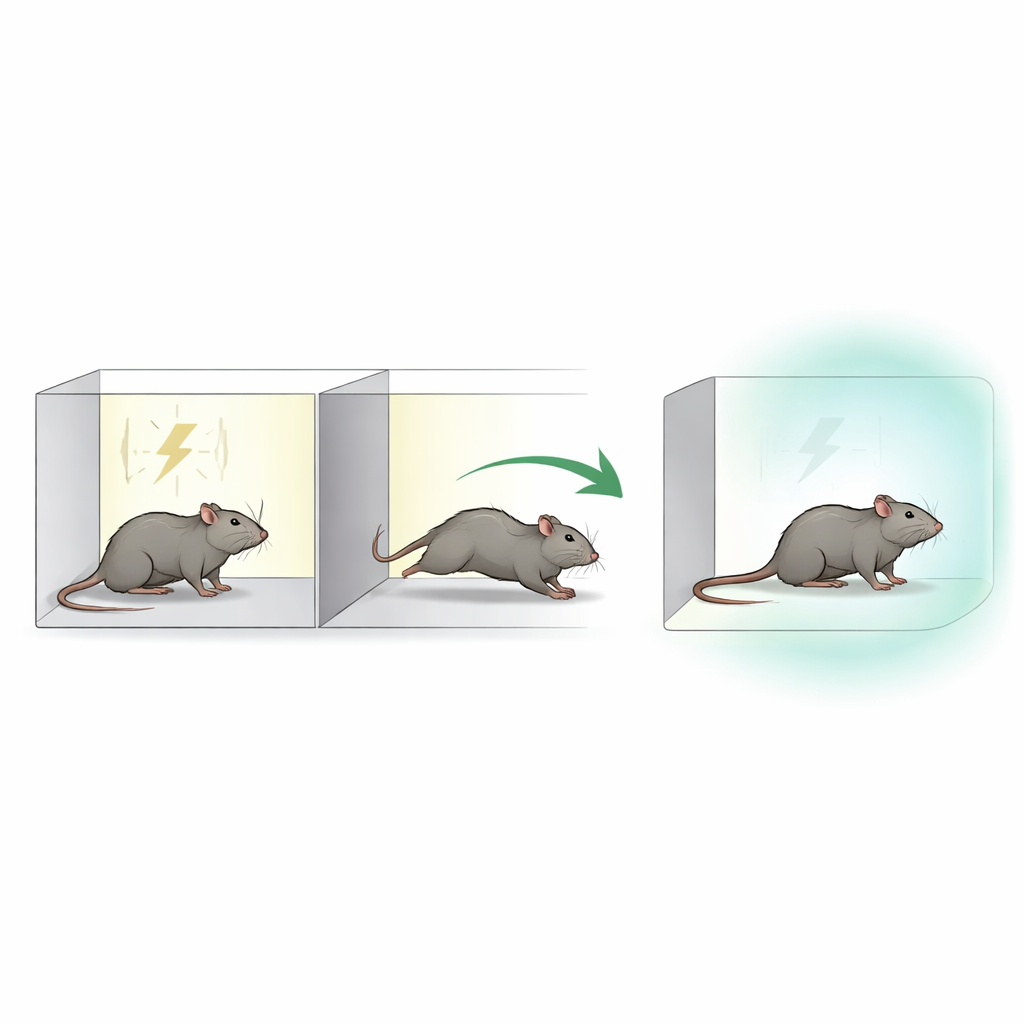
From fear reactions to protective actions
In standard laboratory avoidance tasks, a warning sound signals that a mild footshock is coming. At first, rats freeze in fear. With training, they learn that shuttling to the other side of a box during the warning prevents shock. The puzzle is what reinforces this behavior, since successful trials produce no obvious reward. The authors focused on a brief tone or light that follows each successful shuttle. Over training, this feedback cue comes to predict not just the end of the warning but a period of guaranteed safety. The team asked whether these cues become valuable in their own right and whether rats use this learned value to decide whether to avoid.
Testing whether safety itself is the goal
To probe this, the researchers used an "outcome devaluation" trick adapted from reward studies. After rats had learned to avoid, the feedback tone that signaled safety was later paired with shock in a different setting. For male rats that had received moderate training, this made the once-safe tone now threatening. When these animals were returned to the avoidance task—without any tones or shocks present—their avoidance dropped sharply and freezing returned. Rats whose feedback tone had not been turned into a threat kept avoiding normally. This shows that, at this stage, rats were acting to obtain the valued safety signal stored in memory, even when it was not physically present during the test.
When habits take over and sex differences emerge
With extensive overtraining, male rats continued to avoid even after the safety signal had been devalued. Their behavior no longer tracked the current value of the outcome, a hallmark of habit. Female rats, in contrast, did not reduce avoidance after devaluation at any training stage—even though they clearly learned that the feedback tone now predicted shock. Further tests showed that, in females, whether the tone acted as “safe” or “dangerous” depended strongly on the context in which it was heard. This suggests that experiences that undermine the value of an avoidance cue might only affect behavior in specific situations, a pattern that could be relevant to the higher rates of anxiety disorders in women.
Mapping the brain’s shift from decisions to habits
Next, the authors asked which brain areas support flexible, goal-driven avoidance versus entrenched habits. They used a chemogenetic tool (KORD) to temporarily quiet specific parts of the dorsal striatum, a deep-brain region already known to separate goal-directed and habitual reward-seeking. Silencing the posterior dorsomedial striatum (pDMS) in moderately trained male rats reduced avoidance and increased freezing, indicating that this region is necessary when animals act based on the current value of safety. In contrast, shutting down the dorsolateral striatum (DLS) had little effect at this stage but did disrupt overtrained, habitual avoidance—especially when the safety signal had been devalued—revealing that DLS drives rigid avoidance once habits are formed. 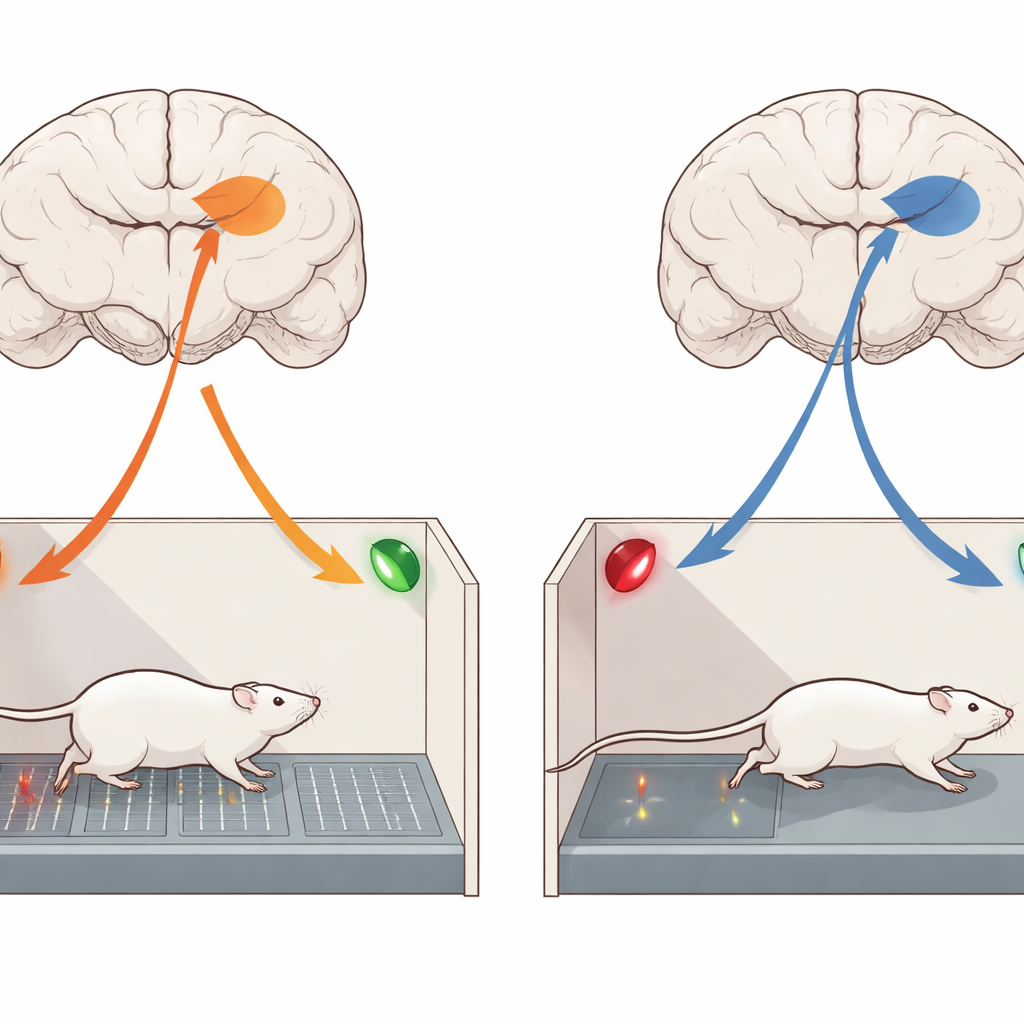
Safety cues drive goal-directed avoidance in both sexes
Finally, the team used a different approach called contingency degradation, in which extra "free" safety signals are delivered regardless of behavior. In a version of avoidance training without explicit warning sounds, both male and female rats reduced their avoidance when safety became available independently of their actions. This confirms that learned safety cues genuinely function as outcomes that guide goal-directed avoidance in both sexes, even though devaluation is harder to read out behaviorally in females.
What this means for everyday anxiety and compulsions
Taken together, the findings show that active avoidance is not just a reflexive escape from fear. At first, animals work to earn moments of safety marked by specific cues, using higher-order decision circuits in the pDMS. With repetition, control shifts to habit circuits in the DLS that continue to drive avoidance even when the safety outcome is no longer valuable. Because overly strong avoidance habits are thought to contribute to anxiety and obsessive–compulsive disorders, this work provides a concrete neural framework—and an experimental safety-signal "stress test"—for separating healthy, flexible coping from maladaptive, rigid avoidance.
Citation: Sears, R.M., Andrade, E.C., Samels, S.B. et al. Devaluation of response-produced safety signals reveals circuits for goal-directed versus habitual avoidance in dorsal striatum. Nat Commun 17, 2542 (2026). https://doi.org/10.1038/s41467-026-69119-3
Keywords: active avoidance, safety signals, habit formation, dorsal striatum, anxiety disorders