Clear Sky Science · en
Structuring light with flows
Seeing Light as Flowing Streams
Light is usually shown as smooth waves or straight rays, but in reality it behaves more like a flowing fluid, carrying energy along hidden paths. This paper reveals a new way to design those paths on purpose, letting scientists “steer” how light moves through space with a level of control that could improve microscopes, optical tweezers, and even high‑speed wireless communication through the air.
From Static Waves to Moving Paths
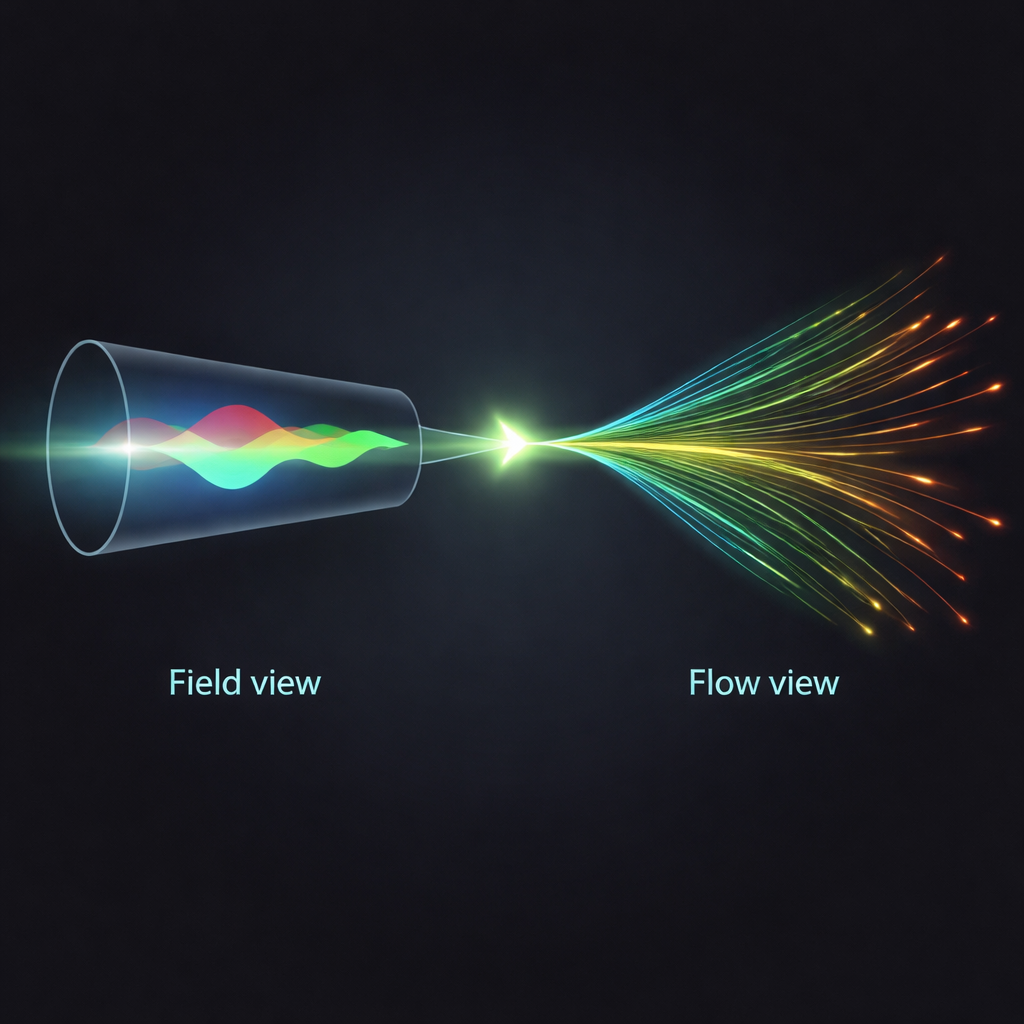
Traditional optics describes light as a static field that must obey strict mathematical rules, which lock familiar beams—such as Gaussian, Bessel, Airy, and vortex beams—into fixed ways of spreading, bending, or staying in focus. These rules explain why a flashlight beam widens, why some special beams can heal after being blocked, and why twisted “vortex” beams grow larger as their twist increases. The authors argue that this field picture is only half the story. Instead, they recast light as a steady flow of energy, much like water moving in a river. In this view, each tiny portion of light follows a streamline: a curve showing exactly where its energy travels as it propagates.
Designing the Flow of Light
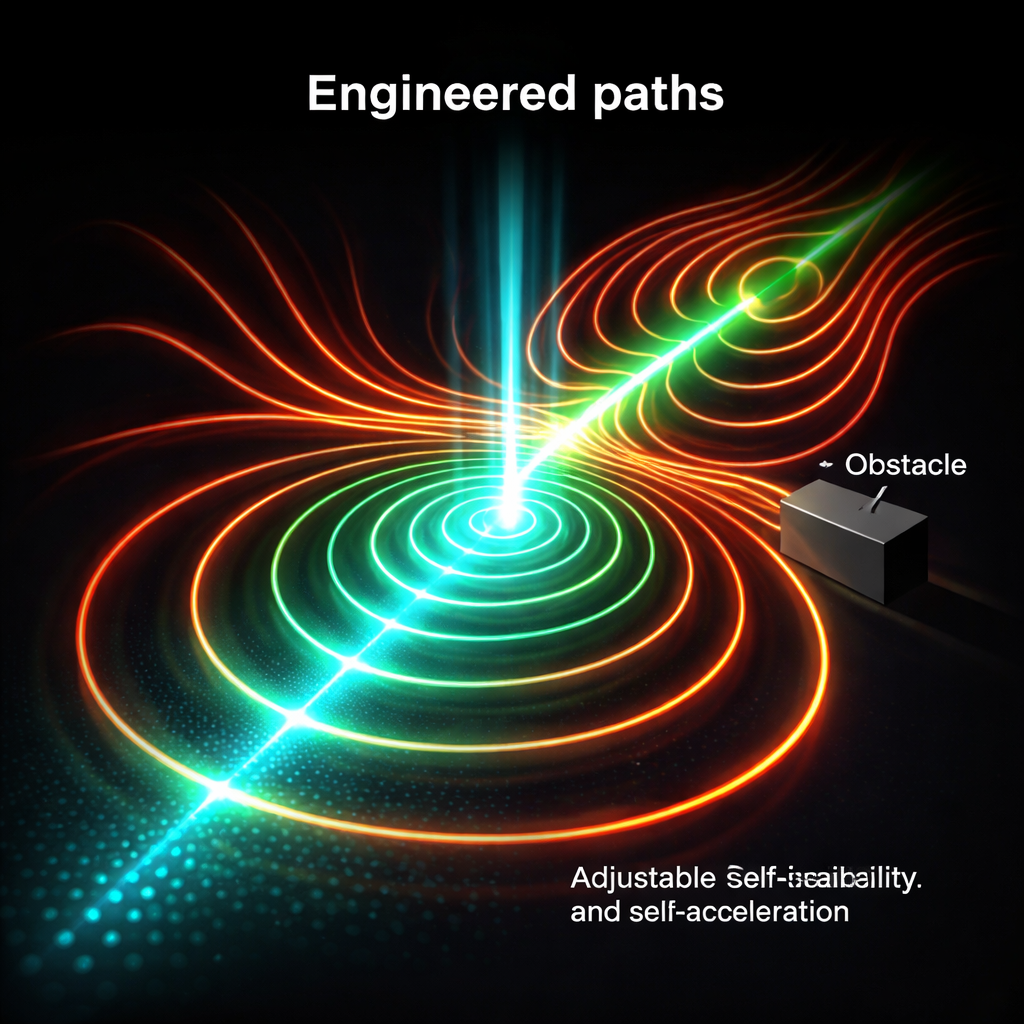
Building on a long‑standing analogy between fluids and light, the researchers describe a four‑step recipe for sculpting these streamlines. First, they choose the desired paths in three dimensions—straight, shrinking, spiraling, or bending around obstacles. Next, they calculate the momentum, or local “velocity,” that the light must have at every point to follow those paths. Then they determine the right mixture of plane waves in momentum space. Finally, they use standard optical tools, such as lenses and spatial light modulators, to physically generate beams whose internal energy flow matches the design. Within a single framework, they can reproduce and combine key behaviors previously tied to separate beam families: self‑similar spreading like Gaussian beams, non‑spreading and self‑healing like Bessel beams, curved trajectories like Airy beams, and the twisting motion and torque of vortex beams.
Making Special Beams for Tough Jobs
Seeing light as flow also suggests new beam types that did not exist before. A central example is the “non‑diffracting perfect vortex beam,” designed so that its bright ring stays the same size no matter how far it travels or how strongly it is twisted. Ordinary vortex beams broaden both because of diffraction and because higher twist pushes energy outward. By carefully tuning the helical streamlines, the authors cancel both effects at once. They also show how the surrounding “sidelobes” of a Bessel‑like beam act as an energy reservoir that can be tapped on demand. By redirecting streamlines from these outer rings into the central core, they can make the core brighter, help it recover after an obstacle, or compensate for loss in foggy or milky media so that intensity stays nearly constant over distance.
Following the Flow with Microparticles
To test whether real light follows the designed streamlines, the team uses optical tweezers, which trap tiny plastic spheres in a focused beam. They suspend micrometer‑scale beads in water, scan them along the beam, and record their three‑dimensional motion. In beams built with the new method, the beads trace out the predicted helical or curved paths, confirming that the internal flow of momentum matches the theory. In contrast, in conventional “perfect” vortex beams that are only ideal in a single plane, trapped particles eventually escape once the beam begins to diffract. This experiment shows that the streamline picture captures not just abstract structure, but the actual forces that light exerts on matter.
Boosting Free‑Space Communication
The authors then explore how engineered flows can benefit free‑space optical links, where information is sent through the air on beams carrying orbital angular momentum. Standard twisted beams spread out with distance and twist, so a receiver of finite size can only catch a limited number of distinct channels; turbulence in the atmosphere further scrambles the modes. Non‑diffracting perfect vortex beams, whose size is almost independent of distance and twist, support far more usable channels within the same aperture and show weaker, more uniform distortion in simulated atmospheric turbulence. Because their streamlines can be bent or made to expand on demand, these beams can also route light around obstacles, enabling non‑line‑of‑sight transmission. In a demonstration, the authors encode a full‑color image across many such modes and successfully reconstruct it after the beam detours around a blocking object, with very low error rates.
Why This Matters for Future Technologies
By shifting from thinking of light as rigid wave patterns to thinking of it as a sculptable flow, this work offers a unifying language for many optical tricks—focusing, self‑healing, acceleration, and twisting—and turns them into design choices rather than fixed properties. For a lay reader, the key message is that we can now draw the paths along which light’s energy travels and then make beams that follow those drawings in real space. This capability could improve how we grab and move microscopic objects, how we see deep into cloudy samples, and how we send huge amounts of data through turbulent, cluttered environments. In short, controlling the “currents” inside light beams may become as important to future photonics as shaping the beams’ brightness and color is today.
Citation: Yan, W., Yuan, Z., Gao, Y. et al. Structuring light with flows. Nat Commun 17, 1817 (2026). https://doi.org/10.1038/s41467-026-69117-5
Keywords: structured light, optical vortices, Bessel beams, free-space optical communication, optical tweezers