Clear Sky Science · en
Historical depletion and future drought-driven risks to Gulf of Mexico fisheries production
Why River Drought Matters for Your Seafood Dinner
For many people along the U.S. Gulf Coast and beyond, the Gulf of Mexico is a source of jobs, food, and recreation. This study asks a deceptively simple question with big consequences: what happens to Gulf fisheries when the great river that feeds them runs low during drought? By tracing how dry years on land ripple through coastal waters, the authors show that future droughts could sharply cut the fish and shellfish that support commercial and recreational fishing.
A Hidden Crash in Gulf Sea Life
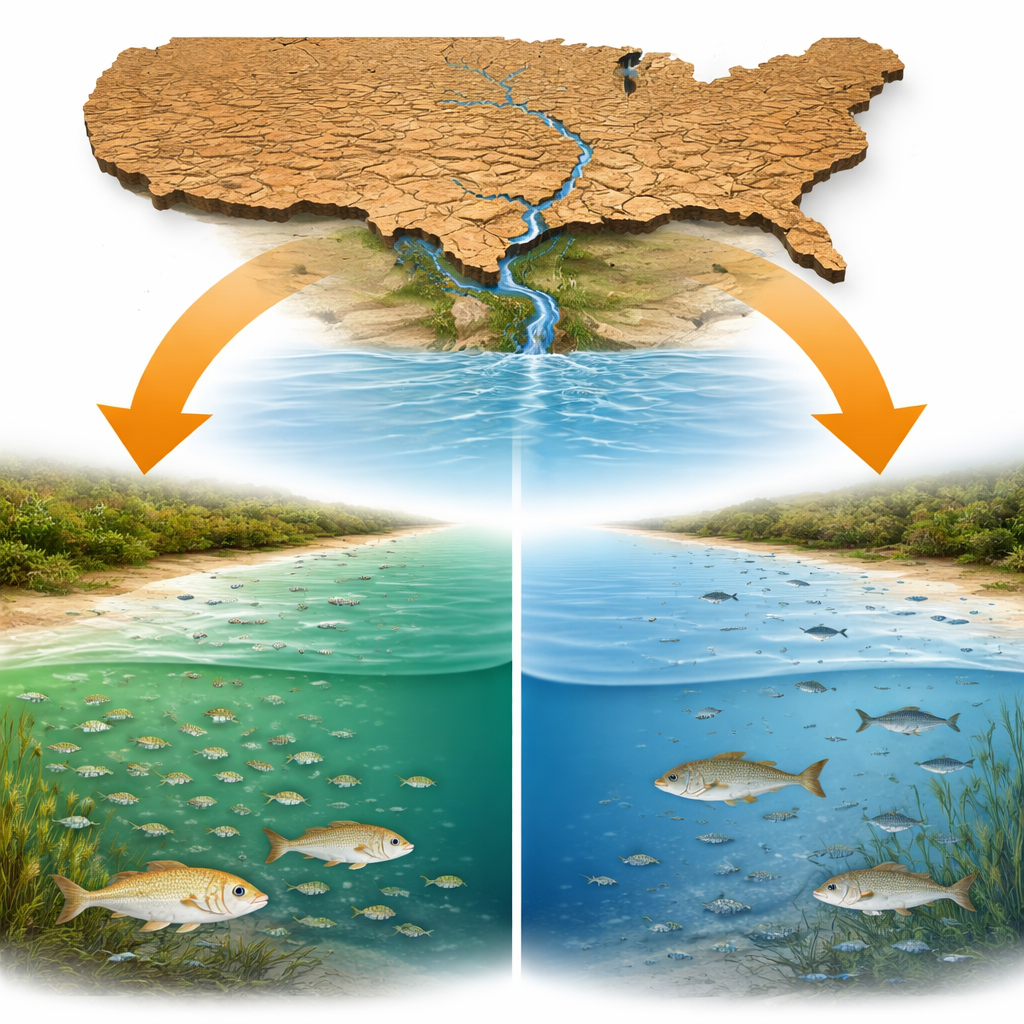
In the late 1980s and early 1990s, total fish and invertebrate biomass in the Gulf of Mexico dropped by about 42 percent, and catches fell by a third compared with the early 1980s. This was not just one species having a bad year: declines showed up in shrimp, oysters, crabs, small schooling fish, and large predators such as mackerel and sharks. Yet this broad downturn drew relatively little scientific attention at the time, and its causes remained uncertain.
The River That Feeds the Gulf
The Gulf is naturally poor in nutrients in the open sea, so it depends heavily on what the Mississippi River delivers. More than 90 percent of the nutrients that fuel coastal plant growth come from this river. Those nutrients support microscopic plants, sea grass, and algae, which in turn feed small animals and fish. Among them, Gulf menhaden play a starring role as a main “forage” fish: they eat plankton and are eaten by a long list of predators, from larger fish to marine mammals. Because menhaden are also harvested in huge quantities for fish meal and oil, they sit at a critical intersection between ecosystem health and the fishing economy.
Linking Drought on Land to Losses at Sea
The authors examined long records of drought conditions, river levels, nutrient loads, sea temperatures, and fisheries data. They found that the big fisheries decline followed on the heels of a severe U.S. drought from 1986 to 1989, when soils dried out, Mississippi River levels fell to record lows, and nutrient delivery to the Gulf dropped by more than half during key summer months. Other environmental factors, such as sea surface temperature and overall fishing effort, stayed broadly similar between the healthy and depleted periods. This pattern points to drought-driven reductions in river flow and nutrients as the main culprits, weakening the food base and especially hitting Gulf menhaden, whose biomass and catch fell by around 40 percent.
Forecasting Tomorrow’s Drought Damage
To see what future droughts might do, the team combined climate projections with a detailed computer model of the Gulf food web. Climate models under a high-emissions scenario (RCP 8.5) suggest that multi-year droughts in the Mississippi basin will become more frequent and intense this century. Using the observed link between drought severity and nutrient input, the authors simulated how the ecosystem responds when river-borne nutrients are cut to levels expected around 2050 and again by 2100. The model projects that five-year extreme droughts could reduce total biomass and catches by about 61 percent by mid-century and up to 72 percent by century’s end, far steeper losses than earlier global estimates for the region.
Food Web Strain from Bottom to Top
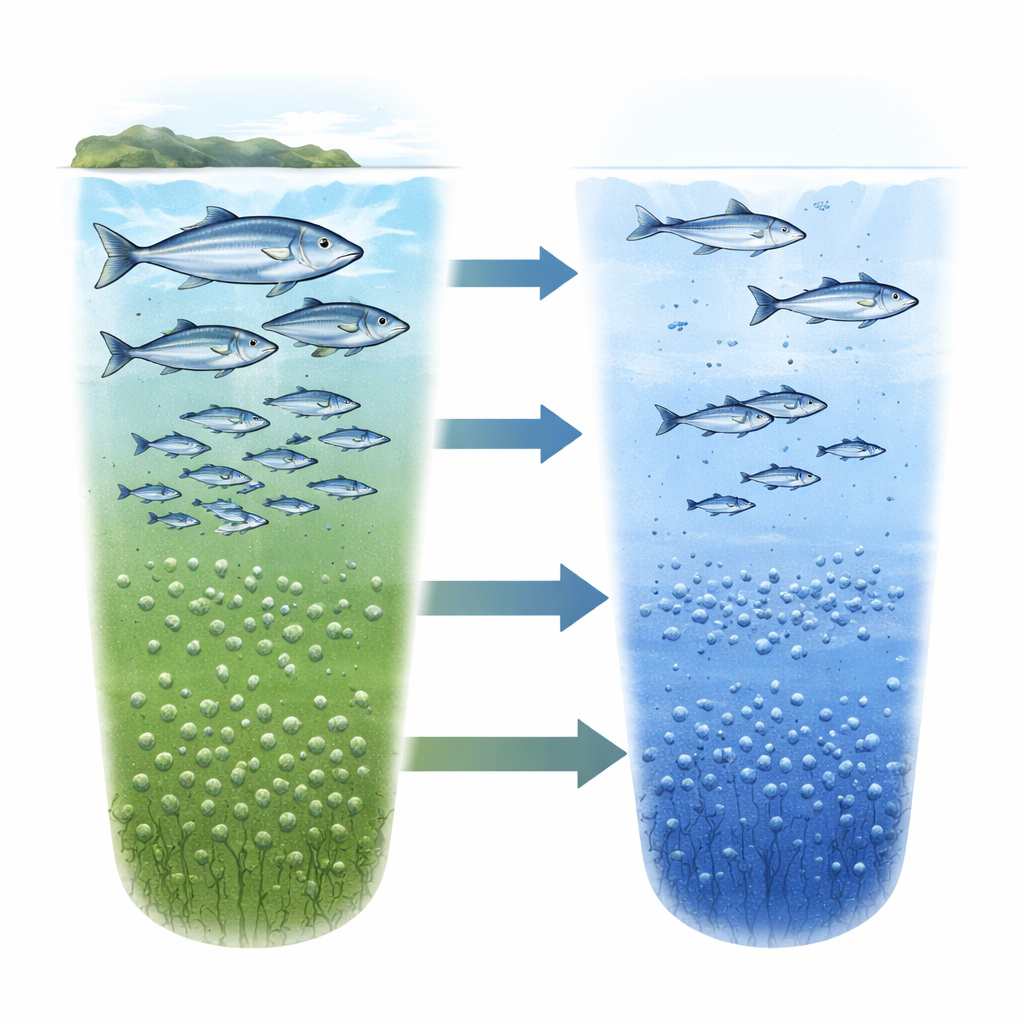
The simulations reveal that drought’s primary impact is to choke off the energy entering the system from below. With fewer nutrients, microscopic plants grow less, leaving less food for small animals and forage fish like menhaden. As menhaden decline, so do their predators, including king and Spanish mackerel and other commercially important species. Lower-level groups such as shrimp and benthic invertebrates are especially hard hit, while some top predators show smaller changes simply because little energy reaches them in any case. Interestingly, changing fishing pressure on menhaden has a smaller overall effect than drought in these scenarios: when nutrients are scarce, the ecosystem cannot fully rebound even if menhaden fishing is reduced.
What This Means for the Future of Gulf Fisheries
To a non-specialist, the message is straightforward but sobering: when the Mississippi River runs low during prolonged drought, the Gulf’s natural “fertilizer” tap is turned down, and the whole marine food chain—from plankton to plate—shrinks. The study suggests that if greenhouse gas emissions remain high, future droughts could trigger repeated, deep drops in fish and shellfish production, threatening both ecosystems and coastal economies. The authors argue that managing water use and fishing with drought in mind, and reducing emissions to lessen drought severity, will be essential to keep Gulf fisheries productive and resilient for the people who depend on them.
Citation: Berenshtein, I., Kirtman, B., de Mutsert, K. et al. Historical depletion and future drought-driven risks to Gulf of Mexico fisheries production. Nat Commun 17, 2409 (2026). https://doi.org/10.1038/s41467-026-69116-6
Keywords: Gulf of Mexico fisheries, Mississippi River drought, nutrient input, Gulf menhaden, climate change impacts