Clear Sky Science · en
Daratumumab in systemic lupus erythematosus: a single-arm phase 2 trial
Why this study matters
Systemic lupus erythematosus, often just called lupus, is a chronic disease in which the immune system attacks the body’s own tissues, causing pain, fatigue, and organ damage. Many people with severe lupus do not respond well to standard treatments, which can leave them facing ongoing symptoms and long-term risks. This study explores whether a cancer drug called daratumumab, already used to wipe out harmful antibody-producing cells in multiple myeloma, can be repurposed to quiet the misfiring immune system in patients with stubborn, hard-to-treat lupus.
A new way to calm rogue antibodies
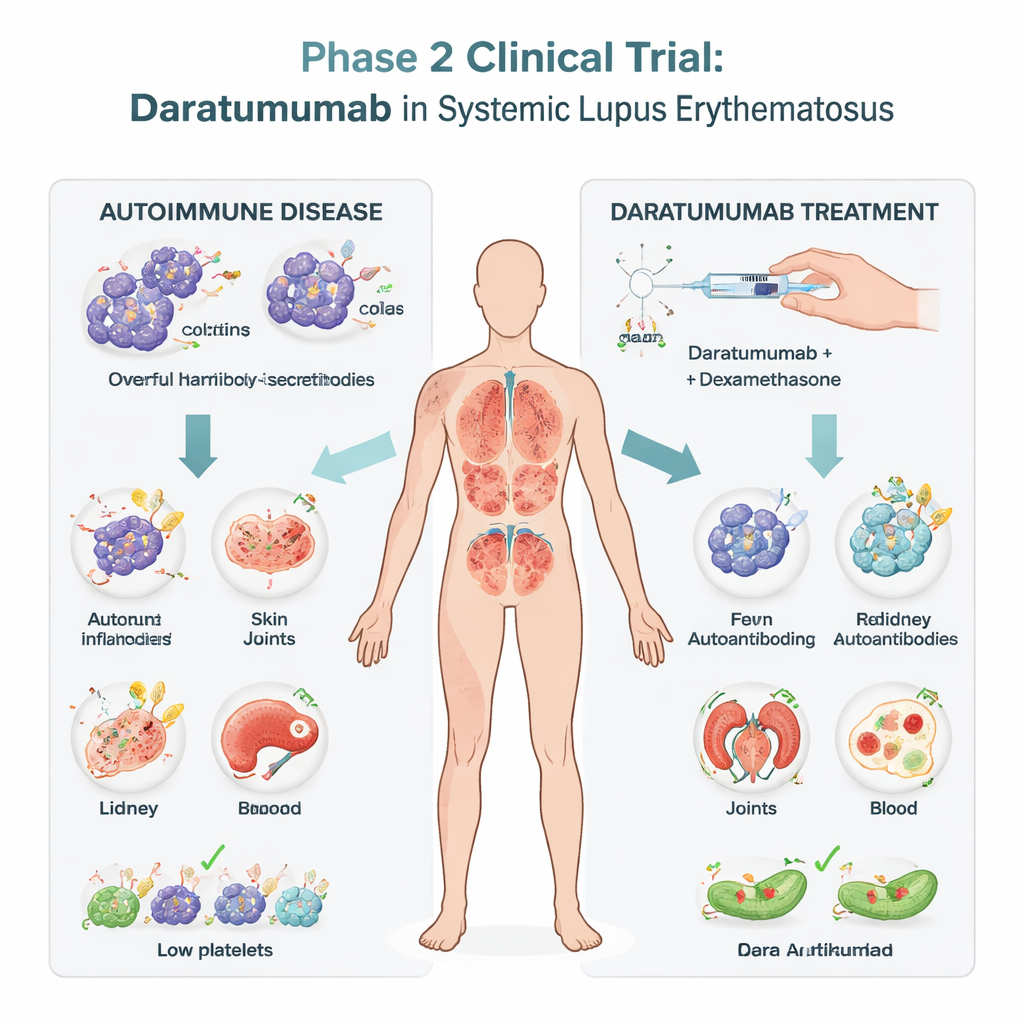
In lupus, much of the damage is driven by antibodies that target the body’s own DNA and other nuclear components. These autoantibodies form immune complexes that lodge in organs such as the kidneys, skin, joints, and blood vessels, sparking inflammation. They are produced by antibody-secreting cells and long-lived plasma cells, which can survive for years and often resist conventional immune-suppressing drugs. Daratumumab targets a molecule called CD38 that is present at high levels on these antibody factories. By binding to CD38, the drug flags these cells for destruction and may also reset aspects of T cell function that are disturbed in lupus. The researchers designed a phase 2 trial to test whether short-term daratumumab treatment could safely lower harmful antibodies and improve disease activity.
The trial in people with difficult-to-treat lupus
The DARALUP trial enrolled ten women with moderate-to-severe lupus who had active disease despite trying a median of six previous treatments, including several modern biologic drugs. All had high levels of anti–double-stranded DNA antibodies and involvement of key organs such as joints, skin, blood, and often kidneys. Participants continued their existing background medications but received eight weekly subcutaneous injections of daratumumab at a fixed dose, along with low to moderate doses of the steroid dexamethasone as premedication. The main goal was to see how much anti-DNA antibody levels fell 12 weeks after starting therapy; the team also tracked clinical disease scores, kidney function, quality of life, and side effects for 36 weeks.
Rapid drops in autoantibodies and disease activity
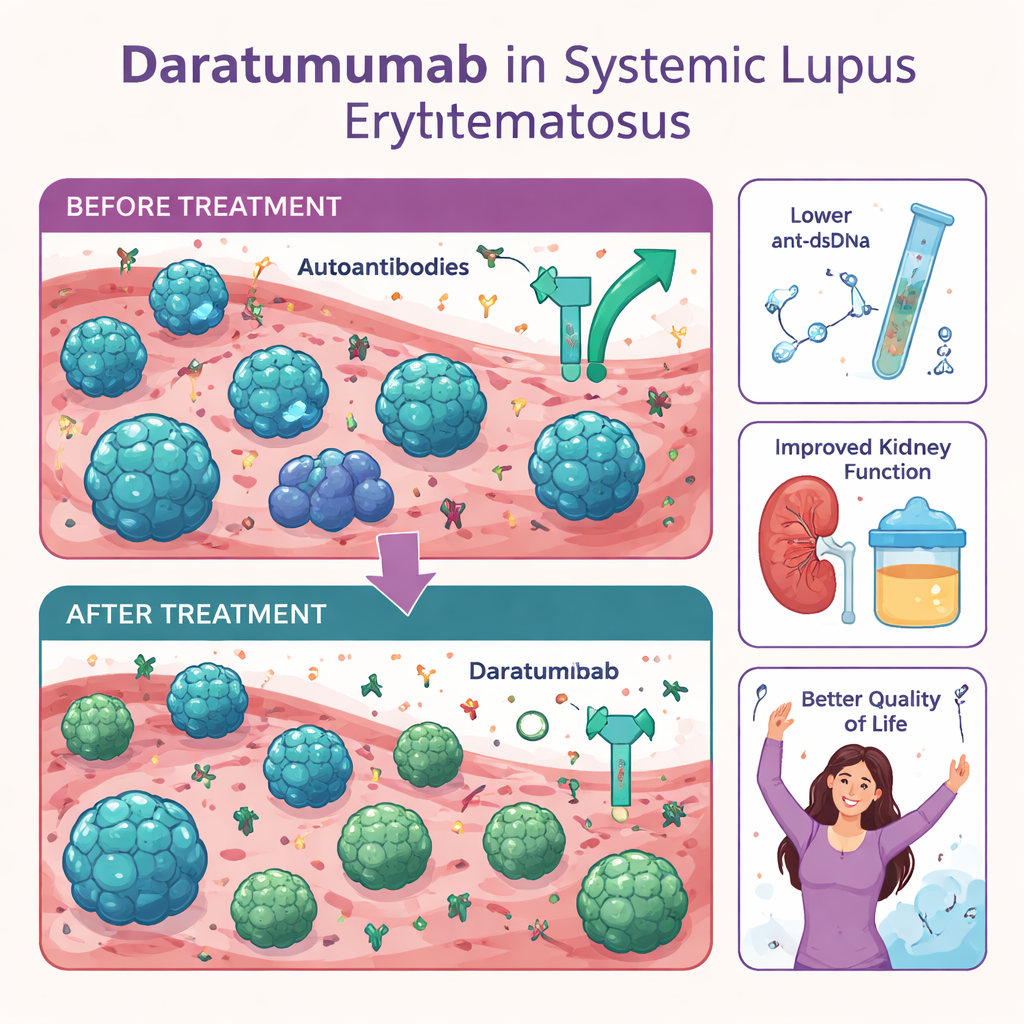
By week 12, blood levels of anti-DNA antibodies had fallen in every patient, with a median reduction of about 110 IU/ml—roughly a 60 percent drop compared with baseline. Levels of complement proteins, which are often consumed during active lupus, rose, signaling less ongoing immune attack. In parallel, standardized disease activity scores improved sharply: the median SLEDAI-2K score fell from 12 to 4 and remained low through week 36. Measures focusing on joints and skin—the Clinical Disease Activity Index and the Cutaneous Lupus Disease Area and Severity Index—both dropped to near zero at week 12. In those with active kidney inflammation, protein loss in the urine roughly halved. All ten patients met a commonly used composite response measure (SRI-4) at week 12, and seven still did so at week 36, even though steroid doses were tapered after week 12.
What happened inside the immune system
Detailed blood analyses showed that daratumumab did what it was designed to do: it markedly depleted circulating antibody-secreting cells, especially the most mature IgG-producing cells that are strongly linked to active lupus. Total IgG levels and vaccine-induced antibodies against tetanus also dropped, suggesting that long-lived plasma cells in the bone marrow were affected. At the same time, the overall numbers of T cells stayed stable, but their behavior shifted. Gene expression patterns in CD4 and CD8 T cells showed a reduction in signals driven by type I interferons—molecular messengers that are chronically elevated in lupus—and signs of improved energy metabolism and reduced cellular stress. Regulatory T cells, which normally restrain autoimmunity but are often faulty in lupus, displayed changes consistent with better function. Together, these findings point to both removal of harmful antibody factories and a broader “reset” of immune balance.
Safety trade-offs and remaining questions
The treatment was generally well tolerated. No severe adverse events or treatment-related study withdrawals occurred. However, nine of ten patients experienced some treatment-emergent side effects, most often mild to moderate infections, stomach upset, injection site reactions, fatigue, and low antibody levels (hypogammaglobulinemia). In five patients, IgG levels fell below a predefined safety threshold, leading to preventive infusions of pooled antibodies (IVIG). Natural killer cells also dropped early after treatment but later recovered. Importantly, while responses were strong, they were not complete or permanent. Anti-DNA antibodies and antibody-secreting cells gradually crept up again in several individuals, and two patients experienced disease flares around weeks 20 and 24, requiring additional biologic therapy.
What this could mean for people with lupus
For lay readers, the takeaway is that a short course of daratumumab substantially quieted the overactive immune system in a small group of patients with tough, long-standing lupus, leading to fast and wide-ranging clinical improvements without serious safety red flags in the observed period. The approach appears to work mainly by stripping away the cells that continuously churn out harmful antibodies, while also easing some of the deeper immune wiring problems seen in lupus T cells. Still, this is an early, single-arm study in only ten participants, and the benefits were not durable enough to call it a one-time cure. Larger controlled trials are needed to define who might benefit most, how long treatment should last, and how best to combine daratumumab with other therapies to maintain remission while minimizing infection risk.
Citation: Ostendorf, L., Zernicke, J., Klotsche, J. et al. Daratumumab in systemic lupus erythematosus: a single-arm phase 2 trial. Nat Commun 17, 1312 (2026). https://doi.org/10.1038/s41467-026-69112-w
Keywords: systemic lupus erythematosus, daratumumab, autoantibodies, plasma cells, autoimmune therapy