Clear Sky Science · en
Scalable modular design of solid oxide fuel cell systems for enhanced large-scale power generation
Power for a Cleaner Future
As the world adds more wind and solar power, we still need reliable electricity around the clock. This paper explores how a promising technology called solid oxide fuel cells can be scaled up to provide clean, efficient power while using less water and fuel. The authors show how breaking a large power plant into standardized building blocks, and reusing hot exhaust gases in smart ways, can cut costs and support a low‑carbon energy system.
Why Better Power Plants Matter
Modern power systems must balance three pressures at once: cutting greenhouse gas emissions, coping with water stress, and keeping the lights on even when the sun and wind are weak. Solid oxide fuel cells turn fuels such as natural gas or biomethane directly into electricity and heat at high efficiency, and they can also run in reverse as electrolyzers to make hydrogen. This makes them attractive partners for renewable energy and long‑term energy storage. Yet today’s commercial systems are often custom‑built, water‑hungry, and expensive, which limits how quickly they can spread.
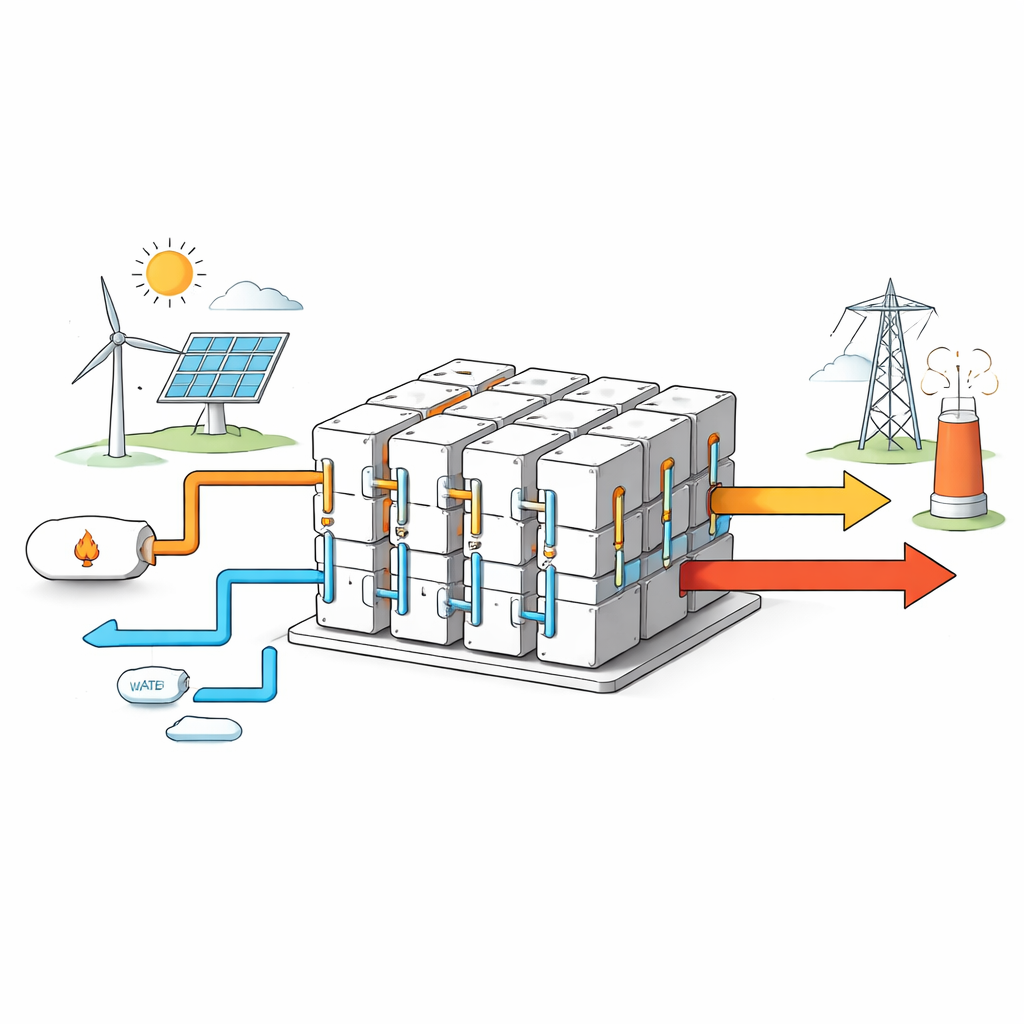
Building with Lego‑Like Power Modules
The study proposes a modular design in which an entire plant is assembled from repeated, standardized modules. Each module contains a fuel cell stack, a fuel processor, and supporting parts such as air blowers, heat exchangers, and a burner. Instead of designing every plant from scratch, manufacturers would produce fixed‑size modules with plug‑and‑play connection points. Engineers can then link modules in parallel and in series, much like Lego bricks, to reach the desired power level—from tens of kilowatts for a building to hundreds of megawatts for a city—without redesigning the basic layout.
Reusing Hot Exhaust to Save Water and Air
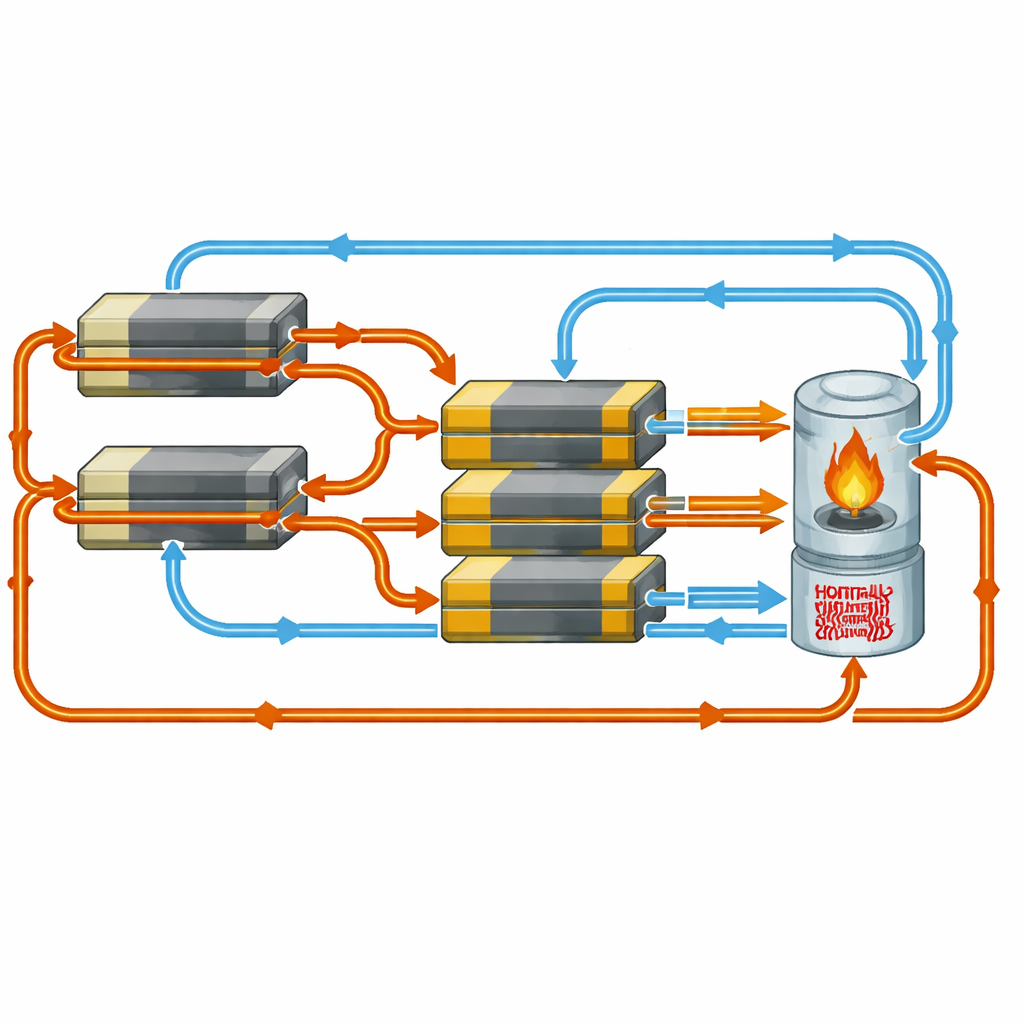
A central innovation is how the plant handles the hot exhaust leaving the fuel cells. On the fuel side, the leftover mixture of steam and unburned fuel from an upstream stack is routed directly into the next stack downstream, rather than being cooled, blown around with a mechanical fan, and reheated. This “forward cascade” reuses the steam already present, sharply reducing the need for extra purified water and avoiding the energy losses of repeated cooling and reheating. On the air side, partially used warm air from multiple stacks is collected, mixed with a smaller stream of fresh air, and redistributed, trimming total air demand while keeping temperatures and oxygen levels within safe limits.
A 50‑Kilowatt Test Case
To test the concept, the authors model a 50‑kilowatt plant built from five 10‑kilowatt stacks: two in parallel feeding three in series. Compared with a conventional layout that does not reuse exhaust gases, the hybrid modular design reaches an electrical efficiency of 66.3%, slightly higher than the reference case, while cutting external water use by about 60% and fresh air demand by about 22%. When the remaining heat is sent to a simple steam cycle, the efficiency rises to 68.5%. Importantly, these gains come without resorting to exotic custom hardware; instead, they rely on clever routing of flows and standardized module interfaces.
What It Costs at Gigawatt Scale
The team then examines four different strategies for scaling to a total output of 1 gigawatt, varying how much of the plant is centralized versus modular. At small sizes, a more traditional, centralized design is cheaper because it avoids duplicating many small units. As plants grow beyond roughly 300 kilowatts per module, however, the hybrid modular design pulls ahead. Thanks to its higher efficiency and lower water and air use, it delivers the lowest levelized cost of electricity at about 0.155 dollars per kilowatt‑hour in the largest case studied. Sensitivity tests show that fuel price dominates costs: as fuel becomes more expensive, the value of efficiency—and thus of the hybrid design—rises further.
A Road Map for Scalable Clean Power
In plain terms, the article shows that carefully designed, Lego‑like fuel cell modules can power larger plants more efficiently and cheaply than today’s custom layouts, especially at high fuel prices and large scales. By reusing hot exhaust instead of wasting it, the hybrid design squeezes more electricity out of each unit of fuel and water. Standardizing module sizes and connections also simplifies manufacturing and maintenance, allowing faulty modules to be swapped without shutting down an entire plant. Together, these ideas point toward solid oxide fuel cell systems that can grow from neighborhood‑scale units to city‑scale power hubs, helping to support a cleaner, more flexible energy grid.
Citation: Wei, X., Waeber, A., Sharma, S. et al. Scalable modular design of solid oxide fuel cell systems for enhanced large-scale power generation. Nat Commun 17, 2421 (2026). https://doi.org/10.1038/s41467-026-69110-y
Keywords: solid oxide fuel cells, modular power systems, energy storage, low carbon electricity, techno economic analysis