Clear Sky Science · en
Fluorescence mapping of atropisomer populations enabled by through-space conjugation
Glowing Molecules That Reveal Their Own Movements
Chemists have long known that some molecules can twist into different shapes that are stable enough to behave like distinct entities. These subtle twists matter enormously in medicines and advanced materials, but they are notoriously hard to watch in action. This study shows how carefully designed glowing molecules can act like tiny beacons, using their own light to reveal how different shapes appear, disappear, and crystallize over time.
Why Twisting Shapes Matter
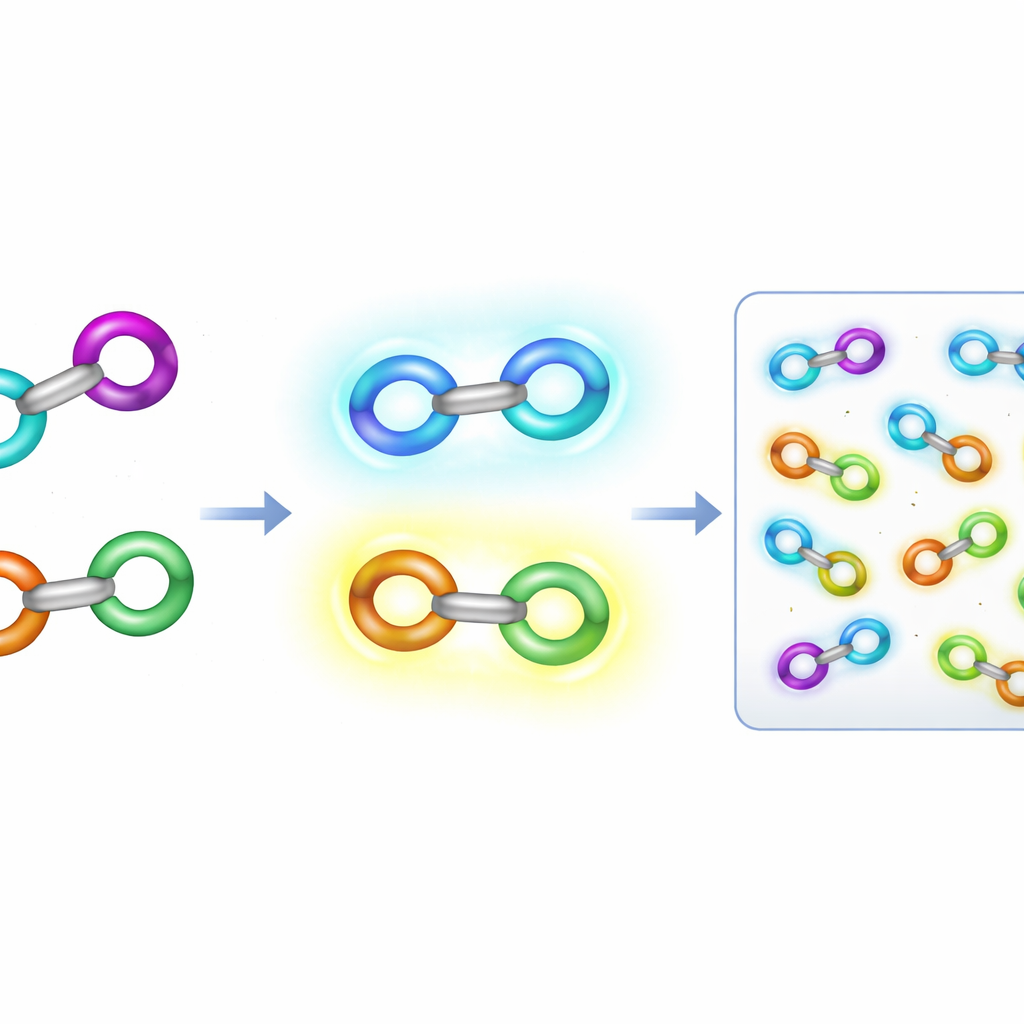
Many important molecules cannot rotate freely around certain bonds because nearby atoms get in each other’s way. This crowding locks the molecules into distinct twisted arrangements, called atropisomers, that interconvert only slowly. While single twisting axes have been explored in depth, nature and technology often rely on more complex molecules with two or more twisting axes. Understanding how these multi-axis shapes form, transform, and coexist is crucial for improving drugs, catalysts, and molecular machines, yet has remained difficult because standard tools like X-ray crystallography and NMR spectroscopy demand ideal crystals, strong signals, or long measurement times.
Designing a Family of Twisting Light Sources
The researchers built a family of molecules in which two light-emitting naphthalene units are connected by a central phenyl “bridge,” creating biaxial and even triaxial twisting systems. By adding or moving small methyl groups, they tuned how strongly nearby atoms bump into each other, which in turn set both the energy difference between shapes (their thermodynamic preference) and how fast one shape can turn into another (its kinetic stability). Some designs, like 22-NB, rotated so quickly that only a single averaged form could be seen, while others, like 11-NB, produced clearly separated “syn” and “anti” shapes with different lifetimes and populations that even shifted with temperature. A more crowded version, 11-NB-8DMe, locked almost entirely into one preferred shape.
When Distance Carries Electricity
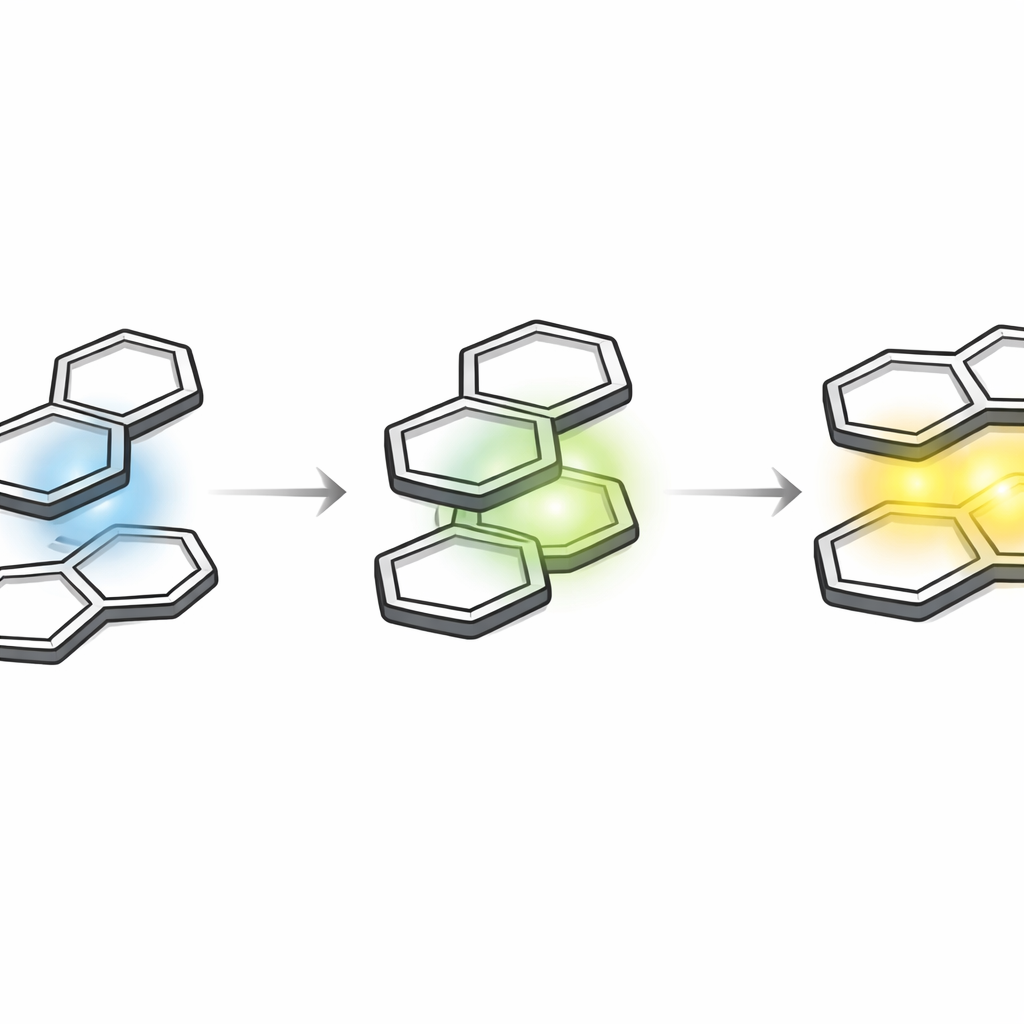
The key twist in this work is how the molecules glow. Usually, color changes arise when electrons travel along a continuous chain of bonds. Here, the team exploited “through-space conjugation,” where electrons interact directly across a short gap between two stacked rings rather than through bonds. Depending on how the naphthalene units were arranged, this through-space interaction could switch on or off and shift the emitted color. In some designs the light came mostly from isolated rings; in others a strong through-space interaction produced a redder hue. By comparing simple model compounds, temperature-dependent spectra, and detailed calculations of how electron clouds overlap, the authors showed that the degree of crowding and rigidity directly controls this through-space glow.
Separating Twins and Reading Their Light
Guided by their design rules, the team created a standout system, 11-NB-2DMe, whose syn and anti forms sit at nearly the same energy yet are separated by enormous twisting barriers. That combination allowed the two shapes to be completely separated and stored for extraordinarily long times—effectively frozen in place. Surprisingly, the two forms absorb light almost identically but emit it quite differently: the syn form shows a mix of classic ring emission and through-space light, while the anti form is dominated by strong through-space emission. Calculations revealed that the syn form behaves like a flexible “butterfly,” with large internal motions that weaken its through-space channel, whereas the anti form is more rigid and better at channeling excited energy into longer-wavelength emission.
Watching Crystals Grow in Real Time
Because syn and anti 11-NB-2DMe shine with distinct colors and intensities, mixtures of the two produce fluorescence spectra whose relative peaks change linearly with the fraction of each shape. This simple relationship allowed the authors to “read off” the syn/anti ratio from light alone. By combining this ratiometric fluorescence with standard absorption measurements during slow evaporation of a solution, they reconstructed the entire crystallization process. First, the solution merely concentrated. Next, crystals formed almost exclusively from the syn form, enriching the remaining liquid in the anti form. Finally, both shapes crystallized together, giving mixed solids. This non-destructive optical tracking revealed when each stage began and ended and how the masses and proportions of each shape evolved over time.
From Lab Curiosity to Versatile Molecular Tracker
In the end, the study delivers more than a set of cleverly designed molecules. It demonstrates a general strategy: by engineering crowded, multi-axis systems that communicate through-space and using their color as a direct reporter of shape, chemists can map otherwise hidden molecular dynamics in real time. This fluorescence-based platform offers a new window into how complex molecules move, interact, and solidify, with potential impact on fields ranging from drug design to smart materials and molecular machines.
Citation: Xu, Q., Luo, K., Wang, Y. et al. Fluorescence mapping of atropisomer populations enabled by through-space conjugation. Nat Commun 17, 2211 (2026). https://doi.org/10.1038/s41467-026-69109-5
Keywords: atropisomerism, fluorescence, through-space conjugation, molecular conformation, crystallization kinetics