Clear Sky Science · en
Tuning superelasticity in high entropy alloy via a hidden strain order
Metals That Stretch Like Rubber
Most metal objects around us bend only a tiny amount before they permanently deform or break. Yet engineers dream of metals that can stretch and spring back like rubber, while still being strong and durable. This paper explores a new class of such “superelastic” metals made from many different elements mixed together. By making only very slight changes in recipe, the researchers show they can dial a metal’s elastic behavior from simple and predictable to extreme and highly adaptable, opening doors for next‑generation sensors, tiny machines and vibration‑damping parts.
Why Superelastic Metals Matter
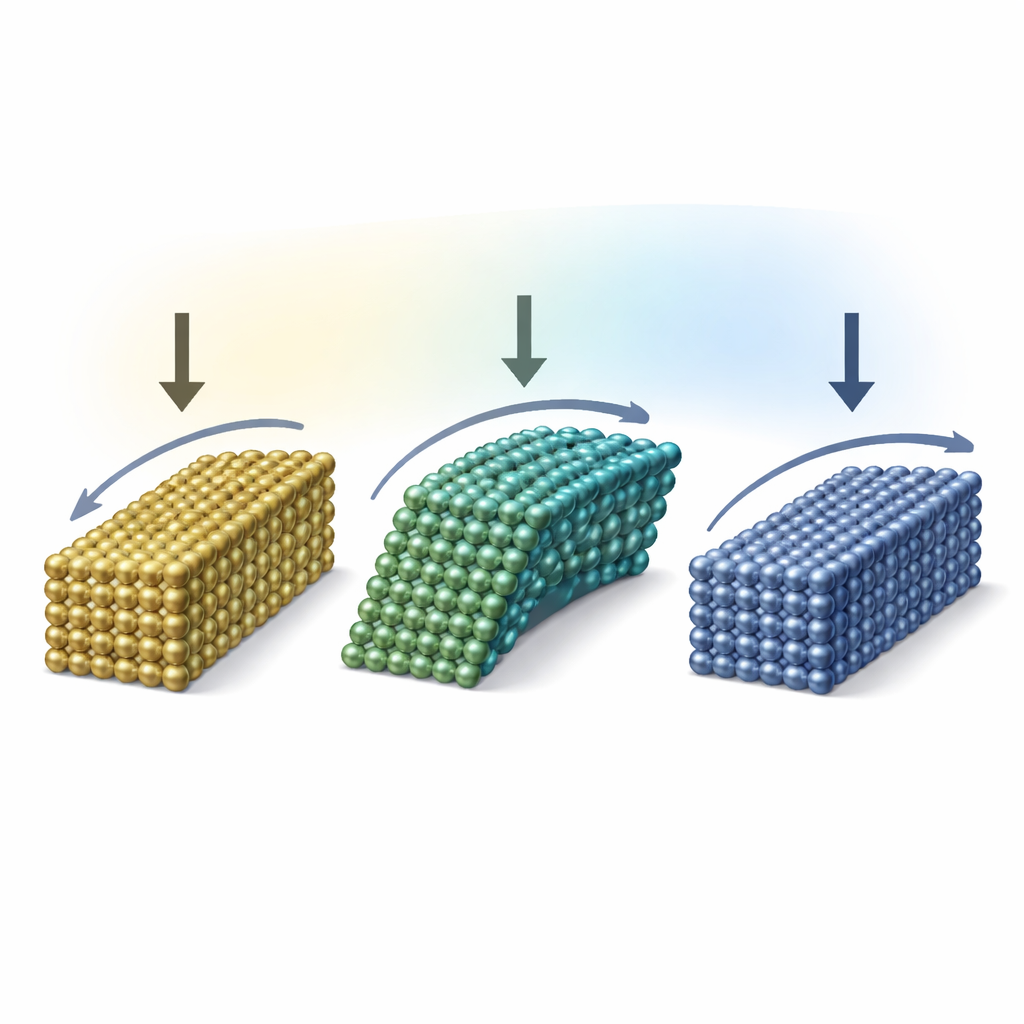
In everyday metals like steel or aluminum, elastic bending is limited to well below 1% strain; push them further and permanent damage sets in. Special alloys called shape‑memory metals, strain‑glass alloys and so‑called Gum metals break this rule: they can recover strains of several percent or more, thanks to tiny, reversible changes in their crystal structure under stress. High‑entropy alloys—mixtures containing four or more principal elements—add another twist. Their atoms differ strongly in size and bonding, which creates a patchwork of local distortions inside the crystal. Experiments have shown that such alloys can exhibit both simple, straight‑line elasticity and dramatic, curved stress–strain responses with large recoverable strain. How the same type of internal disorder can produce such different behaviors has remained a puzzle.
Fine‑Tuning a Metal Recipe
The authors tackle this puzzle using a family of high‑entropy alloys built from titanium, zirconium, hafnium, nickel and cobalt. They vary only the nickel‑to‑cobalt ratio in a fixed base composition, shifting cobalt content by as little as 1–2 atomic percent. Using X‑ray diffraction, heat‑flow measurements and electrical resistance, they map out how the alloy’s crystal structure and phase changes evolve with composition and temperature. At low cobalt levels, the alloy cools into one crystal form; at high cobalt levels, it prefers another. In between, signatures of “frustrated” transformations appear—small regions trying to switch structure but never organizing into a full, long‑range phase change. This compositional map reveals where the alloy is stable, where it transforms, and where it sits in an uneasy, intermediate state.
From Straight‑Line to Curved Elasticity
Mechanical tests on bulk samples and tiny single‑crystal pillars show how this structural landscape translates into elasticity. At one end of the composition range, the alloy behaves in a classic Hookean fashion: stress and strain follow a straight line, and the metal returns exactly to its original shape upon unloading. At intermediate compositions, the response becomes strongly nonlinear. The stress–strain curve bends, and loading–unloading cycles show a loop, meaning that some energy is dissipated each time. Yet the metal still recovers large strains—up to about 8% in carefully oriented micro‑pillars—without permanent damage. At higher cobalt contents, the response straightens again, and the superelastic “loop” vanishes. The same alloy family thus spans simple spring‑like behavior, rubber‑like superelasticity, and back to spring‑like behavior, all controlled by minute shifts in chemistry.
Hidden Patterns of Strain Inside the Metal
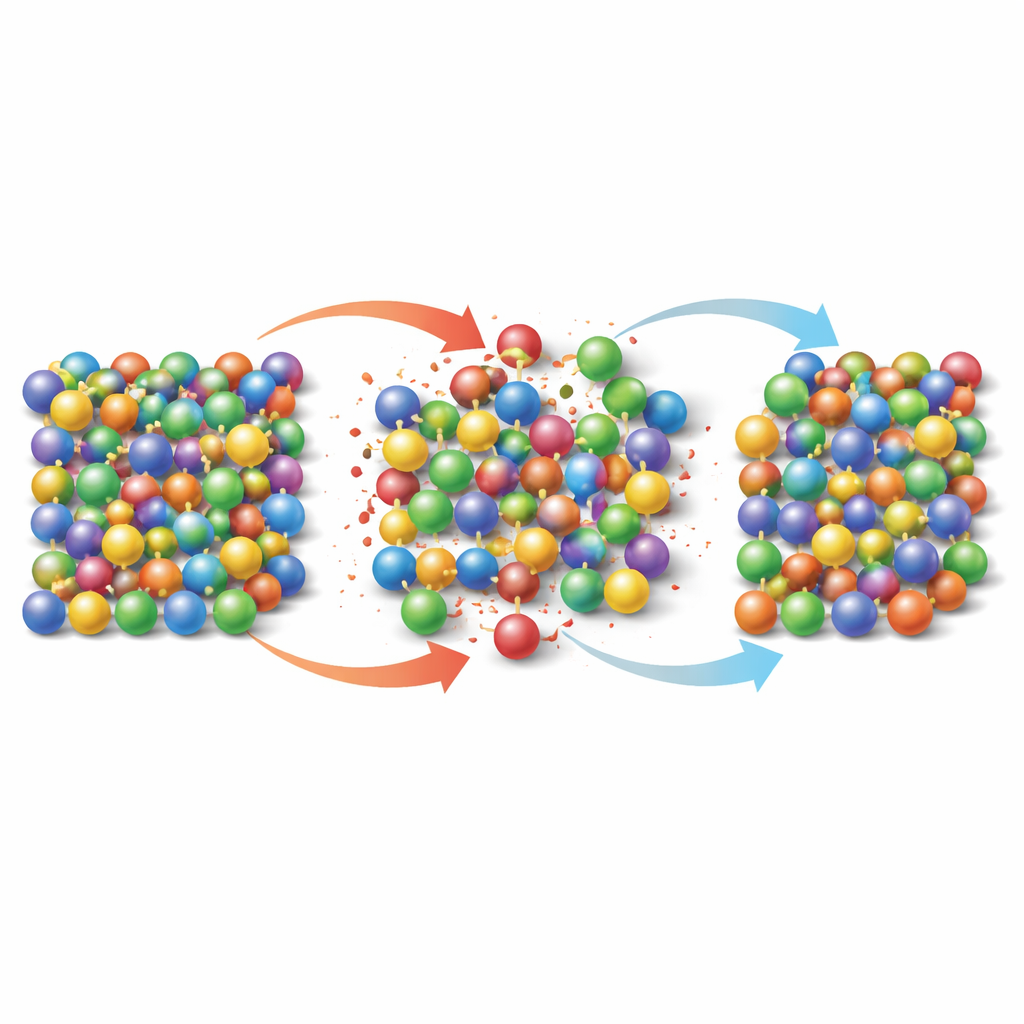
To uncover what drives this tunability, the team images the alloys at the atomic scale using advanced electron microscopes and applies computational modeling based on quantum mechanics. High‑resolution images reveal that chemical species are unevenly distributed, creating regions with different local environments. By tracking tiny shifts in atomic positions, the researchers build “strain maps” that show how stretched or compressed each region is. They find that at low cobalt contents, the crystal is relatively uniform and low in internal strain. At very high cobalt levels, a different crystal form is again fairly relaxed. But at the intermediate compositions that show the strongest superelasticity, the internal strain is both large and highly irregular. Simulations confirm that cobalt changes the relative stability and distortion of the two competing crystal structures, creating an energetic tie at intermediate ratios. The result is a hidden order in how strain is arranged, which makes the crystal reluctant to settle fully into either structure and instead respond elastically in a complex, yet reversible way.
What This Means for Future Devices
Seen from a lay perspective, the study shows that by subtly changing the “ingredient balance” in a complex metal, scientists can program how it stretches and springs back—whether like a simple spring or like a tough, rubbery material that can absorb and release large amounts of energy. This tunable superelasticity, rooted in hidden patterns of internal strain rather than obvious changes in structure alone, offers a powerful design strategy. It could enable precision actuators, resilient parts in tiny machines, and components that quietly damp vibrations or shocks, all built from a single alloy system whose behavior is set not by moving parts but by the deep arrangement of its atoms.
Citation: He, Q., Ren, S., Gu, X. et al. Tuning superelasticity in high entropy alloy via a hidden strain order. Nat Commun 17, 2301 (2026). https://doi.org/10.1038/s41467-026-69108-6
Keywords: superelastic metals, high entropy alloys, lattice strain, shape memory behavior, mechanical damping