Clear Sky Science · en
Environmental and economic benefits of UHPFRC intervention in bridge management for the Swiss network
Why saving old bridges matters
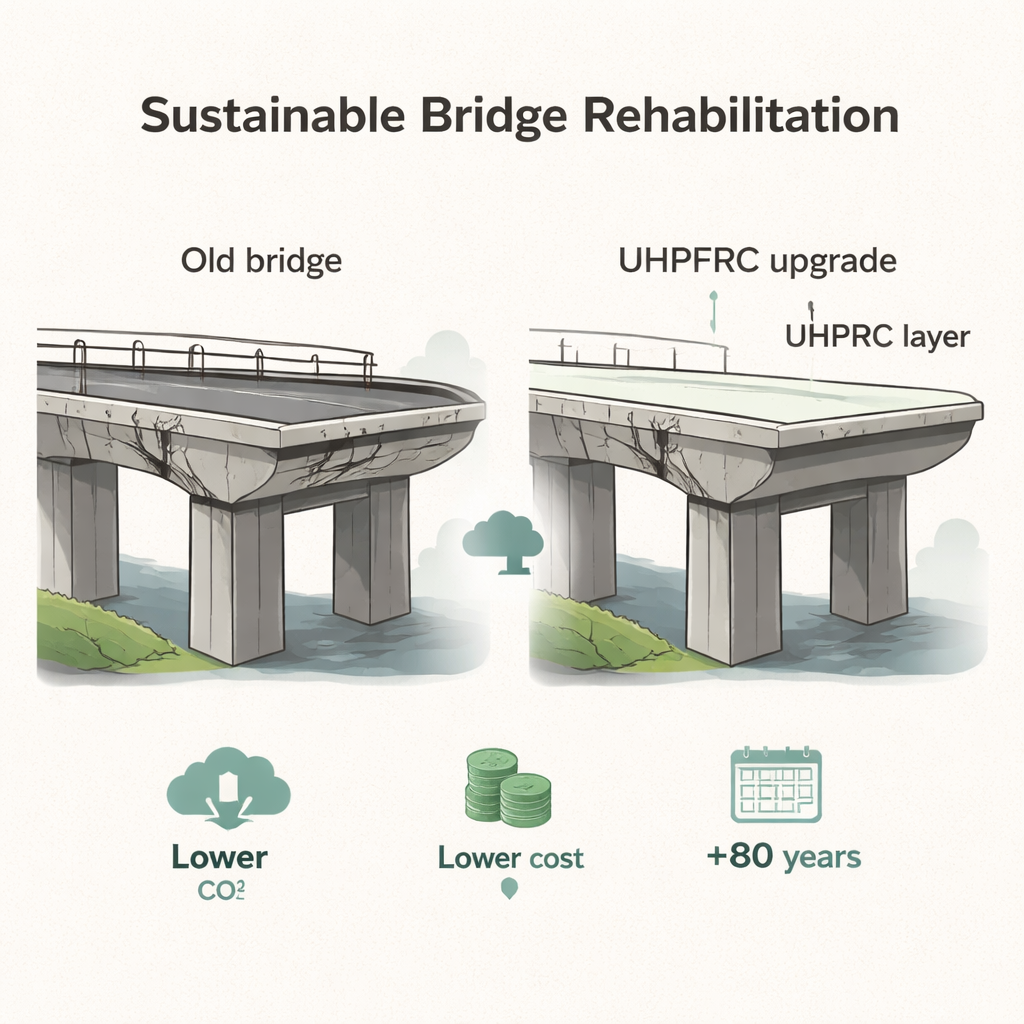
Across the world, many highway bridges built in the mid‑1900s are reaching the end of their intended life. Tearing them down and building new ones is expensive, disruptive for travelers, and releases large amounts of greenhouse gases. This study asks a seemingly simple question with far‑reaching consequences: instead of replacing aging bridges, can we reliably upgrade and protect them so they work like new—while saving money and cutting emissions?
A new skin for tired bridges
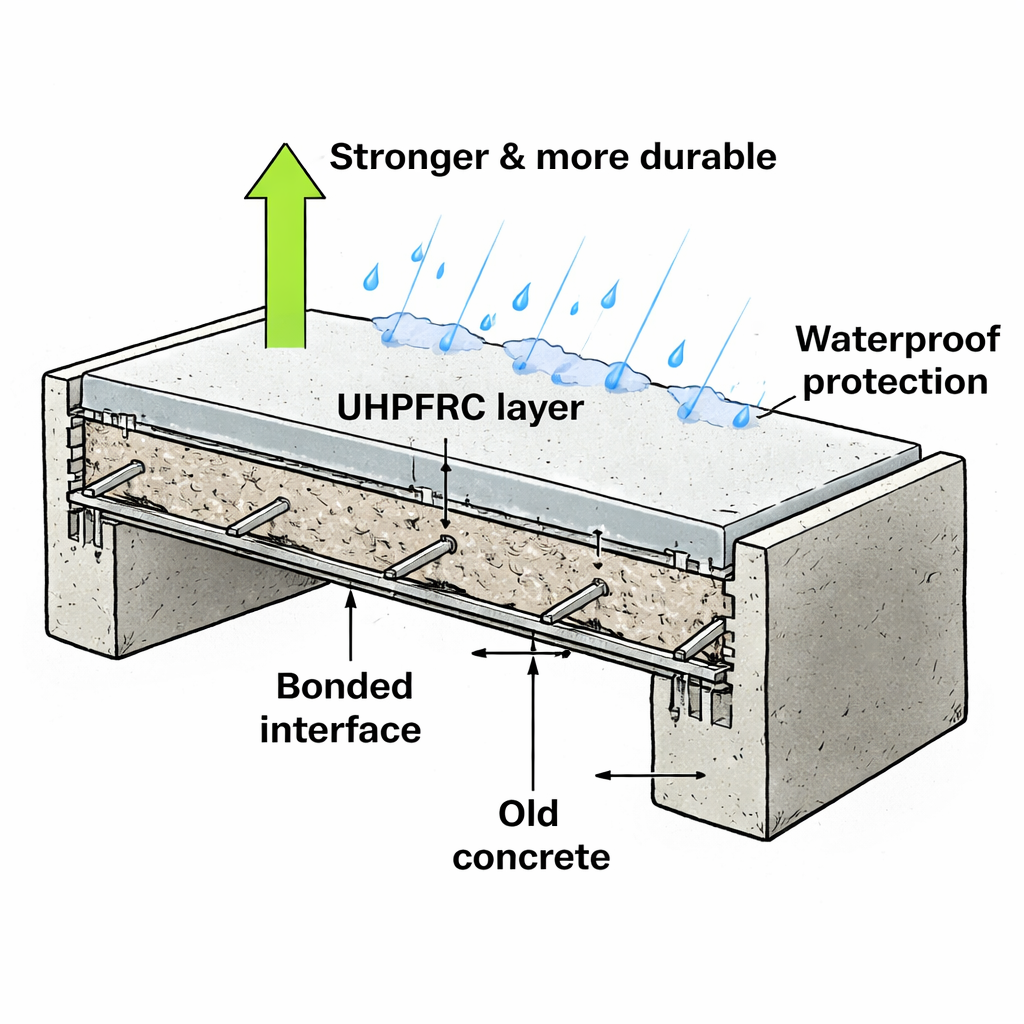
The research centers on a material with a long name and a clear purpose: ultra‑high‑performance fiber‑reinforced cementitious composite, or UHPFRC. Compared with everyday concrete, UHPFRC is much stronger in both compression and tension and is almost waterproof under normal loads. Engineers can place a thin layer of this material, often just 5 to 10 centimeters thick and reinforced with steel bars, over an existing bridge deck. After carefully roughening and wetting the old concrete, the new layer bonds strongly, so the old and new materials act together as a single, tougher structure. This “new skin” not only protects the bridge from water and de‑icing salts but also significantly boosts its ability to carry traffic loads and resist fatigue.
Proven on hundreds of real bridges
Switzerland has become a large‑scale testing ground for this method. Between 2011 and 2024, engineers used UHPFRC on more than 300 bridges across the Swiss motorway network. Some jobs focused only on durability—adding a thin, protective layer—while many others also strengthened the structure. The treated bridges ranged from small rural crossings to major viaducts over two kilometers long, and they included many different designs: slabs, multiple‑beam bridges, box girders, arches, and even composite steel–concrete structures. In most projects, owners wanted the upgraded bridge to offer the same safety and 80‑year service life as a completely new bridge. In practice, the UHPFRC layer extended the useful life of old bridges by several decades and often removed the need to replace them at all.
Counting carbon and francs
The authors compared a typical UHPFRC upgrade with a full demolition and replacement for a common type of highway overpass. They calculated environmental impact in terms of global warming potential—the total climate footprint of all materials and construction steps—and they tracked financial costs per square meter of bridge deck. Building a new bridge emitted around 1085 kilograms of CO2 equivalent per square meter, much of it from producing and assembling large amounts of concrete and steel. The UHPFRC intervention, by contrast, required only a thin layer of high‑performance material and some local repairs, leading to emissions of about 180 kilograms of CO2 equivalent per square meter. That is an 83% reduction in climate impact for the same 80‑year extension of service. Financially, the pattern was similar: replacing the bridge cost roughly 10,000 Swiss francs per square meter, whereas strengthening it with UHPFRC cost about 2,500 francs per square meter—a four‑to‑one saving.
Scaling up to a national road network
To see what this would mean for an entire country, the team analyzed all 3903 bridges on the Swiss federal motorway network. They checked whether the UHPFRC method was technically feasible for each bridge, using factors such as structure type, material, size, age, and current condition. Because almost all the decks are made of reinforced or prestressed concrete and cover the same range of spans and layouts as the bridges already upgraded, they found the technique could be applied to over 99.7% of the total deck area. Using three different scenarios for how and when bridges might normally be replaced—based on design age, observed deterioration, or fixed annual budget—they then estimated how much carbon and money could be saved if owners chose UHPFRC upgrades instead of demolition and rebuilding whenever possible.
Long‑term gains and planning freedom
Across all scenarios, the results were striking. Over an 80‑year horizon, systematically choosing UHPFRC upgrades could avoid up to 7.7 million metric tons of CO2 equivalent—comparable to years of emissions from hundreds of thousands of cars—and save as much as 18.5 billion Swiss francs in construction costs. Because the upgrades are far cheaper than full replacements, the same public budget can treat many more bridges sooner, reducing the risk that aging structures slip into a dangerous state. The analysis shows that with the current annual budget, a traditional replace‑when‑worn‑out strategy produces a growing backlog of bridges needing urgent work, whereas a UHPFRC‑first strategy keeps pace and can even introduce preventive interventions before problems become critical.
What this means for future bridges
For non‑specialists, the main message is that keeping and upgrading our bridges can be smarter than knocking them down. A thin, high‑performance layer on top of existing structures can restore strength, seal out water and salt, and add decades of safe use, all while greatly reducing costs and climate damage. The authors argue that for bridge networks similar to Switzerland’s, UHPFRC strengthening should become the default choice when a bridge nears its notional “end of life,” with full replacement reserved for truly unsalvageable cases. As cleaner versions of the material are developed and experience grows worldwide, this approach offers a practical path toward safer, more affordable, and more climate‑friendly transport infrastructure.
Citation: Bertola, N., Küpfer, C. & Brühwiler, E. Environmental and economic benefits of UHPFRC intervention in bridge management for the Swiss network. Nat Commun 17, 2076 (2026). https://doi.org/10.1038/s41467-026-69103-x
Keywords: bridge rehabilitation, UHPFRC, infrastructure sustainability, life cycle assessment, carbon savings