Clear Sky Science · en
2D/2D phosphorene/BiOI S-scheme heterojunction for subminute photocatalytic water disinfection under real sunlight
Faster Safe Water for Everyone
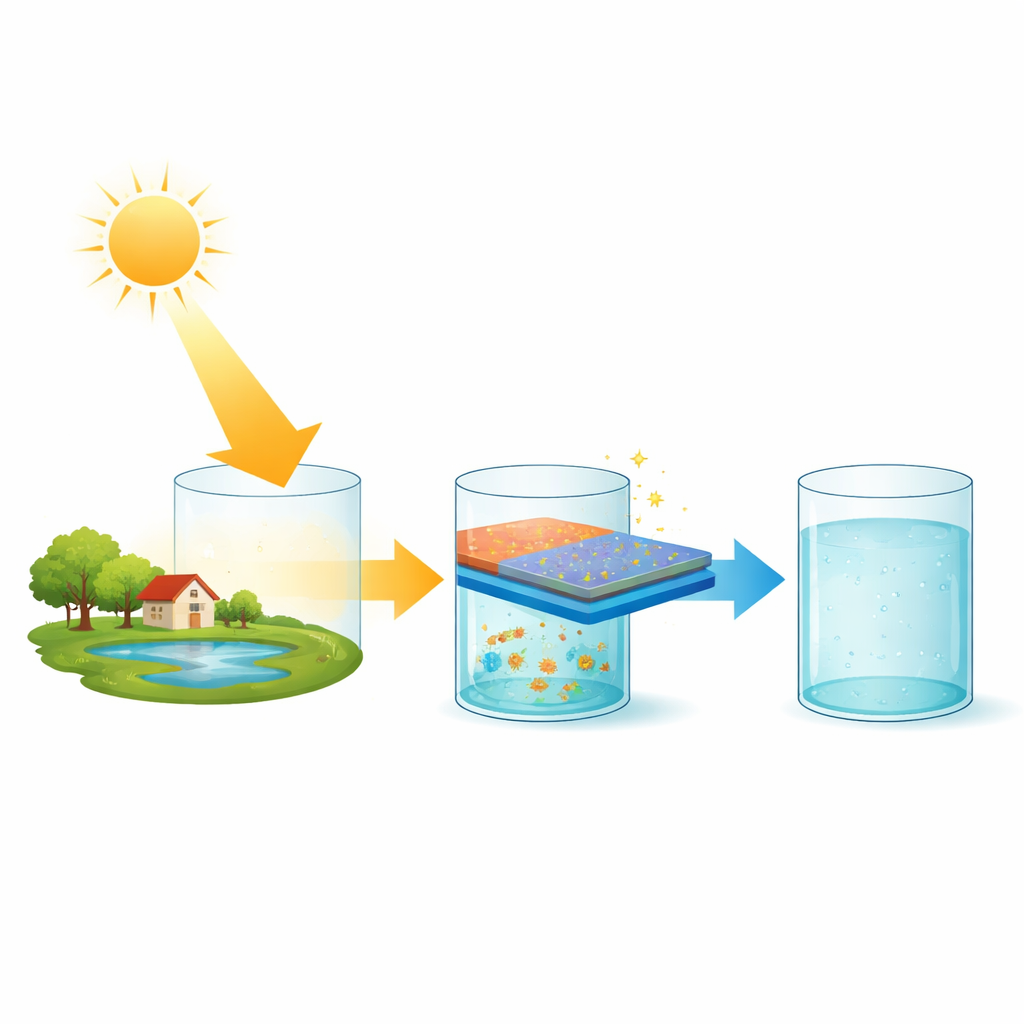
In many parts of the world, getting a glass of safe drinking water still means waiting hours for the sun to do its work. A widely used method called solar disinfection asks people to leave clear bottles of contaminated water in direct sunlight for much of the day, which is hard to manage for busy families and crowded communities. This study introduces a new sunlight-powered material that can kill harmful bacteria in less than a minute, hinting at a future where clean water could be produced almost as quickly as it is poured.
The Challenge of Sun-Powered Disinfection
Solar disinfection is popular in low- and middle-income regions because it needs almost no equipment: just clear containers and sunshine. But it is painfully slow, typically taking 6 to 48 hours of outdoor exposure to make water safe. The main reason is that traditional solar disinfection relies heavily on the ultraviolet portion of sunlight, which makes up only a tiny fraction of the sun’s energy and is quickly weakened as it passes through water. To make solar treatment truly practical at scale, researchers need ways to tap into the far richer visible part of sunlight while turning that energy into chemistry that can rapidly kill microbes.
A New Sunlight-Driven Killing Surface
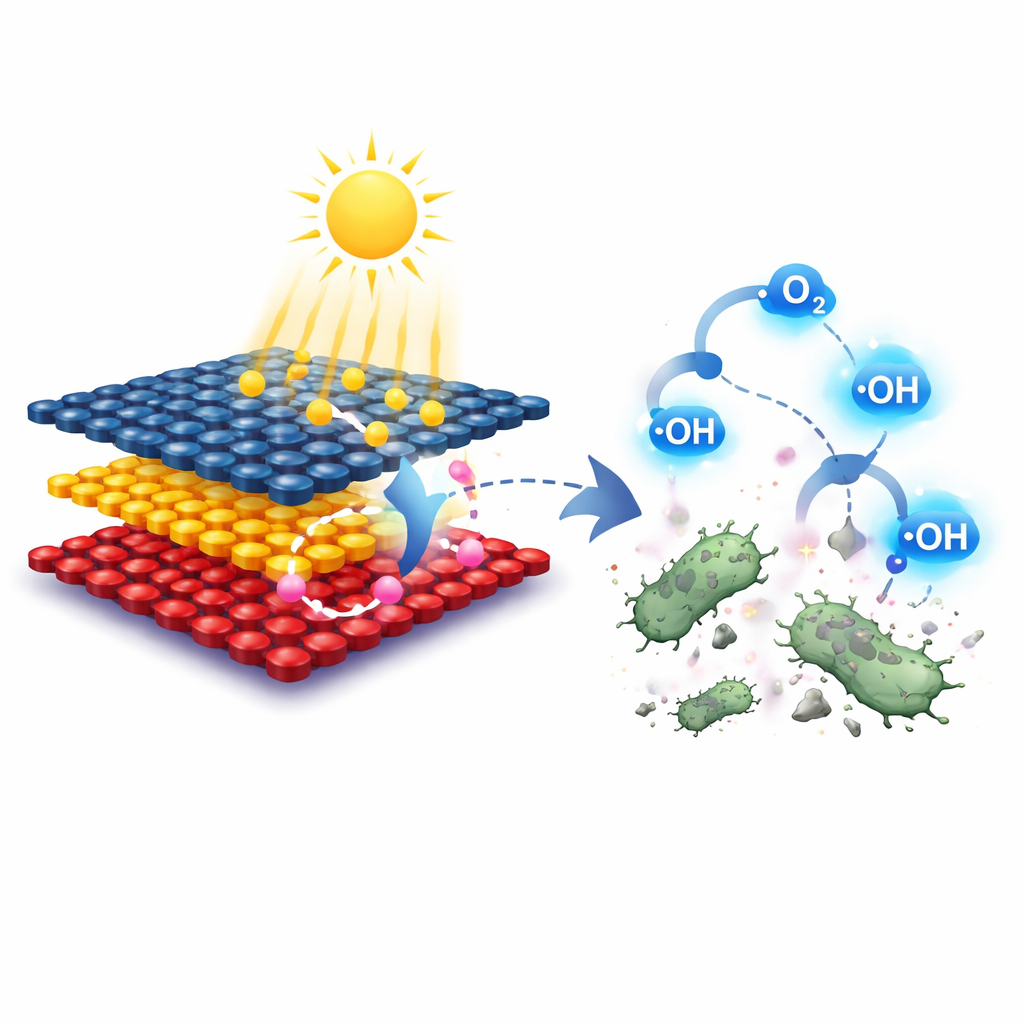
The authors created a thin, layered material that acts like a supercharged solar surface for water disinfection. It is built from two sheet-like substances: phosphorene nanoflakes, made from a form of phosphorus, and nanosheets of a compound called bismuth oxyiodide. Because both ingredients are two-dimensional sheets, they can lie directly against each other over a large area, forming an intimate face-to-face contact. This design, known as a 2D/2D heterojunction, lets electric charges produced by sunlight travel quickly across the interface instead of wasting energy as heat. The researchers carefully tuned the thickness and arrangement of the phosphorene layers so that the pair absorbs nearly the full visible spectrum and sets up a favorable internal electrical landscape.
How the Invisible Attack Works
When sunlight hits this stacked material, it excites electrons and leaves behind positively charged “holes” in specific regions of the two sheets. Because of the way their energy levels are aligned, an internal electric field pushes some of these charges to recombine in low-value positions while preserving the most energetically powerful electrons and holes on opposite sides of the junction. These strong charges then react with oxygen and water at the surface to produce a suite of aggressive short-lived chemicals called reactive oxygen species. These include several different forms of activated oxygen and peroxide that together punch holes in bacterial membranes, disrupt energy production, and damage genetic material. Measurements showed that the new material makes these reactive species far more efficiently than either component alone, limiting losses at each step from light absorption to chemical attack.
From Lab Tests to Real Sunlight
To see how well this plays out in practice, the team tested the material, loaded at an optimal low fraction of phosphorene, against high concentrations of the common gut bacterium Escherichia coli, a standard indicator of fecal contamination. Under simulated visible light, the composite killed seven orders of magnitude of bacteria—reducing their numbers by a factor of ten million—in just five minutes, outperforming many previously reported photocatalysts. Under real midday sunlight outdoors, the same material completely inactivated the same heavy bacterial load in only 45 seconds. In terms of disinfection rate, it was roughly 221 times faster than a widely used commercial titanium dioxide powder. The material also worked in a simple fixed-bed reactor, continuously treating flowing water for 24 hours while maintaining very high disinfection efficiency.
What This Means for Clean Water
For non-specialists, the key message is that the authors have designed a sunlight-activated surface that uses visible light far more efficiently, converting it into powerful but short-lived oxidizing agents that shred bacteria in seconds rather than hours. By pairing two sheet-like materials with carefully matched electronic properties, they overcame both slow charge motion and weak chemical power, the twin bottlenecks that have limited earlier designs. While real-world devices will still need engineering, safety checks, and cost optimization, this work shows that subminute solar disinfection of heavily contaminated water is possible. It points toward compact, low-energy systems that could bring fast, reliable, point-of-use water treatment to communities that have long had to wait for the sun.
Citation: He, D., Zhang, K., Liu, C. et al. 2D/2D phosphorene/BiOI S-scheme heterojunction for subminute photocatalytic water disinfection under real sunlight. Nat Commun 17, 2267 (2026). https://doi.org/10.1038/s41467-026-69101-z
Keywords: solar water disinfection, photocatalyst, reactive oxygen species, phosphorene, drinking water treatment