Clear Sky Science · en
Enhancing film bulk acoustic resonators performance by optimizing AlN seed layer crystallinity and polarity alignment
Why better filters matter for everyday wireless life
From streaming videos on the go to connecting smart home gadgets, our devices rely on tiny components that clean up crowded radio signals. As 5G, future 6G networks, and next‑generation Wi‑Fi push into higher frequencies, these components—especially radio filters—are being pushed to their limits. This paper explores how to build better versions of one key building block, the film bulk acoustic resonator, so that future wireless systems can carry more data with less interference.
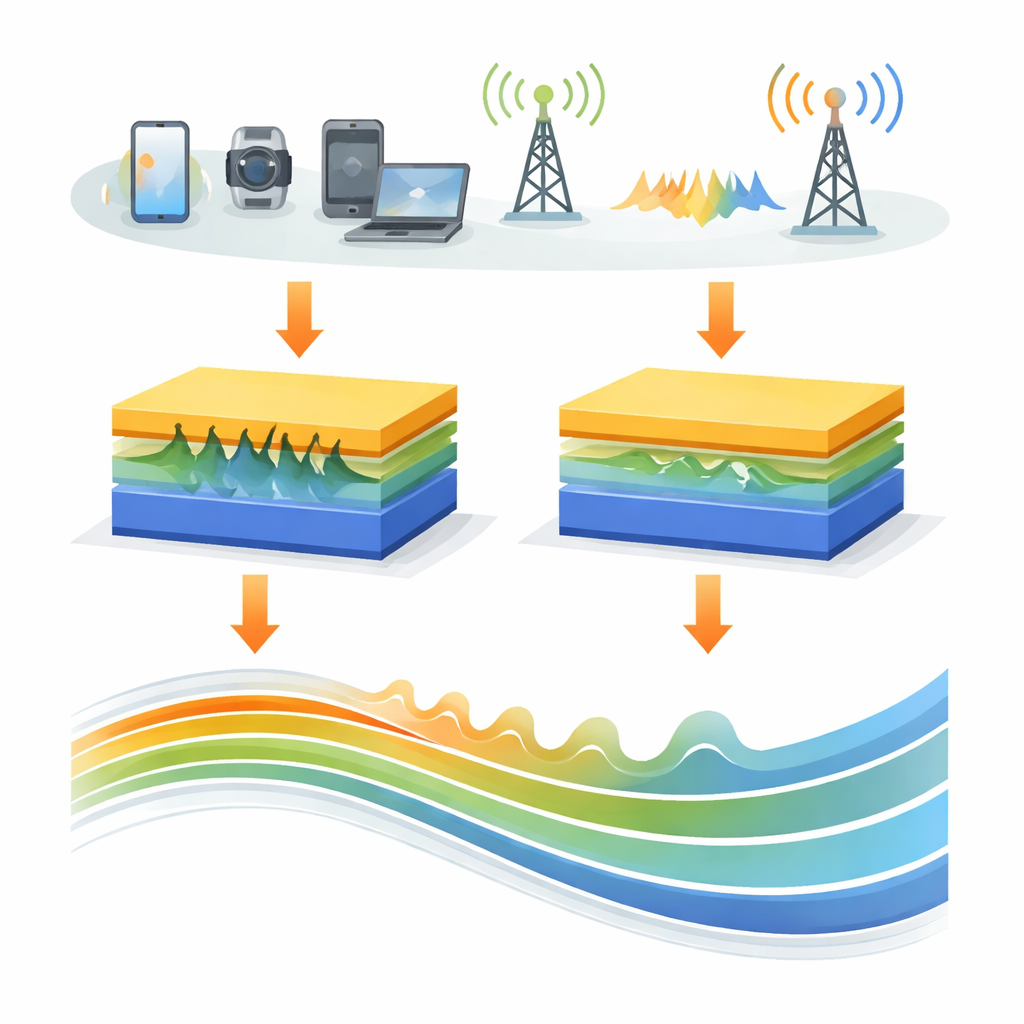
How tiny “sound boxes” clean up radio signals
Film bulk acoustic resonators (FBARs) act like microscopic sound boxes etched into a chip. Instead of vibrating in air, they vibrate within a thin solid film, turning electrical signals into mechanical waves and back again. By vibrating strongly at only certain frequencies, they let wanted channels through and block the rest. A common material for these films is aluminum nitride, which is stable, fast, and compatible with standard chip processing. However, its ability to convert electrical energy into mechanical motion is modest, which limits how wide a useful band it can filter—an important drawback for the broad channels used in modern wireless links.
Boosting performance with a carefully doped crystal
To get stronger response, researchers often add a small amount of scandium to aluminum nitride, creating scandium‑doped aluminum nitride. This alloy can vibrate more efficiently and support filters with wider bandwidths. The catch is that adding scandium tends to roughen the film and disturb its crystal alignment, both of which hurt device performance. Engineers usually try to fix this by adding an underlying “seed layer” of aluminum nitride to guide the growth of the scandium‑doped layer. The seed layer is meant to act like a template, encouraging the active layer to line up perfectly along its preferred direction.
When upside‑down crystals cancel each other out
This study shows that the seed layer carries a hidden risk: it can end up pointing in the opposite internal direction from the active scandium‑doped layer. In these crystals, atoms stack along a vertical axis in a way that gives them a built‑in electrical direction, or polarity, a bit like microscopic arrows pointing up or down. Using computer modeling and detailed electron microscope images, the authors reveal that if the seed layer’s arrows point one way and the active layer’s arrows point the other, their responses partially cancel. This polarity mismatch drastically weakens the coupling between electrical signals and mechanical vibrations, even if the crystal looks well ordered overall.
Two‑step strategy: grow with help, then remove the helper
To get the best of both worlds, the researchers propose a dual‑optimization strategy. First, they grow a high‑quality, single‑crystal aluminum nitride seed layer using a chemical vapor process, then deposit the scandium‑doped layer on top. This produces a very smooth, well‑aligned active film with fewer defects than films grown on bare silicon or on rough, polycrystalline seed layers. Next, after forming the stack, they selectively remove the seed layer underneath the active film, eliminating the polarity clash while preserving the excellent crystal quality of the scandium‑doped layer. Tests on completed resonators show that this approach almost doubles the effective electromechanical coupling—from about 6% to over 13%—while maintaining high quality factors, a measure of how sharply the resonator responds at its target frequency.
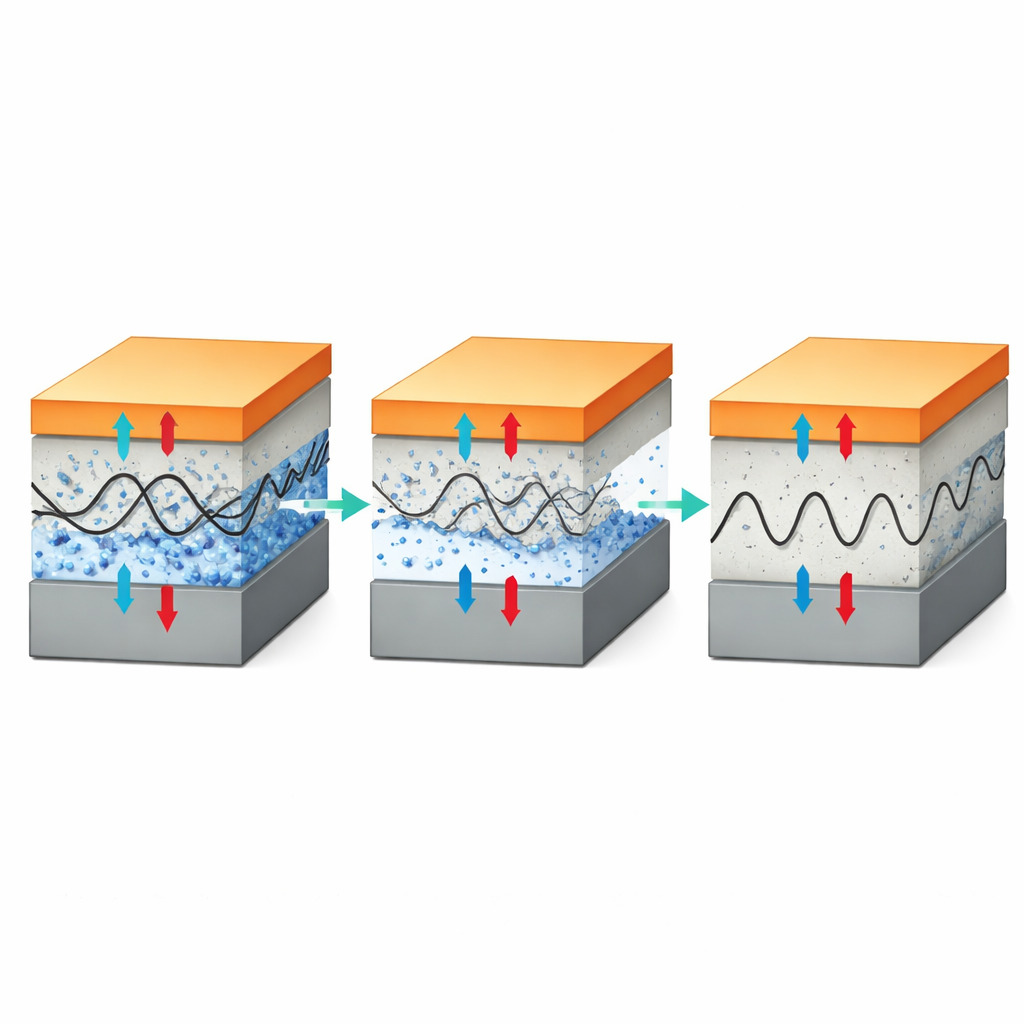
From better building blocks to stronger filters
Finally, the team builds full radio filters using these improved resonators and measures their performance around 6.4 GHz, a key band for future wireless systems below 7 GHz. The resulting filters offer a broad 740 MHz passband, low signal loss of about 2.6 decibels, and strong rejection of unwanted signals outside the band, exceeding 40 decibels. In plain terms, their design lets more of the desired signal through while more effectively blocking noise and neighboring channels. By carefully managing both crystal quality and internal polarity, this work points the way toward smaller, more efficient filters for future phones, routers, sensors, and other connected devices.
Citation: Yang, T., Xu, Q., Wang, Y. et al. Enhancing film bulk acoustic resonators performance by optimizing AlN seed layer crystallinity and polarity alignment. Nat Commun 17, 2114 (2026). https://doi.org/10.1038/s41467-026-69096-7
Keywords: wireless filters, acoustic resonators, scandium-doped nitride, radio frequency devices, 5G and 6G