Clear Sky Science · en
Short-range order in high entropy carbides
Why tiny patterns in tough materials matter
Materials that can shrug off intense heat and radiation are essential for future nuclear reactors, spacecraft, and hypersonic flight. This study looks inside a new class of super‑hard ceramics called high‑entropy carbides and discovers that the way different metal atoms quietly arrange themselves over just a few atomic distances can dramatically change how well these materials survive radiation damage. By uncovering and tuning this hidden atomic patterning, the work points to smarter design rules for the next generation of extreme‑environment materials. 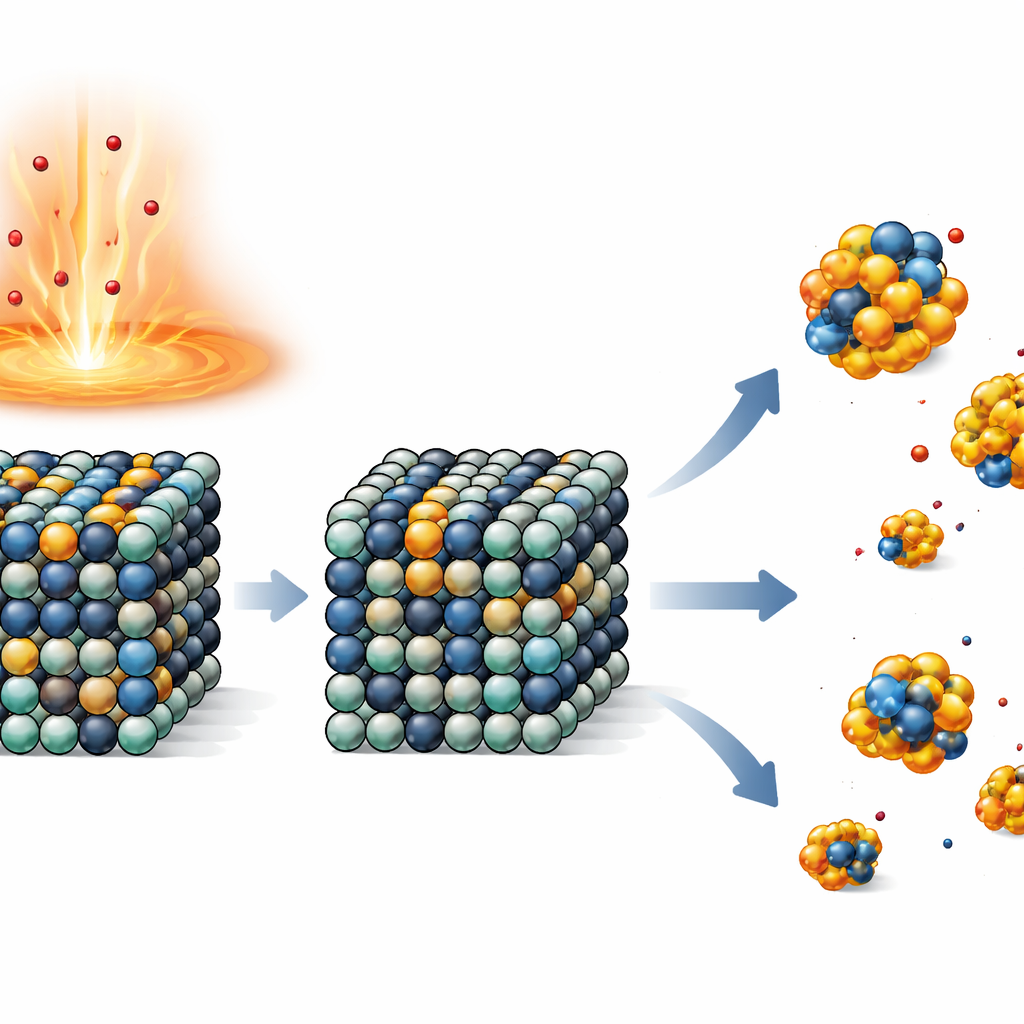
A new breed of rugged ceramics
High‑entropy carbides are built by mixing several different metals with carbon into a single, uniform crystal. This cocktail approach can produce ceramics that are both very hard and unusually resistant to damage at high temperatures and under radiation. But even when the overall mixture looks uniform, the atoms may not be perfectly shuffled. Pairs or small groups of certain metal atoms can subtly prefer to sit next to one another, or to avoid each other. This local patterning, called chemical short‑range order, had been seen in some metallic alloys and oxides, but had not been clearly observed in these strongly bonded carbides, and its influence on their performance was unknown.
Revealing hidden atomic neighborhoods
The researchers focused on two closely related carbides that share the same crystal structure but differ by swapping zirconium (Zr) for molybdenum (Mo), nicknamed HEC‑Zr and HEC‑Mo. They first trained a machine‑learning interatomic model, grounded in quantum‑mechanical calculations, to simulate how atoms arrange themselves in these complex solids. Large‑scale molecular dynamics and Monte Carlo simulations showed that both materials naturally develop short‑range order: some types of metal atoms, such as vanadium pairs, strongly cluster, while others either mix or repel. HEC‑Zr showed stronger short‑range order overall than HEC‑Mo. The simulations also predicted that heating the material and then cooling it could weaken this ordering, pushing the atoms toward a more random mix. 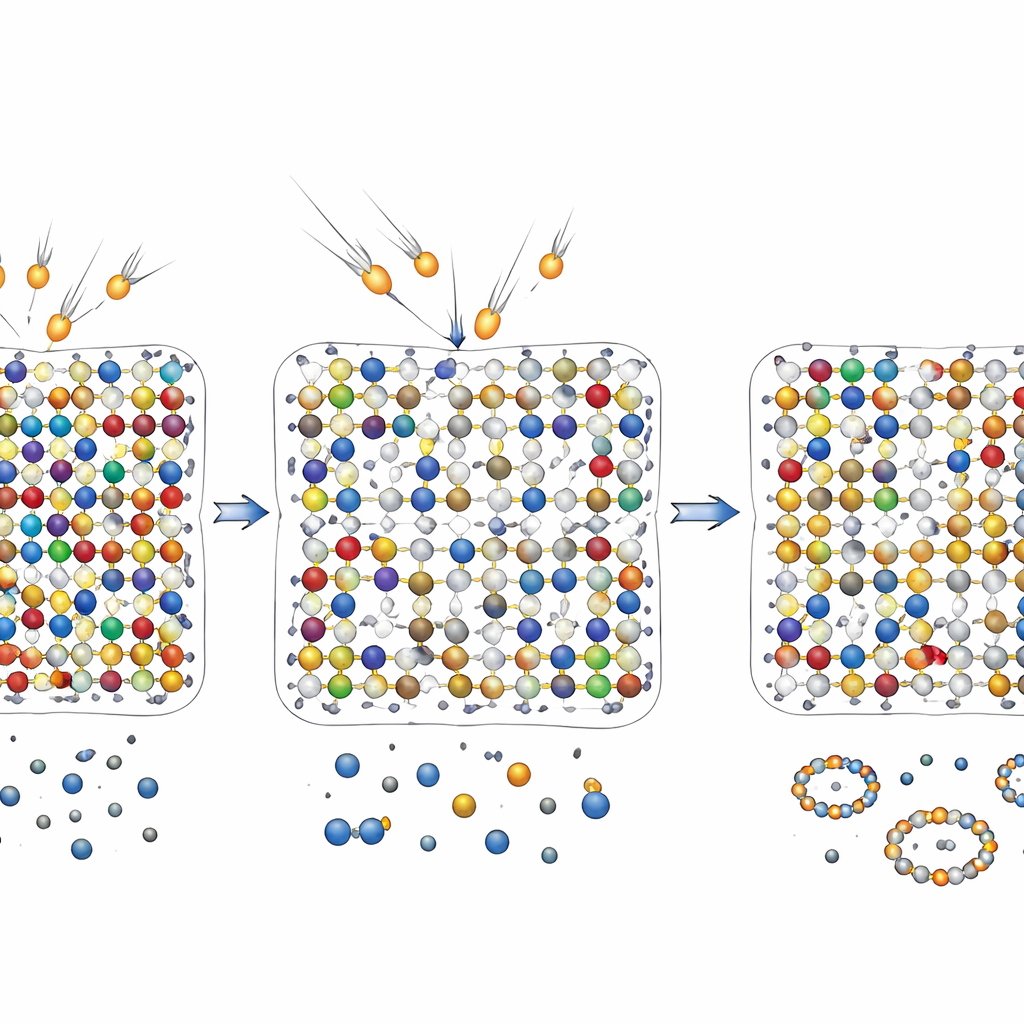
Watching patterns form and fade with heat
To test these predictions, the team combined several sensitive experimental techniques. Differential thermal analysis measured tiny heat signatures as samples were heated and cooled. Specific peaks in the heat‑flow curves lined up with the formation and dissolution of short‑range order, and their sizes matched formation energies calculated from quantum theory, confirming that real atomic rearrangements were taking place. High‑resolution scanning transmission electron microscopy produced “Z‑contrast” images where heavier and lighter metal atoms appear as brighter and darker spots. In HEC‑Zr, the images revealed nanometer‑scale bright and dark patches, consistent with clusters of particular metals; HEC‑Mo showed similar but weaker contrast. When HEC‑Mo was annealed at a higher temperature, these patches almost vanished, indicating that short‑range order had largely been erased.
Strain maps as fingerprints of local structure
The scientists then turned to four‑dimensional electron microscopy, collecting thousands of tiny diffraction patterns across each sample and processing them with advanced signal‑analysis tools. From these data they extracted maps of local lattice strain—minute stretches and compressions of the atomic grid. Regions with strong short‑range order produced heterogeneous strain patterns about one to two nanometers across, matching the domain sizes seen in the images and simulations. HEC‑Zr with strong short‑range order displayed the largest strain variations and the highest density of such domains; HEC‑Mo had smaller and fewer domains, and after high‑temperature annealing its strain map became much more uniform. These results established that irregular strain patterns can serve as a reliable fingerprint for hidden short‑range order in high‑entropy carbides.
Radiation damage: when order helps and when it doesn’t
With the atomic landscape mapped out, the team asked how it affects a key property: resistance to radiation damage. They bombarded the materials with energetic silicon ions and measured how much the crystal lattice swelled, a sign of accumulated defects. At a given irradiation temperature, HEC‑Mo with strong short‑range order swelled the least, while the same composition with weakened ordering swelled more, even though other factors such as grain size were similar. Electron microscopy of the damaged regions showed that the more ordered HEC‑Mo formed many small defect clusters, whereas the less ordered version developed larger dislocation loops—evidence that short‑range order can hinder defect motion and coarsening. Surprisingly, the strongly ordered HEC‑Zr swelled the most, revealing that chemical composition also plays a major role and that more order is not always better.
What this means for future extreme materials
This work shows that high‑entropy carbides host a rich, tunable pattern of atomic neighborhoods that do not change the overall crystal structure but still steer how radiation damage develops. By choosing particular metals and tailoring heat treatments, researchers can dial the degree of short‑range order to improve radiation tolerance, at least in some compositions. The broader message is that such hidden atomic patterns may be a universal feature of high‑entropy materials and a powerful, underused design knob for building ceramics and alloys that can better withstand the harshest environments.
Citation: Wei, S., Qureshi, M.W., Wei, J. et al. Short-range order in high entropy carbides. Nat Commun 17, 2362 (2026). https://doi.org/10.1038/s41467-026-69095-8
Keywords: high-entropy carbides, short-range order, radiation resistance, extreme environment materials, ceramic microstructure