Clear Sky Science · en
Vaccination against H5 HP avian influenza virus leads to persistent immune response in wild king penguins
Why penguin vaccines matter to us
Deadly bird flu has swept across the globe, killing wild birds and even marine mammals in huge numbers. This study asks a timely question: can a modern vaccine, similar in spirit to some COVID-19 shots, safely protect wild penguins from the latest strain of avian influenza? By testing a new RNA-based vaccine in king penguin chicks living freely in a sub-Antarctic colony, the researchers explore whether vaccination could become a real conservation tool rather than just an idea on paper.
A growing virus threat in remote seas
Over the past few years, highly pathogenic avian influenza (HPAI) H5N1 has spread around almost the entire planet, reaching species as diverse as seabirds, vultures, condors and seals. For long-lived animals that raise only a few chicks, the loss of adults can quickly push populations toward decline. Even remote islands in the Southern Ocean are no longer safe havens: the virus was recently detected in penguins and elephant seals there. King penguins, which breed in tight, noisy crowds and rear chicks on land for most of a year, are particularly exposed if the virus arrives in their colonies.
A real-world vaccine trial in wild chicks
To test a new way to protect such wildlife, scientists worked in a large king penguin colony on Possession Island in the Crozet archipelago. They used a self-amplifying mRNA (saRNA) vaccine designed against the current H5 influenza strain, a technology that prompts the penguin’s own cells to briefly make a harmless piece of the virus, training the immune system to recognize it. Fifty emancipated chicks, roughly 45 days old and still living naturally in the colony, were tagged and followed. Thirty received a first injection of vaccine and a booster about five weeks later; twenty control chicks received only a harmless liquid. The team then monitored growth, survival and blood markers of immunity for about 250 days, nearly the whole period before the chicks fledged to sea. 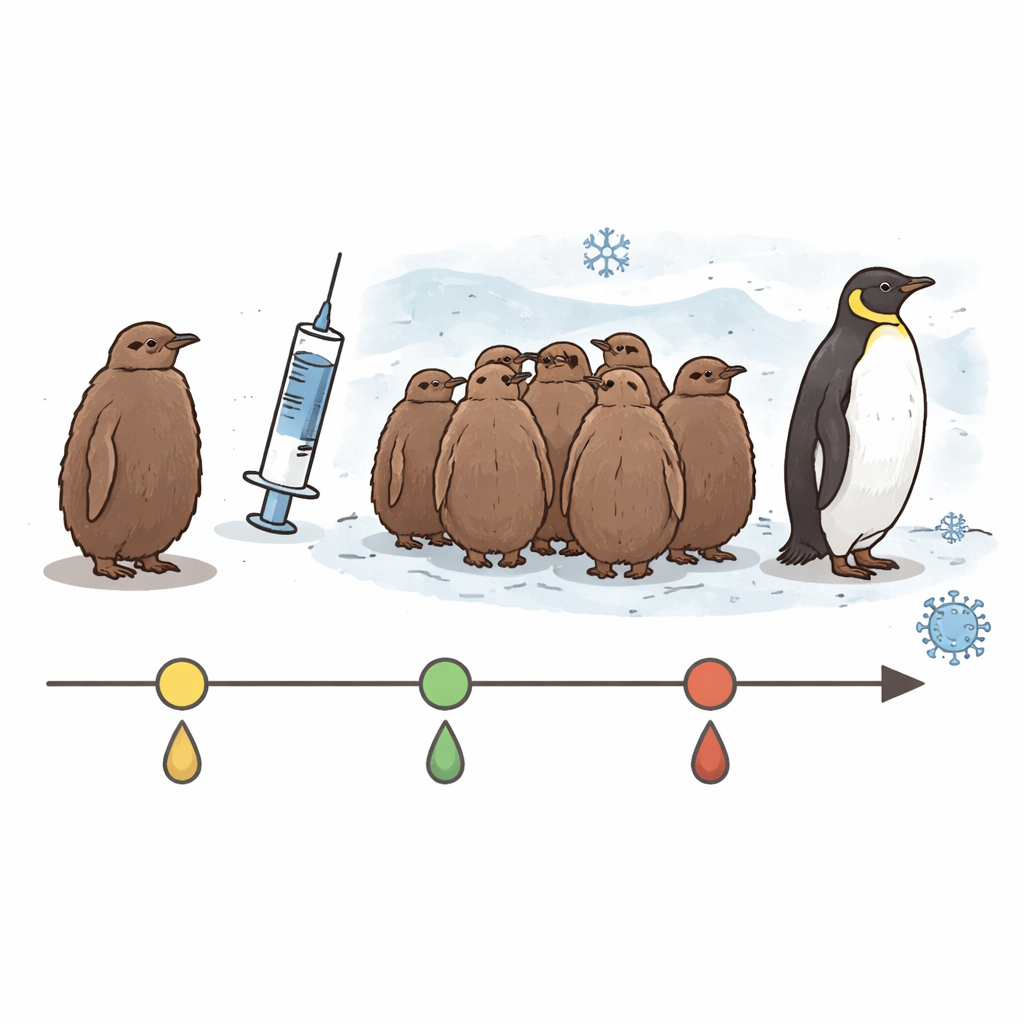
No harm to growing penguins
One essential question was safety: would vaccination slow growth, weaken the chicks or increase deaths? Throughout the study, vaccinated and control birds gained weight and grew their flippers at similar rates. Survival was also comparable between the two groups, even through the harsh sub-Antarctic winter. Careful checks right after injections found no limping, distress or visible swelling. Statistical tests confirmed that any differences in growth or survival were too small to be biologically meaningful. In short, the vaccine behaved much like a routine shot in domestic animals, but here in free-living, wild penguin chicks.
A strong and lasting shield against bird flu
The more challenging test was whether the vaccine would trigger a strong and durable immune response. Blood samples showed that all vaccinated chicks developed high levels of antibodies against the H5 part of the virus, while control chicks stayed negative. These antibody levels rose sharply after the booster, peaked roughly three months after the first dose, and then declined only slowly. Many vaccinated chicks remained clearly positive right up to fledging, more than eight months after vaccination began. When researchers mixed the chicks’ blood with live H5N1 virus in the lab, samples from vaccinated birds were able to neutralize the virus at both early and late time points, whereas samples from controls could not. This indicates that the antibodies were not just present, but also functional and likely protective. 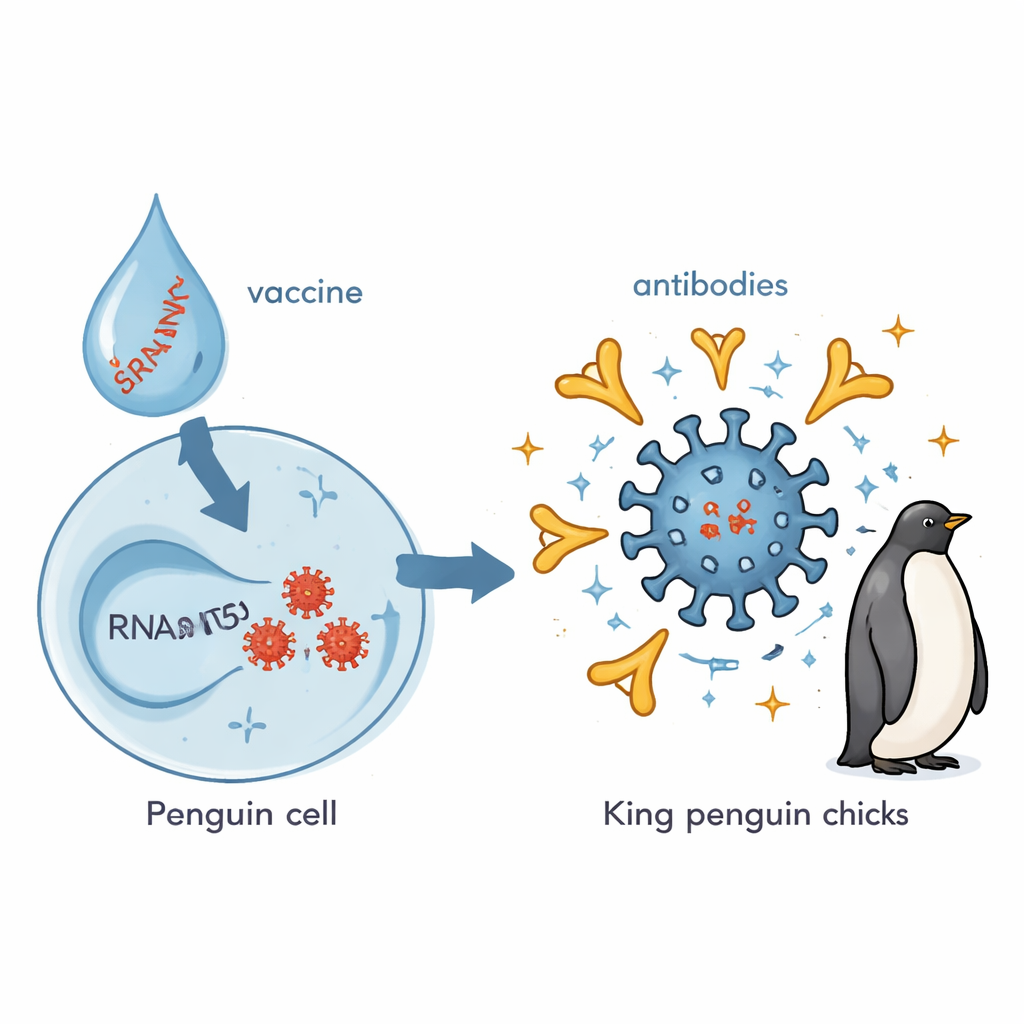
Separating vaccine effects from natural infection
Because the vaccine targets a specific viral protein, the team could also test whether chicks had been naturally infected by any influenza virus using a second blood test directed at a more general internal viral component. Both vaccinated and control chicks remained negative on this test. Interestingly, during the final weeks of the study, the same island recorded its first confirmed cases of H5N1 in seals and adult penguins, yet none of the monitored chicks showed signs of infection. That suggests the virus either had not yet spread widely among chicks, or encounters were too recent for their immune systems to show a measurable response.
What this means for saving wildlife
To a layperson, the bottom line is that a cutting-edge RNA vaccine, already used at scale in farmed ducks, appears safe and highly effective at triggering lasting immunity in wild king penguin chicks without disrupting their natural lives. While the trial did not expose birds directly to the virus in the field, the strength and persistence of their neutralizing antibodies make it likely that such a vaccine could help shield endangered seabird populations if bird flu sweeps through their colonies. The work also shows that carefully planned vaccination campaigns in wild settings are feasible, opening the door to using vaccines as one part of broader efforts to protect vulnerable species in an era of fast-moving diseases and a changing climate.
Citation: Lejeune, M., Tornos, J., Bralet, T. et al. Vaccination against H5 HP avian influenza virus leads to persistent immune response in wild king penguins. Nat Commun 17, 1395 (2026). https://doi.org/10.1038/s41467-026-69094-9
Keywords: avian influenza, penguin vaccination, wildlife conservation, RNA vaccines, seabird health