Clear Sky Science · en
dHyperCas12a enables multiplexed CRISPRi screens
Programming the Cell’s Volume Knob
Our cells constantly decide which genes to turn up, which to turn down, and which to keep silent. Many diseases arise when this delicate balance goes wrong, yet most tools for probing gene control can only nudge one switch at a time. This paper introduces a powerful method, built on a CRISPR protein called dHyperCas12a, that lets scientists dial many genetic switches up or down at once. By doing so efficiently and safely, it opens the door to mapping how networks of DNA control elements work together in health, disease, and cell therapies. 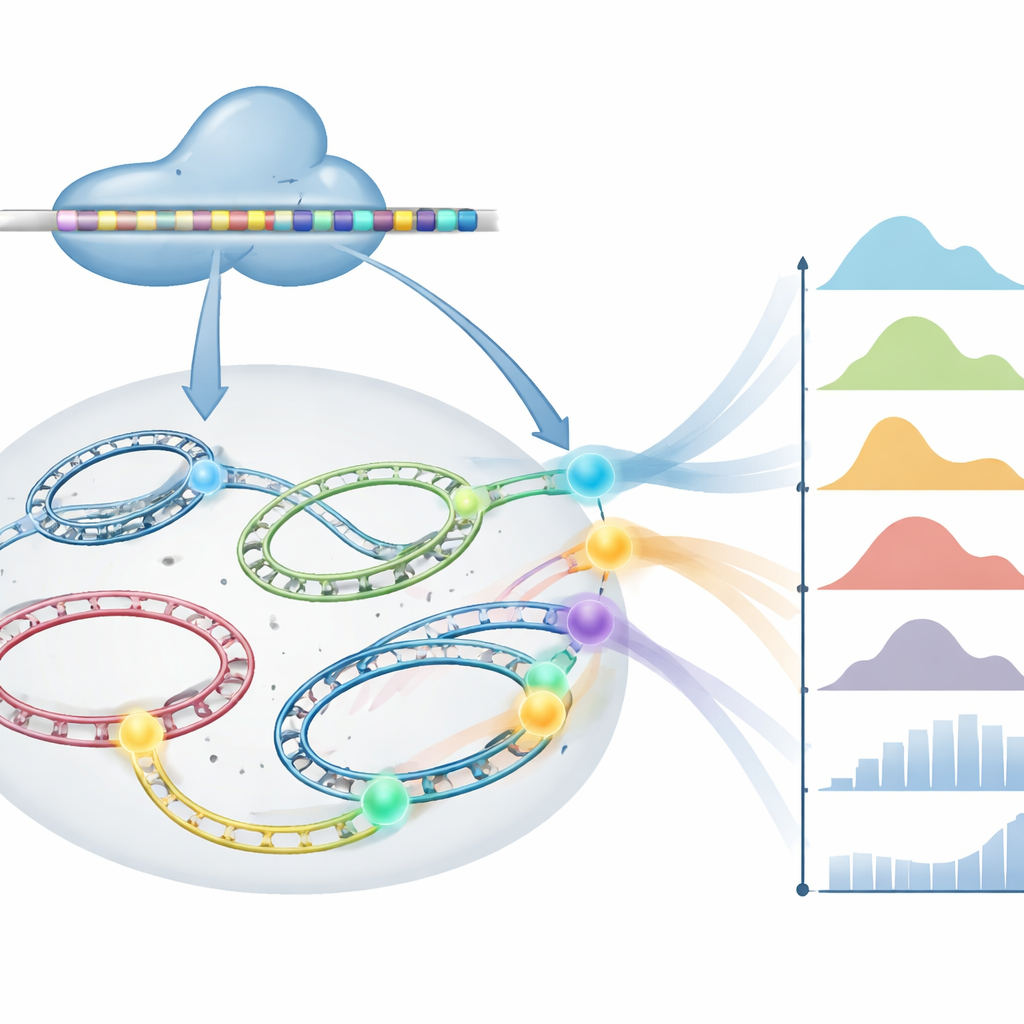
Many Switches, One Control Board
Most genes are not controlled by a single on–off switch, but by several short stretches of DNA called regulatory elements. These act together to decide when, where, and how strongly a gene is used. Traditional CRISPR tools can turn genes on or off, but studying combinations has been hard because each target usually needs its own guide molecule and delivery cassette. Handling dozens of nearly repetitive guides tends to break the DNA constructs researchers rely on, making comprehensive tests of gene–gene or element–element interactions impractical.
Why Cas12a Is a Better Multitasker
The researchers turned to Cas12a, a cousin of the familiar Cas9 enzyme, because it naturally reads a long “guide RNA array” and cuts that array into many individual guides inside the cell. They compared several engineered Cas12a variants and found that one, called dHyperLbCas12a, was especially good at turning target genes up or down even when guide levels were low. They then improved how the guide arrays are made in human cells by switching from a short, hard‑to‑extend RNA promoter to a more powerful one that can drive long transcripts. This change allowed them to build single RNAs carrying up to 14 guides, all processed by Cas12a into separate targeting instructions.
Building a Flexible Gene Dimmer System
To control gene activity, the team fused dHyperCas12a to “effector” domains that either activate or repress nearby DNA. They created versions that shut genes down strongly (using a KRAB domain), versions that repress more gently (using a SID domain), and versions that switch genes on (using VPR or P300 activators). In multiple human cell types—including liver cells, lung cancer cells, immune T cells, and stem cells turning into neurons—they showed that a single dHyperCas12a protein plus a multi‑guide array can simultaneously raise or lower many genes. They also demonstrated a hybrid array that mixes guides for two compatible Cas12a proteins, so one protein activates some genes while the other represses others within the same cell.
Putting the System to the Test
With these tools in hand, the scientists carried out large screens. In one, they asked which genes are essential for cell growth by slightly repressing hundreds of targets at once, each encoded as part of four‑guide arrays. The dHyperCas12a paired with a KRAB domain gave the strongest and most reliable depletion of known essential genes, even when delivered at low copy number by lentivirus—important for realistic disease models. In another screen, they dissected how two nearby regulatory elements control the gene PER1, a key player in daily body rhythms that responds to stress hormones. By constructing over 8,000 six‑guide arrays that hit one enhancer, the other, or both in thousands of combinations, they showed that one enhancer dominates at very low hormone levels, while both contribute as the dose increases. 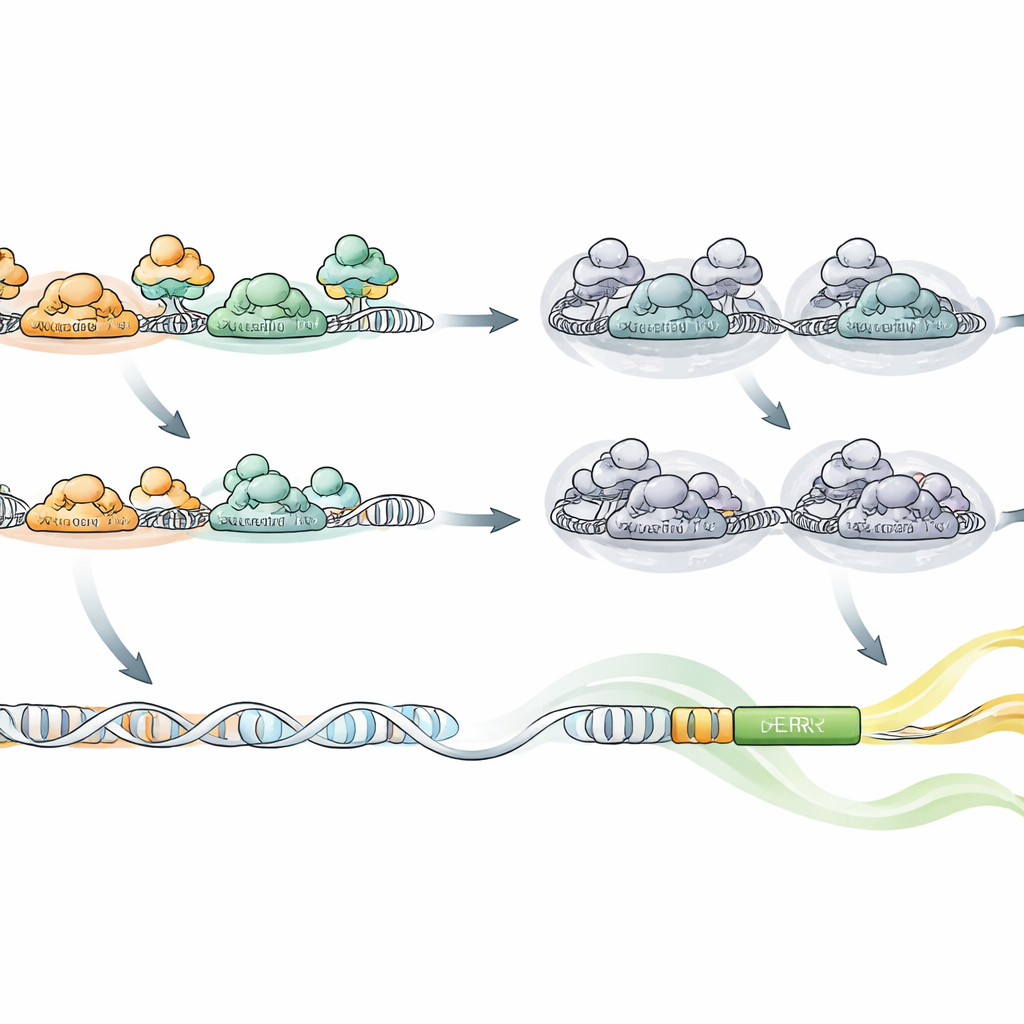
What This Means for Future Research
For non‑specialists, the advance can be thought of as moving from flipping one light switch in a building to controlling whole banks of dimmers from a single smart panel. dHyperCas12a and its guide arrays let researchers precisely dampen or boost many genetic controls at once, in combinations that more closely resemble real biology. This makes it possible to ask which sets of DNA elements truly matter for a drug response, a developmental step, or a disease trait, without permanently cutting the genome. While more work is needed to chart off‑target effects and scale to even larger combinations, this study lays the groundwork for powerful “many‑at‑once” CRISPR interference screens that can reveal how complex gene control systems really work.
Citation: Melore, S.M., McRoberts Amador, C.D., Hamilton, M.C. et al. dHyperCas12a enables multiplexed CRISPRi screens. Nat Commun 17, 2642 (2026). https://doi.org/10.1038/s41467-026-69090-z
Keywords: CRISPRi, Cas12a, gene regulation, enhancers, functional genomics