Clear Sky Science · en
Ultra-coherent meta-emitter tailors arbitrary thermal wavefront
Turning Heat into Useful Light
Anything warm glows, from a cup of coffee to the human body, but this thermal glow is normally messy and hard to control. Lasers, in contrast, produce sharply directed, highly ordered beams that underpin modern communication and imaging. This paper shows how to make ordinary heat behave more like a laser beam, using a tiny engineered surface called a “meta-emitter” that can bend and focus thermal radiation into almost any pattern, opening paths to new types of sensors, communication links, and holographic displays powered simply by temperature differences.
Why Controlling Heat Light Is Hard
Thermal radiation is rooted in random motion of atoms, so the light it produces is spread over many colors and directions, with its waves jumbled out of step. Traditional optics can filter and collimate this glow, but only by throwing away most of the energy and adding bulky parts. For decades, researchers have tried to tame thermal light directly at the emitting surface, using specially patterned materials that support collective surface waves. These designs can steer and narrow the emission, yet they hit a wall: the more complex the pattern you want—such as a sharp focus or a hologram—the more the tiny structural details disturb the delicate resonances that create coherence, ruining the signal-to-noise ratio and limiting real devices to simple, almost flat beams.
A Dual-Funnel Pathway for Photons
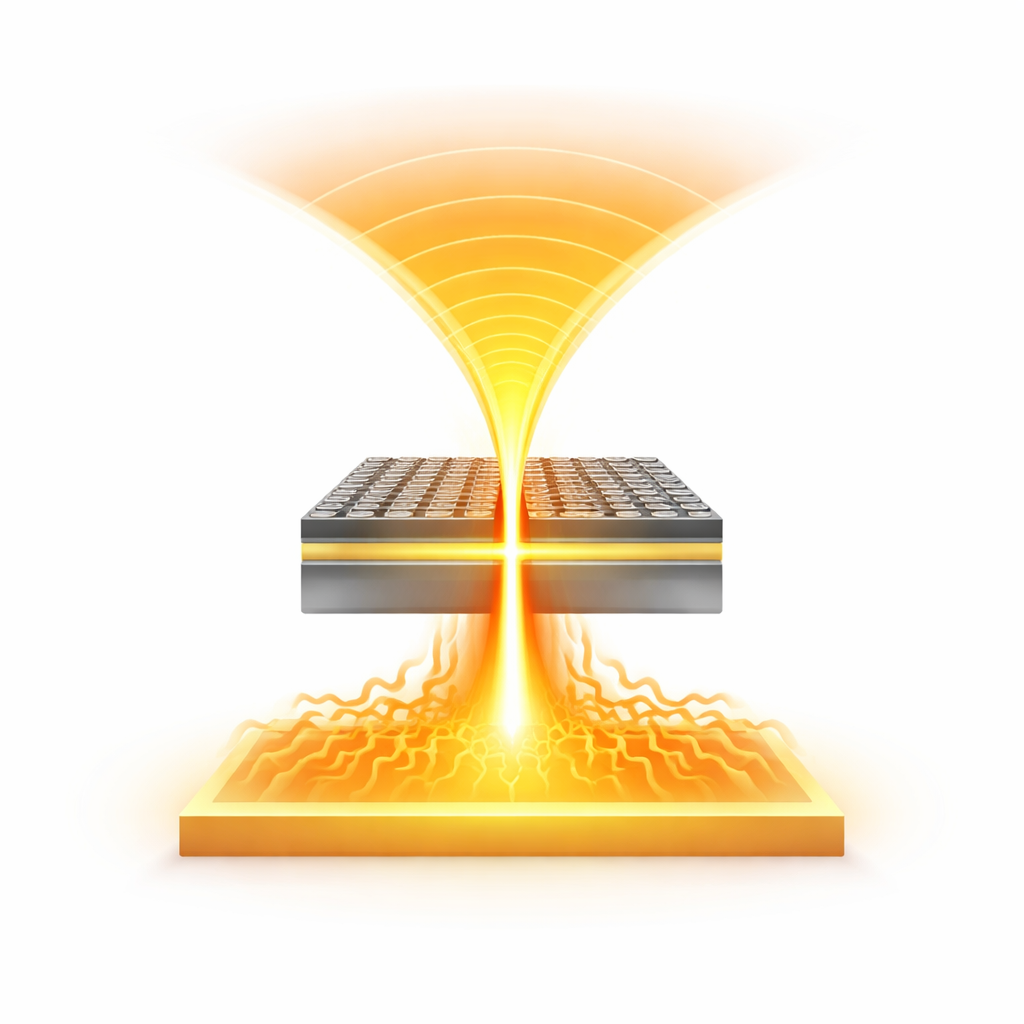
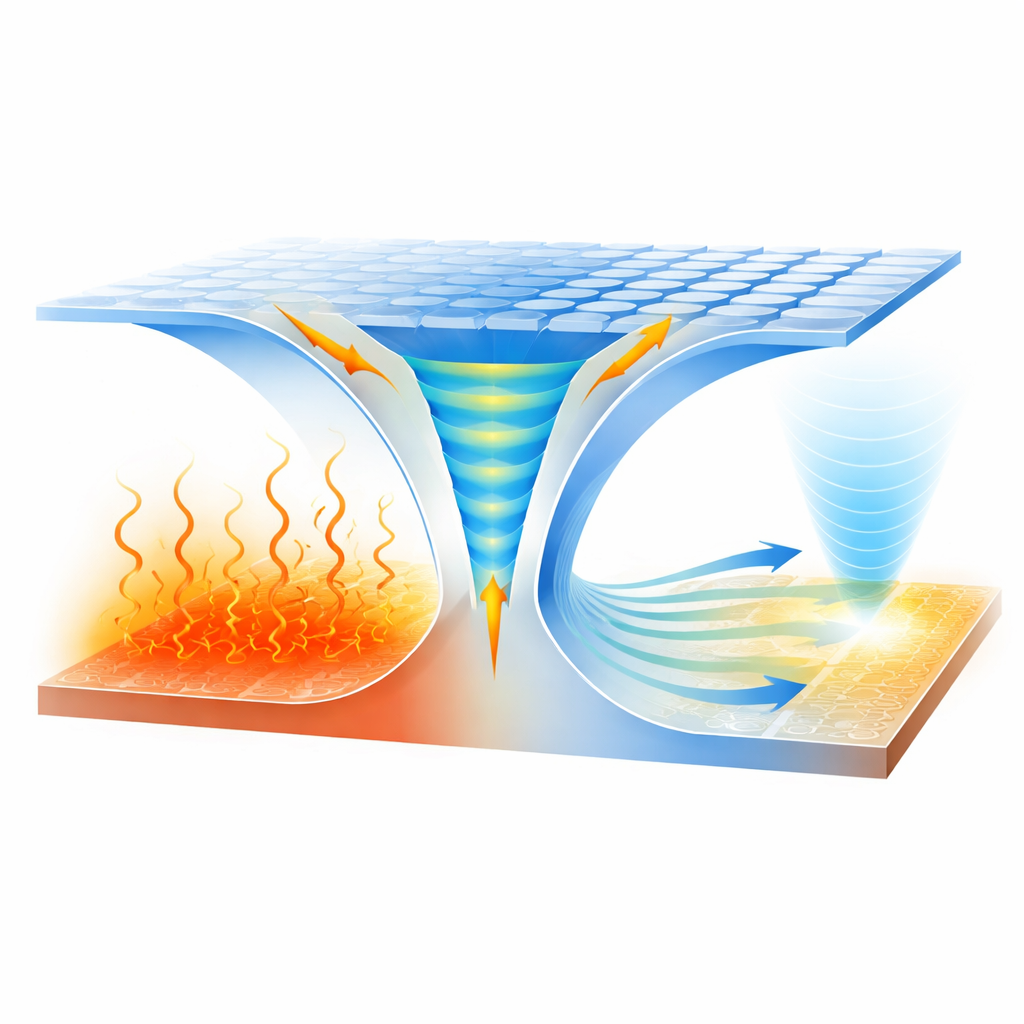
The authors propose a deceptively simple workaround: separate where heat is generated from where the outgoing wavefront is shaped, and connect them with a single, well-controlled channel. They call this a dual-funnel design. The lower “lossy” side absorbs thermal energy and converts it into surface waves that hug the metal, while the upper “lossless” side is engineered only to sculpt the phase of those waves. A narrow central waveguide—essentially a tiny tunnel—links the two. Inside this tunnel, a resonant cavity traps light for many cycles, greatly extending the lifetime of the photons and making them more coherent in time. When they leak out onto the top surface, they travel as engineered surface waves whose phase is now tightly correlated, so small scatterers on that surface can redirect the waves into almost any desired pattern without spoiling the resonance below.
From Theory to Focusing and Holograms
To make this concept practical, the team uses so‑called “spoof” surface plasmons: guided waves on corrugated metal that behave like plasmonic waves but at terahertz and infrared frequencies. By tuning the groove depth and spacing, they can control how fast these waves move and how far they travel before fading, independently of how long they live in the waveguide cavity. This independent tuning lets them convert temporal coherence (how long a wave keeps its phase) into spatial coherence (how far along the surface waves remain in step). In simulations and then in carefully machined copper devices, they design a one‑dimensional meta-emitter that focuses thermal radiation into a narrow line at a distance of about ten wavelengths from the surface, reaching nearly the diffraction limit—the sharpest possible focus allowed by physics—while maintaining strong brightness and low background noise.
Drawing Pictures with Heat
Beyond simple focusing, the same platform can draw images in thermal light using holography. On the top surface, the researchers carve groove patterns that scatter the coherent surface waves into predesigned intensity patterns in space, forming digits like “0,” “4,” “7,” and “8” when viewed with a terahertz detector. Clever use of polarization—waves vibrating in different directions—and multiple input slits allows the same chip to encode several holograms that can be switched on demand by exciting different channels, a form of spatial and polarization multiplexing. Because the thermal light is only moderately coherent rather than perfectly laser-like, these holograms appear clean and largely free of the speckle noise that often plagues laser-based holography.
What This Means for Future Technologies
The dual-funnel meta-emitter shows that it is possible to start from something as unruly as heat and turn it into highly structured light fields, including tightly focused spots and multiplexed holograms, without resorting to bulky optics or powerful lasers. By further refining the central cavity and surface wave design, the authors predict that coherence lengths a thousand times the wavelength are achievable, enabling even more intricate thermal wavefronts. Such compact, temperature-driven light sources could underpin new generations of energy‑efficient wireless links, secure mid‑infrared anti-counterfeiting labels, and miniature thermal imaging systems, bringing information-rich photonics closer to the everyday world of heat and temperature.
Citation: Chen, R., Chen, T., Liu, M. et al. Ultra-coherent meta-emitter tailors arbitrary thermal wavefront. Nat Commun 17, 2210 (2026). https://doi.org/10.1038/s41467-026-69088-7
Keywords: thermal radiation, metasurface, coherent emission, terahertz photonics, thermal holography