Clear Sky Science · en
Prolonged cooling and degassing of Apollo 17 volcanic glasses on the lunar surface
Why Moon Glass Matters
On the Moon, tiny colorful glass beads hold clues to how our nearest neighbor formed, how long it stayed volcanically active, and even how it may have briefly held a whisper‑thin atmosphere. This study focuses on orange volcanic glass collected by Apollo 17 and asks a simple but profound question: how long did these beads stay hot and leaking gas after they erupted? The answer reshapes our view of lunar eruptions and the way water and other gases cycle on the airless Moon.
Fire Fountains on an Airless World
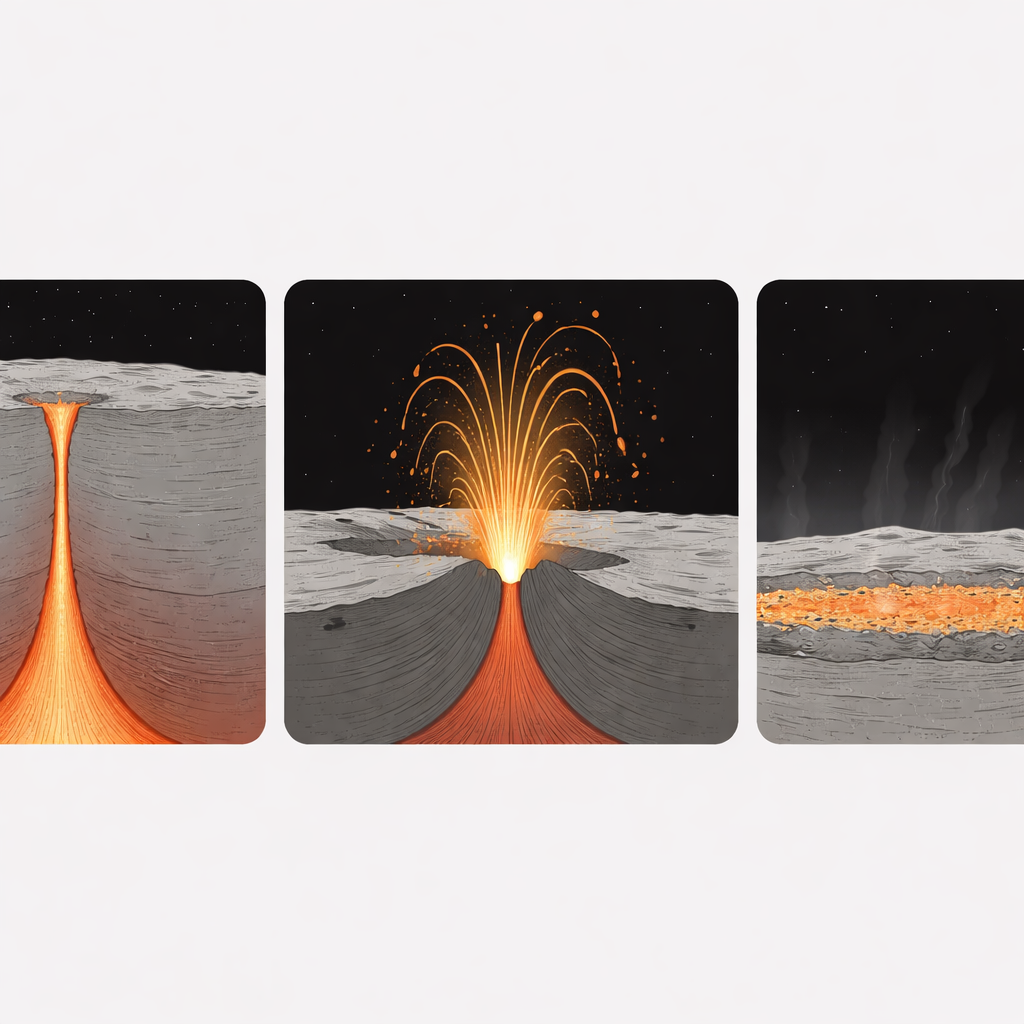
Unlike the broad lava seas that form the dark lunar “maria,” some Moon eruptions behaved more like giant fire fountains, blasting sprays of molten droplets into space. As these droplets cooled, they turned into glass beads with vivid colors that reflect their chemical makeup and the depths from which they rose. Because they come from deep, primitive parts of the lunar mantle and are rich in easily evaporated elements, these beads are among the best natural recorders of the Moon’s interior and its hidden supply of water and other gases.
Tiny Time Capsules of Trapped Gas
The Apollo 17 sample known as 74220 is especially valuable because it contains three related types of material: glass beads fully exposed to space, narrow melt pockets fully trapped inside crystals, and partially open “melt embayments” that connect the interior melt to the outside. The fully trapped pockets preserve the original abundance of water, fluorine, chlorine, and sulfur before eruption. The partially open pockets and the exposed beads show progressively stronger loss of these gases. By comparing all three, the authors reconstruct how much gas escaped, and when. They find that water and chlorine were stripped away by more than 90 percent in many beads, far more than sulfur, which diffuses more slowly.
Too Much Degassing for a Brief Flight
Past work assumed that almost all gas loss happened while the droplets were in “free flight” after being hurled out of the vent—at most a few minutes before they landed. The authors tested this idea using detailed models of how gases diffuse through hot glass and escape from its surface as the droplets cool. They also modeled the long, 300‑micrometer‑scale melt embayment that cuts through one crystal, which should preserve a record of how quickly gases moved along it. In both cases, matching the severe loss of water, fluorine, chlorine, and sulfur required cooling and diffusion over many thousands of seconds—far longer than any realistic flight path allows. Even generous assumptions about faster diffusion could not bring the required times down to a few minutes.
Slow Baking Beneath Lunar Dust
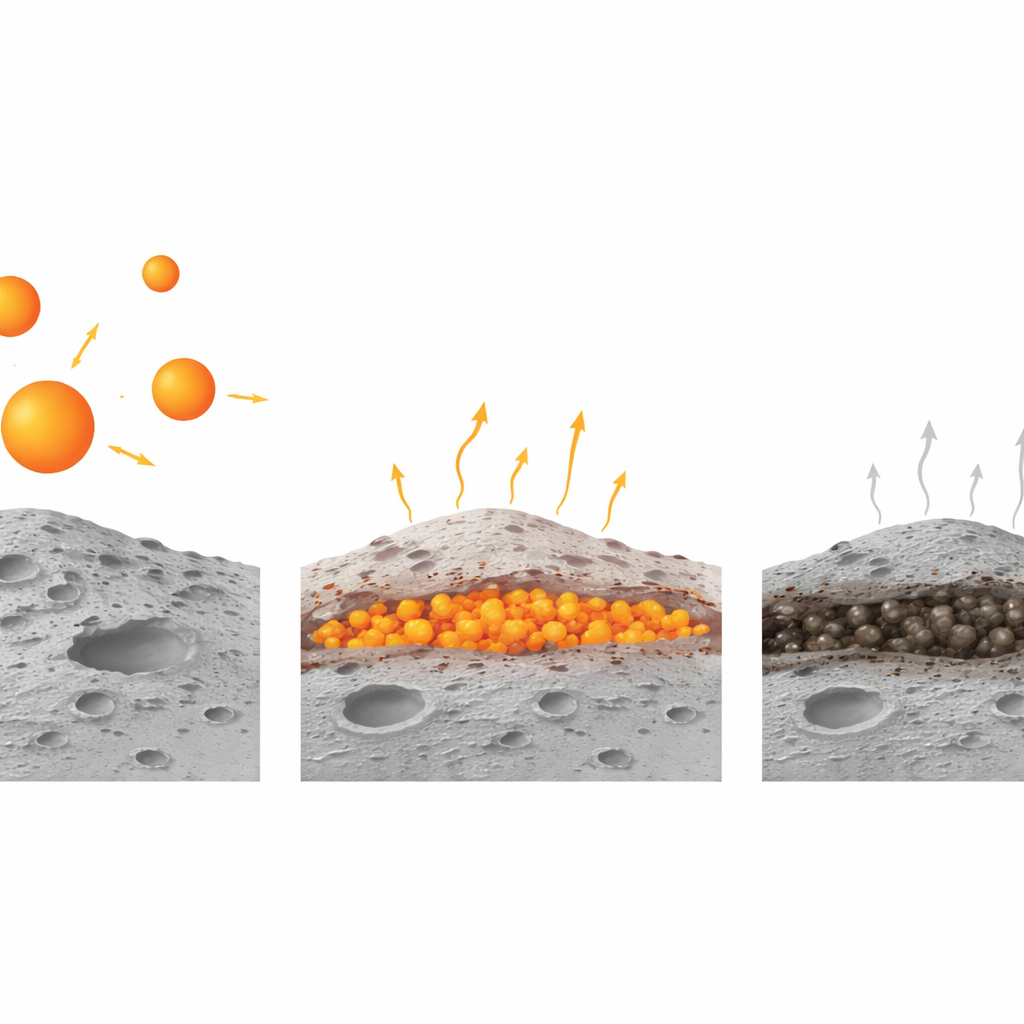
To resolve this mismatch, the authors considered what happens after the beads land. Lunar soil is extremely fluffy and a poor conductor of heat, so a thick blanket of hot glass mixed with dust can act like insulation. Thermal models show that orange glass buried only about 30 centimeters below the surface could linger near its “glass transition” temperature—hot enough for atoms to move slowly—for years. When the authors added a third stage of prolonged, warm burial to their models, letting beads and embayments stay near this transition temperature for roughly three years or more, the predicted gas losses finally matched the measurements. In this view, most of the degassing happens not in mid‑flight, but during a long, slow bake beneath the surface.
A Long-Lived Lunar Breath
The study concludes that Apollo 17’s orange glass deposit stayed hot and kept leaking gases such as water, sulfur, and halogens for years after the fire fountain eruption ended. Earlier‑buried beads likely cooled even more slowly, altering their textures and driving still more gas loss and later “ingassing” from overlying layers. This means that lunar pyroclastic deposits are not brief, one‑shot gas sources but long‑lasting emitters that could help sustain a thin, local atmosphere and feed volatile material toward the Moon’s permanently shadowed cold traps. In short, the Moon’s fiery fountains may have given way to a drawn‑out exhalation that quietly shaped its surface chemistry long after the last sparks faded.
Citation: Ni, P., Zhan, Y. Prolonged cooling and degassing of Apollo 17 volcanic glasses on the lunar surface. Nat Commun 17, 2291 (2026). https://doi.org/10.1038/s41467-026-69087-8
Keywords: lunar volcanism, pyroclastic glass beads, volatile degassing, Apollo 17, lunar atmosphere