Clear Sky Science · en
High-temperature probe of electron compressibility via asymmetric Coulomb drag
Listening to Electrons Without Touching Them
Modern electronics rely on how easily electrons can move through a material, but many of the most intriguing quantum effects barely show up in ordinary electrical measurements. This study introduces a way to "listen" to electrons in one ultrathin material by watching how they tug on a neighboring sheet, even when the first sheet itself seems quiet. The approach could help scientists probe fragile quantum behavior at much higher temperatures than before, opening doors to new sensors and interaction-based devices.
A Gentle Tug Between Two Electron Seas
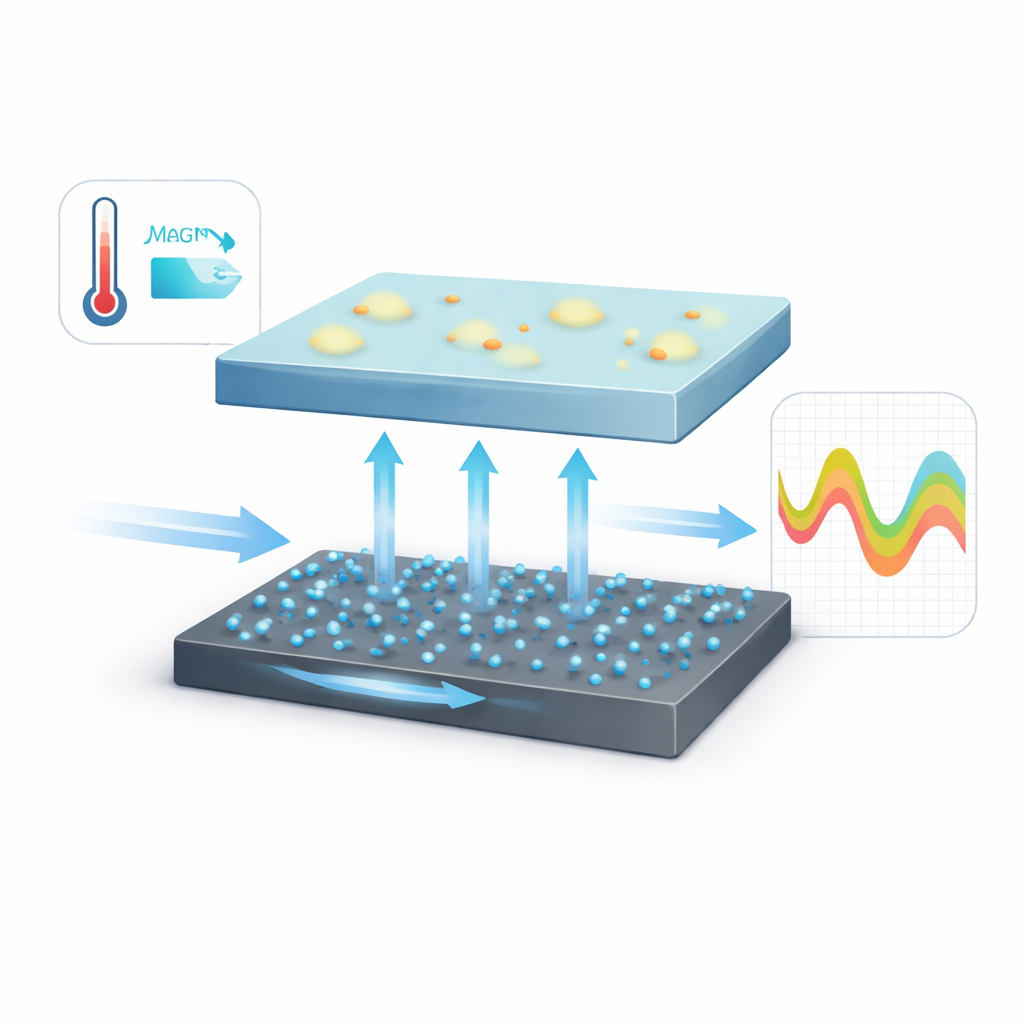
When two very thin conductors are placed close together, electrons moving in one sheet can pull on electrons in the other through their electric charge. This long-range interaction, called Coulomb drag, causes a small voltage or current in the passive layer even though no wires are directly driving it. Traditionally, researchers have used this effect to study how electrons exchange momentum and energy, or to look for exotic collective states where electrons in different layers pair up. In most earlier work, the two layers were deliberately made similar. Here, the team instead builds a strongly asymmetric pair to see whether that imbalance can be turned into an advantage.
Building an Unequal Quantum Sandwich
The researchers stack a single layer of graphene, where electrons behave like nearly massless particles, together with a thin semiconductor made of molybdenum disulfide (MoS2), whose electrons are heavy and sluggish by comparison. The two layers are separated by a sheet of hexagonal boron nitride only about 3 nanometers thick, thin enough that the layers feel each other’s electric fields but not so thin that electrons tunnel across. Using carefully engineered contacts and gate electrodes above and below, they can independently tune the number of electrons in each layer while keeping the MoS2 well behaved from less than a degree above absolute zero up to room temperature. This device geometry produces unusually strong drag: the induced current or voltage in the passive layer can reach a sizable fraction of the drive signal, far larger than in many earlier double-layer systems.
A New Window on Hidden Electron Stiffness
A central quantity in this work is electron “compressibility,” which describes how easily the electron density in a material changes when its energy landscape is nudged. In a strong magnetic field, graphene’s electrons condense into discrete Landau levels, causing its compressibility to oscillate as those levels fill and empty. Normally, such oscillations show up as Shubnikov–de Haas ripples in the material’s resistance, but at higher temperatures these ripples blur away. In the MoS2 layer, by contrast, the compressibility stays almost constant under the same conditions because its own quantum levels are washed out. This contrast turns MoS2 into a flat, quiet background that can faithfully transduce changes happening only in graphene.
Seeing Quantum Ripples When Transport Looks Flat
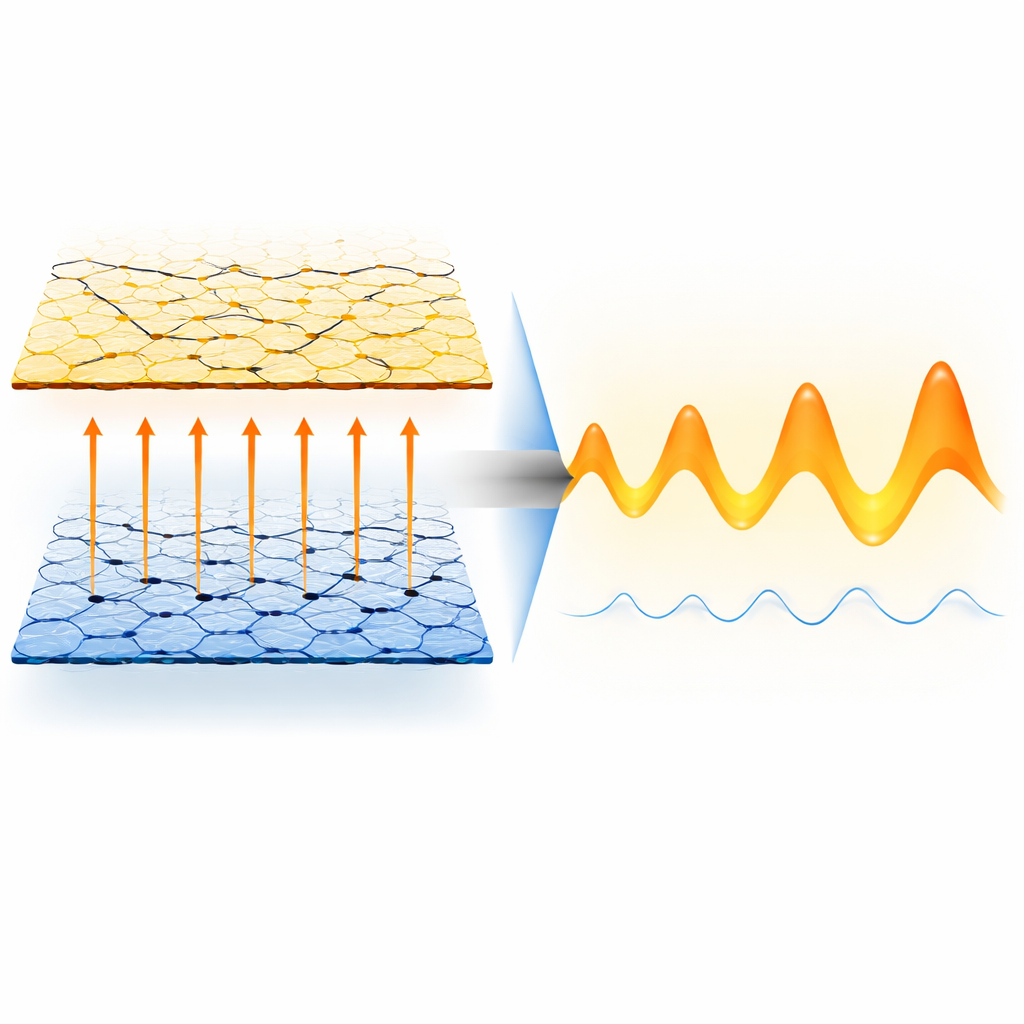
By driving current in one layer and reading out the drag signal in the other while sweeping temperature, gate voltages, and magnetic field, the team maps how the drag resistance behaves. At low temperatures the drag grows roughly with the square of temperature, a hallmark of a standard Fermi liquid where electrons behave like weakly interacting quasiparticles. As temperature rises, the behavior gradually crosses over to a more linear trend, and eventually the drag fades when MoS2 becomes too insulating to support carriers. Most strikingly, at around liquid nitrogen temperature, ordinary measurements of graphene’s resistance barely show any quantum oscillations in field, yet the drag voltage measured in MoS2 still reveals clear, periodic ripples. These oscillations match the spacing expected from graphene’s Landau levels and can be over an order of magnitude easier to detect than graphene’s own signal at the same temperature.
Tuning and Extending the Quantum Probe
The strength of this effect depends on how closely the layers are spaced and how many electrons they contain. Thinner spacers lead to larger drag signals and more pronounced oscillations, confirming that strong interlayer coupling is essential. By tracking how drag changes when the carrier densities in the two layers are matched, the researchers find behavior consistent with theoretical predictions for a “massless–massive” electron pair, further supporting a Fermi-liquid picture. Because MoS2 acts mainly as a constant-compressibility partner while graphene carries the oscillations, the concept could in principle be extended to other flat-response semiconductors stacked with more delicate quantum materials.
Why This Matters for Future Devices
To a non-specialist, the key message is that the team has built a kind of stethoscope for electrons. Instead of listening to a material’s own electrical heartbeat directly, they eavesdrop on how its electrons push and pull on a neighboring, calmer layer. This lets them read out subtle quantum oscillations in graphene at temperatures where they would normally vanish from simple resistance measurements. The work establishes asymmetric Coulomb drag as a practical form of “compressibility spectroscopy” for atomically thin materials, providing a new way to access hidden quantum states and suggesting design principles for next-generation sensors and electronic components that harness, rather than avoid, strong electron–electron interactions.
Citation: Liu, Y., Yang, K., Wang, H. et al. High-temperature probe of electron compressibility via asymmetric Coulomb drag. Nat Commun 17, 2393 (2026). https://doi.org/10.1038/s41467-026-69086-9
Keywords: Coulomb drag, graphene, MoS2, quantum oscillations, two-dimensional materials