Clear Sky Science · en
Constructing scalable hydrophobe–water micro-interfaces for catalyst-free generation of H2O2 via macroporous resins
Why Making Peroxide from Plain Water Matters
Hydrogen peroxide is a workhorse chemical, used to disinfect wounds, bleach paper, clean water, and even help run certain fuel cells. Today it is mostly made in giant factories using an energy‑hungry, waste‑producing method that depends on costly metal catalysts. This study explores a radically simpler idea: can we coax ordinary water and oxygen from air to slowly turn into hydrogen peroxide on their own, using only inexpensive plastic beads and gentle stirring?
Tiny Meeting Places Between Water and Plastic
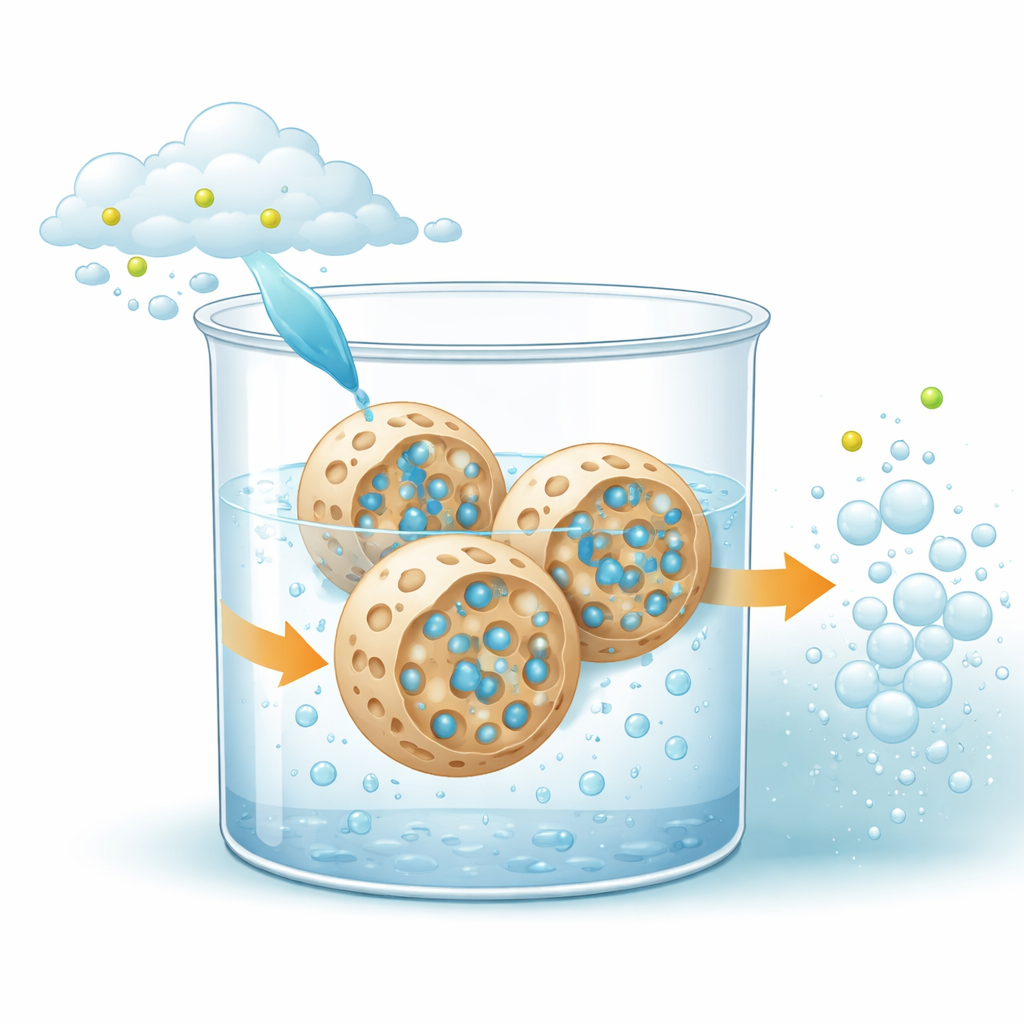
The researchers focus on special plastic beads called macroporous resins. These off‑the‑shelf materials are full of interconnected holes ranging from nanometers to micrometers in size, giving each bead a huge inner surface. The walls of these pores are water‑repelling, or hydrophobic, much like a nonstick pan. When the beads are stirred in water, they do more than just float around: they grab and hold countless tiny pockets of water inside their pores while also trapping small amounts of air or oxygen. Each pocket becomes a microscopic meeting place where water, oxygen, and the hydrophobic surface interact, creating what the authors call hydrophobe–water micro‑interfaces.
From Beads and Air to Measurable Peroxide
By simply stirring 20 milligrams of these resins in less than a milliliter of water under normal room air, the team measured a steady formation of hydrogen peroxide over many hours and days. The best-performing resins, made from a common plastic backbone (polystyrene crosslinked with divinylbenzene), produced peroxide at a rate of about 0.51 micromoles per gram of resin per hour. Left to run for a week, the small test tubes reached around 1 millimolar peroxide—roughly a thousand times higher than earlier attempts that relied on brief‑lived airborne water droplets. Screening many different materials showed two clear requirements: a large internal surface area from the porous structure, and a water‑repelling surface. Non‑porous plastics or hydrophilic (water‑loving) solids made much less peroxide under the same conditions.
Probing What Really Drives the Reaction
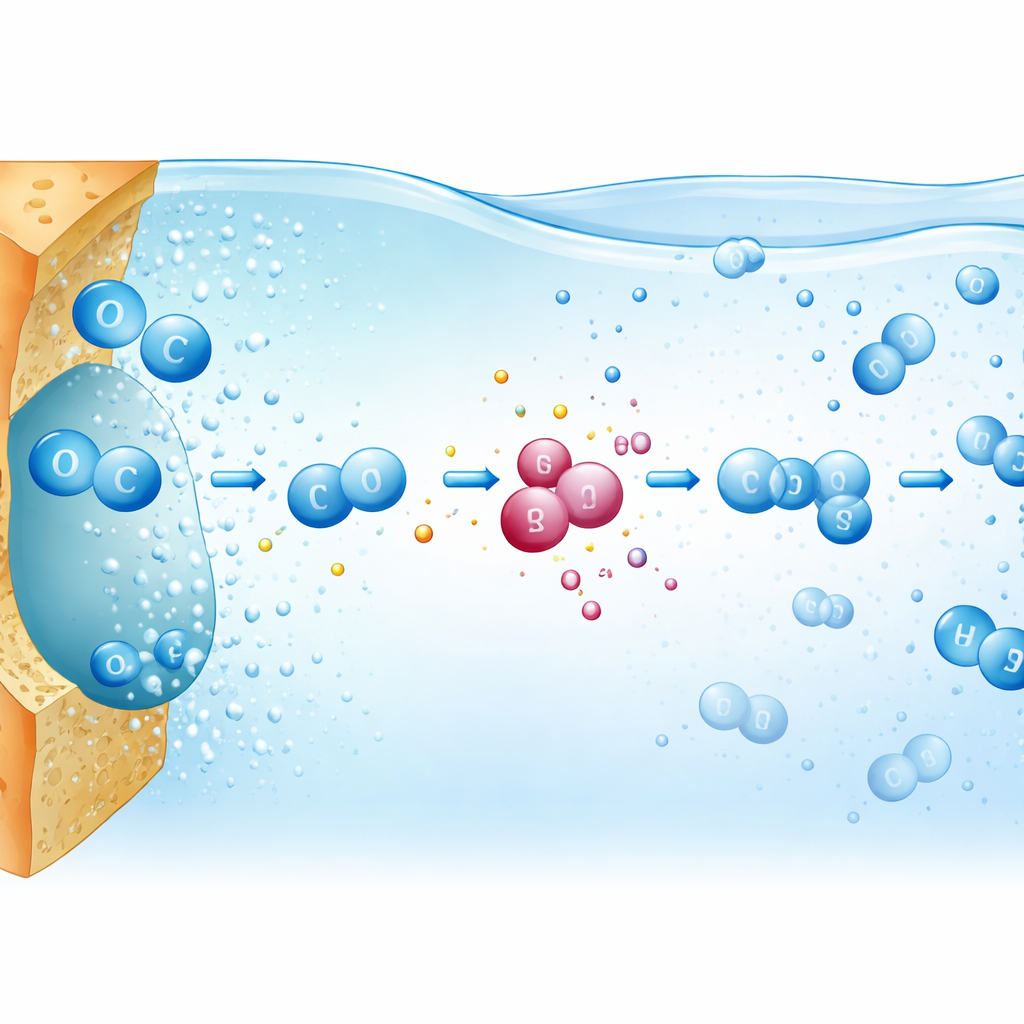
To understand how this quiet chemistry works, the authors used isotope‑labeling tests, radical scavengers, and spectroscopy. Labeling experiments showed that the oxygen atoms in the produced hydrogen peroxide come almost entirely from dissolved oxygen gas, not from splitting water molecules, strongly pointing to an oxygen reduction pathway. Additional tests detected fleeting reactive species—such as short‑lived radicals and extra electrons—near the resin–water interfaces. Together the evidence supports a picture where the interface helps separate charges and shuttles electrons to oxygen, turning it stepwise into hydrogen peroxide. The reaction works best in mildly alkaline water (around pH 9) and continues without any added light, electric current, or metal catalysts. Interestingly, although a small amount of more aggressive radicals also appears, they are far less abundant than peroxide and may arise mainly as side reactions.
Built‑In Robustness in Salty, Hot, and Large Systems
For any real‑world use, such a system must tolerate impurities, salts, and scale‑up. The macroporous resins pass these tests surprisingly well. Concentrated salts like sodium chloride and sodium sulfate barely reduce the peroxide output, and even tap water and simulated seawater only modestly slow it down. Heating the resins to 300 degrees Celsius for several hours leaves their activity largely unchanged, revealing a rugged material. In a one‑liter tank loaded with 100 grams of resin and mixed by a simple mechanical stirrer, peroxide builds up steadily over a week to more than 100 micromolar, despite less efficient stirring than in the small vials. The peroxide can then be separated from the solid beads by straightforward filtration.
What This Means for Everyday Uses
In plain terms, this work shows that common porous plastic beads can quietly turn air and water into useful amounts of hydrogen peroxide, without complicated equipment or added catalysts. While the production is slow compared with industrial plants, the method is simple, continuous, and potentially powered by natural motion such as waves, tides, or wind‑driven mixers. That makes it attractive for decentralized uses—like onboard disinfection on ships, remote water treatment, or small on‑site chemical supplies—where transporting concentrated peroxide is difficult or unsafe. More broadly, the study illustrates how carefully designed microscopic contact zones between solids, water, and gases can host unusual, energy‑saving chemistry that might one day complement or partially replace conventional large‑scale processes.
Citation: Gao, J., Zhou, K., Guo, X. et al. Constructing scalable hydrophobe–water micro-interfaces for catalyst-free generation of H2O2 via macroporous resins. Nat Commun 17, 2692 (2026). https://doi.org/10.1038/s41467-026-69085-w
Keywords: hydrogen peroxide, porous resins, interface chemistry, green synthesis, oxygen reduction