Clear Sky Science · en
Deep learning drives autonomous molecular reactions with single-bond selectivity in tetra-brominated porphyrins on Au(111)
Teaching Machines to Tweak Molecules One Bond at a Time
Chemists have long dreamed of steering reactions with the precision of a watchmaker, changing exactly one bond in exactly one molecule on command. This study shows how artificial intelligence can take a big step toward that dream: a computer-controlled system that finds individual molecules on a surface and breaks chosen chemical bonds on its own, without human hands on the knobs. That kind of control could eventually let us "write" new materials atom by atom and explore exotic molecular structures that normal test-tube chemistry cannot easily reach.
Why Single Bonds Matter
Most chemical reactions happen in bulk: countless molecules collide and rearrange according to broad rules of thermodynamics and kinetics. While this works well for many applications, it is like trying to sculpt marble with a hammer instead of a fine chisel. If scientists could pick out a single bond in a single molecule and decide whether it stays or breaks, they could build custom molecular patterns for next-generation electronics, quantum devices, and ultra-dense data storage. Scanning tunneling microscopes (STMs) already let experts image and poke individual molecules on metal surfaces with atomic resolution. But until now, performing these reactions has relied on human intuition and patience, limiting how reproducible, scalable, and programmable the process can be.
Turning the Microscope into a Self-Driving Lab
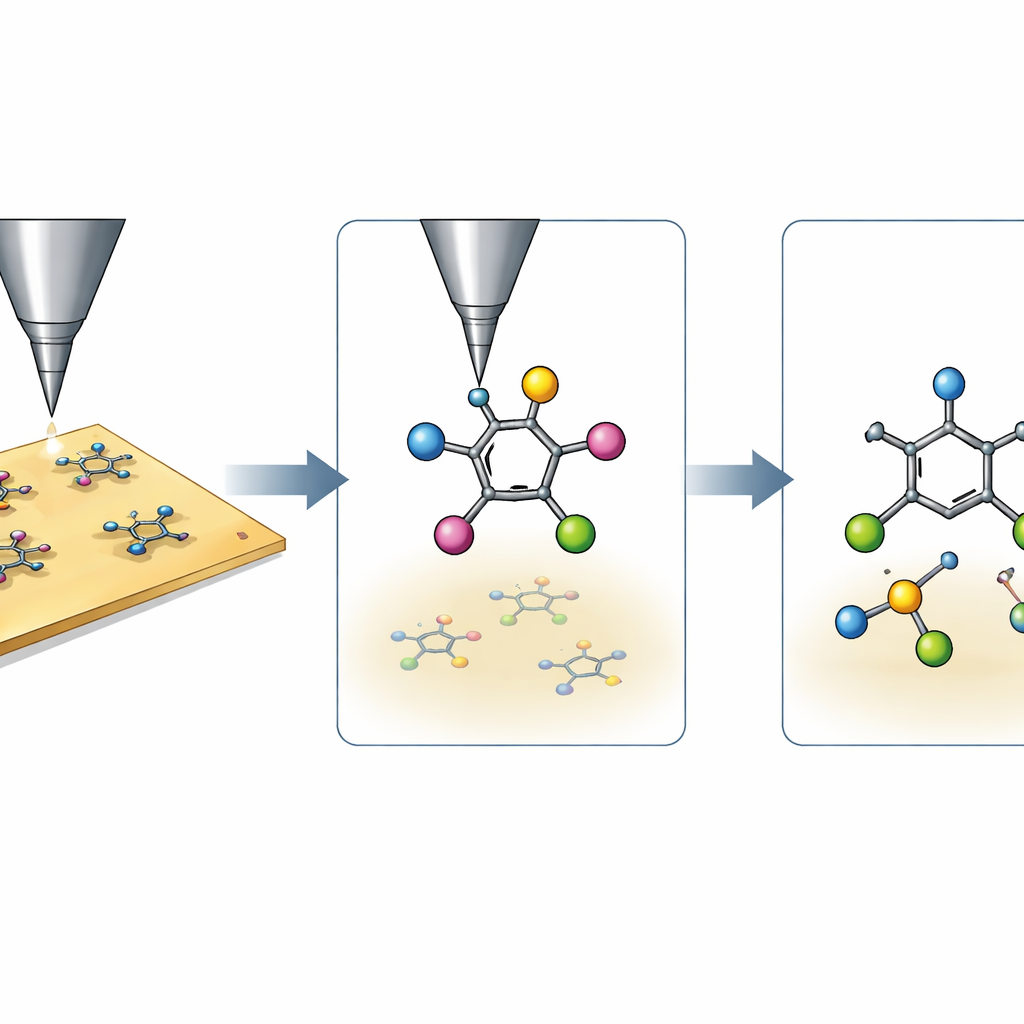
The authors transform a conventional STM into a kind of self-driving chemical lab by layering multiple deep learning tools on top of the instrument. First, a computer-vision module surveys large areas of a gold surface to automatically spot isolated target molecules, then zooms in for a close-up view. Additional neural networks trace each molecule’s outline, determine its orientation, and inspect four specific corners where bromine atoms sit. By analyzing small image patches at these corners, the system decides whether each bromine is still attached or has been removed in a previous step, effectively keeping track of the molecule’s "bond-by-bond" status without a human operator interpreting the images.
An AI Agent that Learns How to Break Bonds
Once the molecule is recognized and its current state is known, a reinforcement learning agent chooses how to act. It treats each attempted bond break as a move in a complex game, where the STM tip position, voltage, and current are its moves, and the resulting molecular change is the feedback. The system encodes the four bond states as a simple four-bit pattern and adds a code for which overall pathway it aims to follow. Using a modern algorithm called soft actor-critic, the agent gradually learns which combinations of tip placement and electrical pulse lead to a clean break of a single carbon–bromine bond, which cause nothing to happen, and which damage or overreact the molecule. A narrow safe-and-effective window exists, and early in training most attempts fail, but by replaying and augmenting its experiences, including taking advantage of the molecule’s fourfold symmetry, the agent converges on reliable strategies.
Programming Multi-Step Molecular Journeys
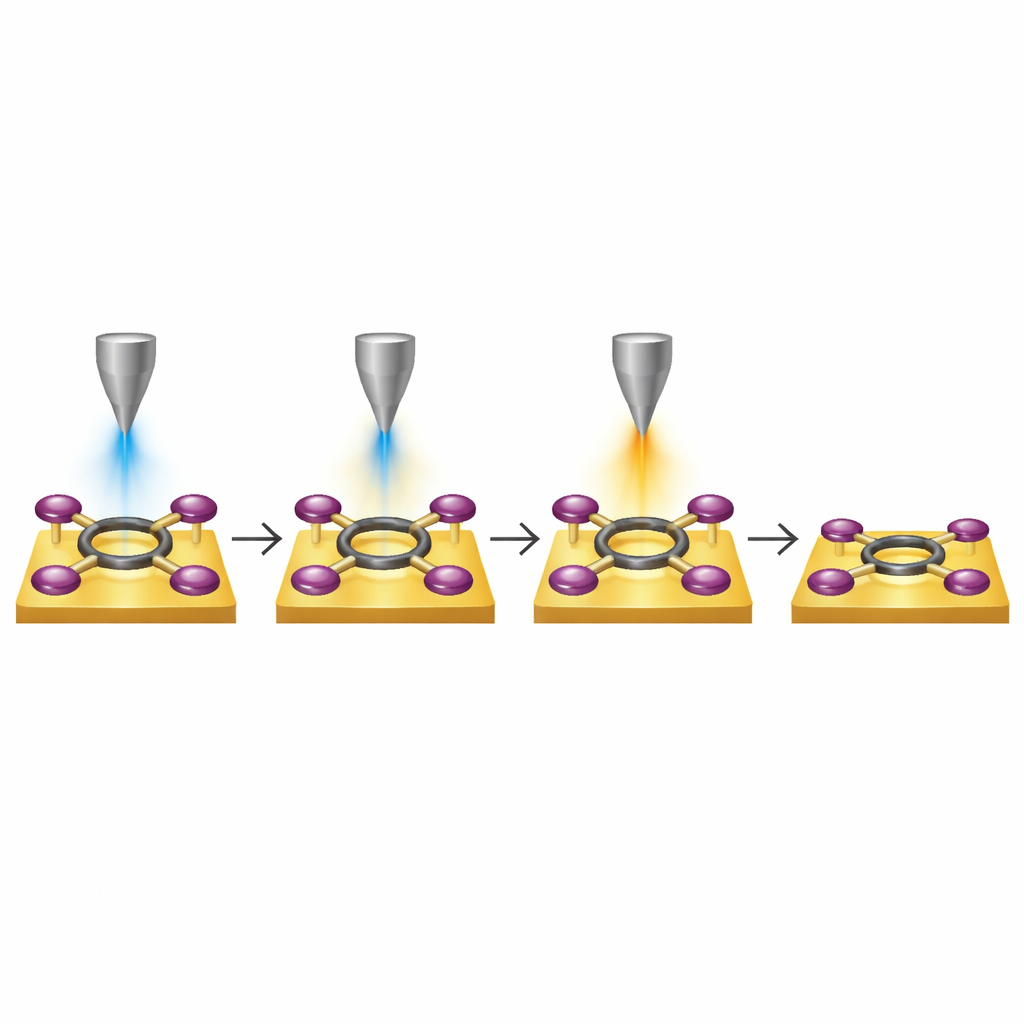
After about a day and a half of continuous training over hundreds of reaction attempts, the system can carry out multi-step, predesigned reaction routes with notable success. The testbed molecule, a tetra-brominated porphyrin on a gold surface, starts with four equivalent bromine-bearing arms. The AI is instructed to follow different stepwise patterns of bond removal—such as "orthogonal" or "zig-zag" sequences—each of which passes through distinct intermediate shapes before ending in a fully debrominated molecule plus four free bromine atoms on the surface. For each step, the agent automatically chooses where to position the tip, how strong a voltage pulse to apply, and how much current to use, checks the result with its vision system, and then decides what to do next. Over time it discovers that higher voltages are needed as more bromines are removed and that positioning the tip right above the target bond maximizes the chance of success.
From Single Events to Future Atom-by-Atom Manufacturing
The researchers ultimately show that their platform can repeatedly guide the molecule along four distinct reaction pathways while maintaining single-bond selectivity, achieving success rates that improve step by step and reach nearly 80% in the final bond-breaking stage. Just as important, the system adapts when the microscopic tip changes shape or behavior, quickly relearning the best settings rather than stalling. To a layperson, the key message is that the microscope is no longer just a passive viewer but an active, learning tool: it can find molecules, decide which bond to break, apply the right push, and verify the outcome on its own. This blend of precise instrumentation and AI control points toward a future where scientists can program complex, atomically accurate fabrication tasks, using software agents to build and explore custom molecular structures that would be nearly impossible to craft by hand.
Citation: Zhu, Z., Huang, Q., Yang, T. et al. Deep learning drives autonomous molecular reactions with single-bond selectivity in tetra-brominated porphyrins on Au(111). Nat Commun 17, 2348 (2026). https://doi.org/10.1038/s41467-026-69080-1
Keywords: autonomous chemistry, single-molecule reactions, scanning tunneling microscopy, deep reinforcement learning, on-surface synthesis