Clear Sky Science · en
Tracking country-level mitigation progress using NGHGI-consistent carbon budgets
Why this matters for every country
When governments promise to cut greenhouse gases, they rarely say how much carbon dioxide they still plan to emit in total. This article tackles that gap by asking a simple but pressing question: how large is each country’s fair “carbon budget” if the world is to keep warming within the Paris Agreement limits—and are countries already overspending it? The authors show that once you count emissions the same way governments officially report them, the global and national room left to emit CO2 is even smaller than many people think.
How much carbon is really left to burn?
Climate scientists often talk about a global “remaining carbon budget”: the total amount of CO2 humanity can still emit while keeping warming below a chosen temperature, such as 1.5 °C. These numbers are usually based on climate model conventions used by the IPCC, which treat certain land and ocean CO2 uptakes as natural. But governments report and plan their emissions under a different set of rules, the national greenhouse gas inventory (NGHGI) guidelines. The authors show that if you want to compare national pledges with remaining carbon budgets in a fair way, you must first translate the global budget into this NGHGI language—and doing so shrinks the budget substantially. 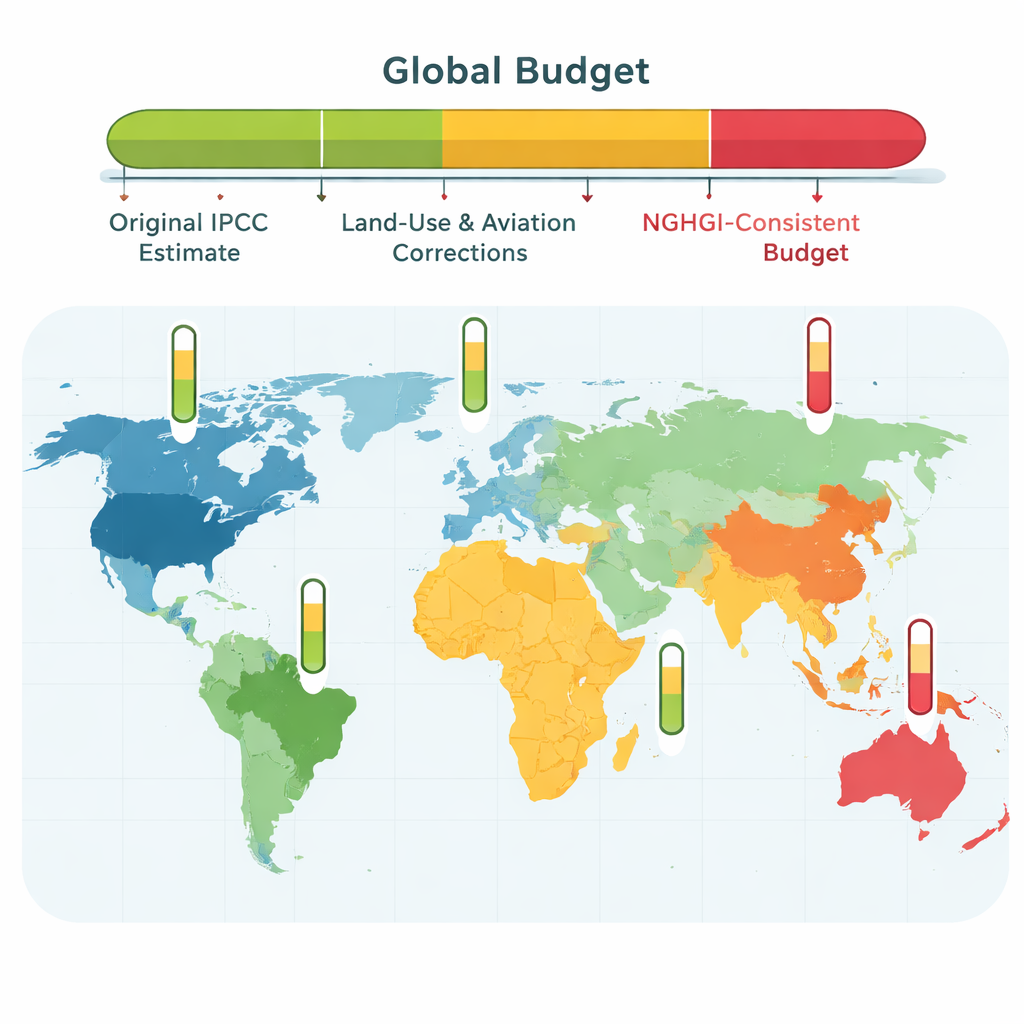
Why accounting rules change the answer
Two technical but crucial bookkeeping issues drive this shrinkage. First, models and national inventories draw the line between human-caused and natural land-use CO2 differently, especially for forests and farmland. Inventories often credit countries with large CO2 “removals” on managed land that models treat as part of the natural carbon sink driven by higher CO2 and a warming climate. Second, emissions from international aviation and shipping are typically left out of national totals even though they add to global warming. When the authors correct for both effects, the 2024 global 1.5 °C (50% chance) carbon budget falls by roughly half, to about 109 billion tonnes of CO2, and the 2 °C (66% chance) budget drops by about a fifth. At current emissions rates, this tighter 1.5 °C budget is exhausted around 2027.
Dividing a shrinking pie among nations
Translating the global budget into national fair shares is not just a math exercise; it is also an ethical and political choice. The study explores a range of established allocation methods, including simple equal-per-person shares, approaches that factor in countries’ economic capacity, and methods that adjust for historical responsibility since 1990 or earlier. Using the NGHGI-aligned global budget, the authors compute time-varying national carbon budgets for almost all countries and many sharing rules. They find that, although the accounting correction can significantly reduce some countries’ budgets, the biggest differences usually arise from the value judgments behind each allocation method—for example, whether past emissions or consumption-based emissions are counted.
Who is already over budget?
By tracking how these national budgets evolve over time, the study reveals growing carbon inequality. Under a set of “fair-share” methods that reflect UN climate equity principles, the United States’ 1.5 °C budget turns negative around 2000, meaning it has long overshot its fair share. China’s budget begins to deplete faster than the global average after about 2010, while low-income countries such as Nigeria retain positive budgets under most methods. Globally, only Africa, Asia, and Central America had not yet used up their collective fair shares of the 1.5 °C budget by 2022. The authors estimate that, by 2025, between 64 and 85 countries—representing roughly one quarter of the world’s population and about half of global GDP—will have exceeded their fair-share 1.5 °C budgets. 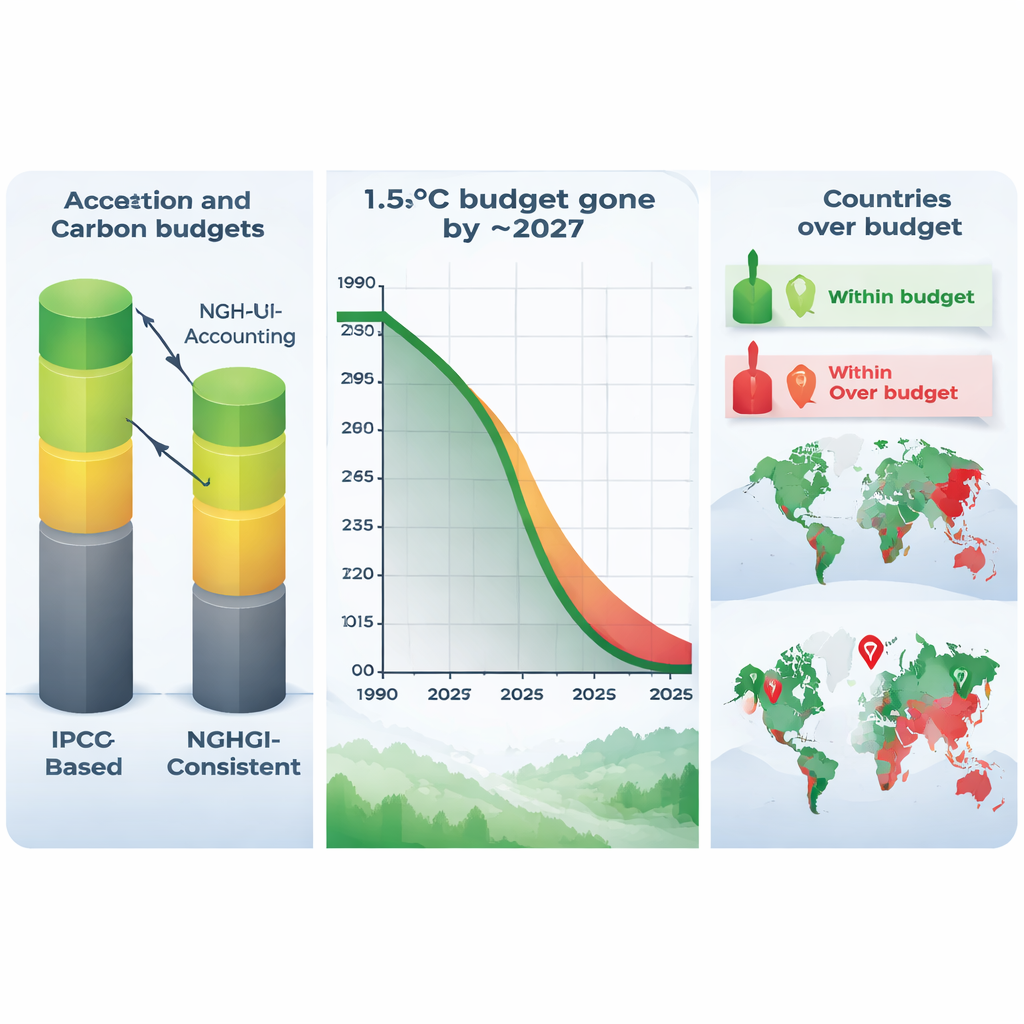
What this means for climate promises and courts
The authors also examine Switzerland, a country at the center of a landmark European Court of Human Rights case on climate protection. They show that when the global budget is corrected to match NGHGI rules and updated science, Switzerland’s fair-share 1.5 °C budget becomes much smaller than the emissions implied by its national climate plan, regardless of the sharing method used. More broadly, the study argues that while no single “right” way exists to split the global budget, any serious assessment of national climate targets—whether by policymakers, analysts, or courts—must start from accounting rules consistent with how countries actually report emissions. For lay readers, the core message is stark: the world’s carbon budget compatible with the Paris goals is rapidly vanishing, many nations are already in “carbon debt,” and honest, transparent accounting is essential for tracking who is truly doing their fair share.
Citation: Weber, K., Brunner, C. & Knutti, R. Tracking country-level mitigation progress using NGHGI-consistent carbon budgets. Nat Commun 17, 1494 (2026). https://doi.org/10.1038/s41467-026-69078-9
Keywords: carbon budget, climate policy, national emissions, Paris Agreement, climate justice