Clear Sky Science · en
Digitaria genome analyses indicate introgression may drive local adaptation and herbicide resistance
Why this weed story matters to farmers and food
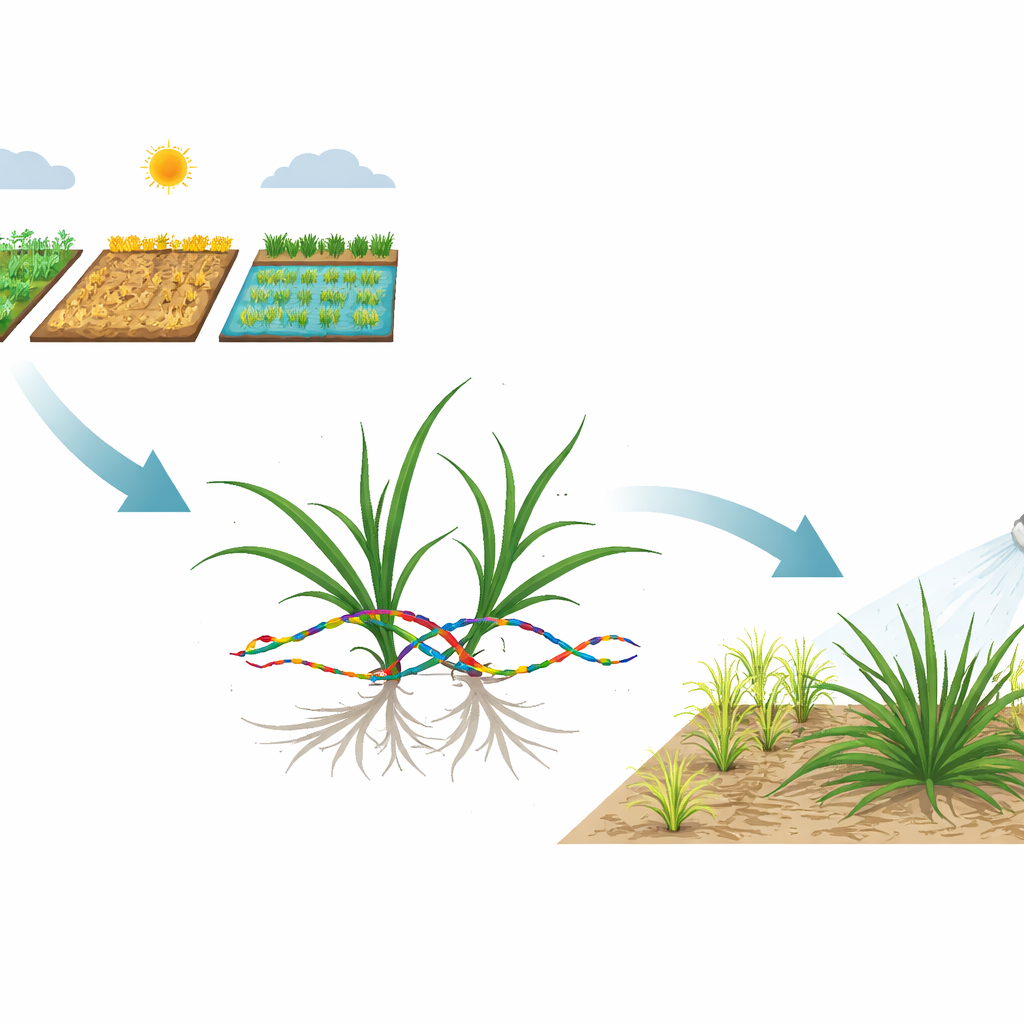
Large crabgrass might look like just another lawn nuisance, but in farmers’ fields it can be devastating, slashing harvests of corn, soybeans, and other grains by more than 90 percent. This study digs into the full genetic blueprint of crabgrass and its close relatives to ask two big questions with real-world consequences: what makes this weed so adaptable to different environments, and how is it evolving such stubborn resistance to herbicides? The answers reveal that crabgrass is not only a genetic heavyweight, but that it also borrows useful genes from neighboring species, helping it survive cold, drought, and chemical attacks.
Building a complete map of a superweed
The researchers began by decoding, nearly end to end, the genome of large crabgrass (Digitaria sanguinalis). They also assembled genomes for its likely ancestors: one species with two sets of chromosomes and another with four. Crabgrass itself carries six sets, making it a “hexaploid.” Having multiple copies of every gene can give plants extra flexibility to tinker with traits like stress tolerance without breaking essential functions. The team confirmed that their genome maps were highly accurate and showed that most of crabgrass’s chromosomes line up neatly with those of its ancestors, revealing how its three subgenomes were stitched together over the past million years.
Genes tuned for life in disturbed fields
When the authors compared crabgrass with crops and other weedy grasses, they saw a striking pattern. Crabgrass and its relatives had shed many classic disease-resistance genes, which in crops help fight infections but can be costly to maintain. At the same time, crabgrass showed an expansion of gene families involved in coping with stress and breaking down foreign chemicals. These include enzymes that modify toxic molecules so they can be safely removed from cells, as well as regulators that help the plant adjust to shade and variable light. Together, this genetic toolkit appears tailor-made for life in plowed, fertilized, and chemically treated fields, where fast growth and tolerance to human-made disturbances are more important than long-term defense against natural enemies.
A nationwide survey of hidden diversity
The team then resequenced 579 crabgrass and related Digitaria plants collected from 24 grain-growing provinces across China. By combining genome data with careful measurement of traits like seed size and leaf shape, they sorted the samples into two broad groups of species and, within crabgrass itself, four distinct varieties. These varieties tend to dominate different regions of China—from cold northeastern provinces to warm, humid southern areas—and differ in features that likely influence how they compete with crops and spread via seed. Genetic analyses showed that crabgrass populations have been reshaped over tens of thousands of years, with some lineages passing through bottlenecks while others remained stable, and that in recent decades local populations have become more genetically mixed, probably helped along by modern farming and seed movement.
Borrowing genes to match local climates
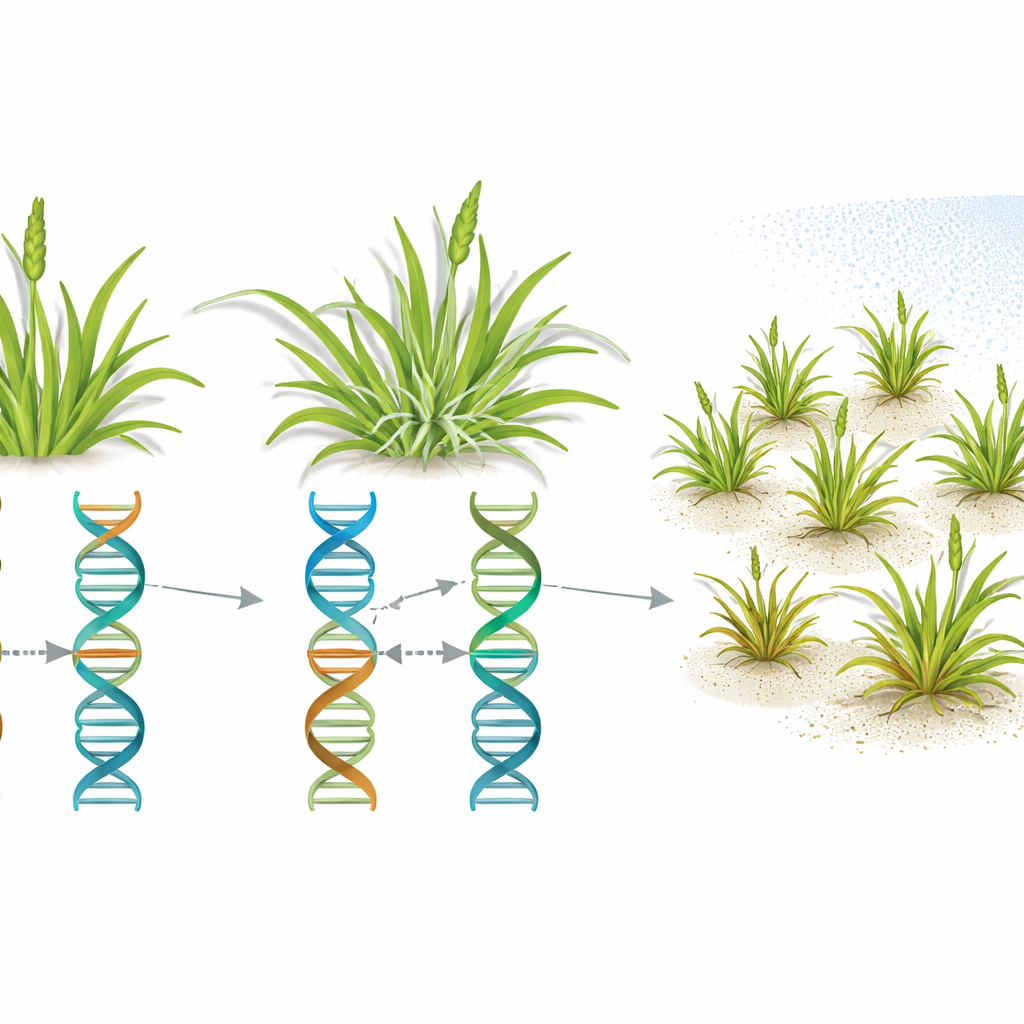
One of the most intriguing findings is that crabgrass shares genes with its close cousin Digitaria ciliaris, which often grows in the same fields. Using statistical tests that can distinguish recent gene flow from older shared ancestry, the authors detected extensive “introgression”—the movement of DNA from one species into another’s gene pool. In several regions of the genome, crabgrass individuals in certain climates carried DNA segments that match local D. ciliaris plants better than other crabgrass. Some of these borrowed segments contain clusters of genes known from rice and other crops to aid in coping with cold or heat. For example, at one region linked to winter temperature, different versions of a cold-response gene form clear north–south patterns, suggesting that gene sharing has helped crabgrass fine-tune its performance to local weather.
Escaping herbicides through shared defenses
The study also tackles why a widely used herbicide called nicosulfuron is losing its punch. By testing 196 populations over a decade, the researchers showed that resistance levels in crabgrass have climbed sharply, with many plants now surviving doses higher than those recommended for field use. Surprisingly, classic mutations in the herbicide’s direct target—changes that usually block the chemical from binding—were rare and at low frequency. Instead, a genome-wide scan linked resistance to many different genes involved in detoxifying chemicals. One standout gene, called DsSOH1, showed both herbicide-induced activity and a strong association between a particular DNA variant and high resistance. Detailed evolutionary modeling and local family trees pointed to this resistant version having recently entered crabgrass from D. ciliaris, then spreading through crabgrass populations under the pressure of repeated spraying.
What this means for managing tough weeds
Taken together, the work paints crabgrass as a highly adaptable “genetic sponge”: it carries extra copies of many genes, reshapes its genome after whole-genome duplication, and readily absorbs helpful DNA from neighboring species. This combination allows it to adjust to new climates and agricultural practices at remarkable speed, including evolving complex, multi-gene resistance to herbicides rather than relying only on single-point mutations. For farmers and weed scientists, the message is clear: relying on one or two chemical tools invites weeds like crabgrass—and their relatives—to trade and refine resistance genes. Sustainable control will likely require a mix of strategies, including rotating herbicides with different modes of action, integrating non-chemical methods such as crop rotation and mechanical control, and closely monitoring weed populations using the kind of genomic insights provided by this study.
Citation: Huang, Y., Li, J., Li, Z. et al. Digitaria genome analyses indicate introgression may drive local adaptation and herbicide resistance. Nat Commun 17, 2669 (2026). https://doi.org/10.1038/s41467-026-69076-x
Keywords: weed genomics, herbicide resistance, adaptive introgression, crabgrass, weed management