Clear Sky Science · en
Bell correlations between momentum-entangled pairs of 4He* atoms
Spooky action with heavy atoms
When we hear about the weirdness of quantum mechanics, it is often in the context of light: particles of light (photons) that seem to influence each other instantly over a distance. But if quantum theory really is universal, the same strange behavior should also show up in chunks of matter – actual atoms with mass that fall under gravity like anything else. This article reports a landmark step in that direction: it shows that pairs of ultracold helium atoms can share “spooky” correlations in their motion that defy any explanation based on ordinary local causes.
Why distant particles can share a fate
For decades, physicists have used a mathematical test called Bell’s inequality to ask whether the world is governed by hidden local rules, or whether nature truly allows nonlocal connections between particles. Experiments with light and with the internal states of atoms have repeatedly shown that these inequalities are violated, favoring the quantum picture of entanglement. However, almost all of those tests dealt with properties like polarization or spin – internal settings on a particle – rather than with the particle’s actual motion through space. Demonstrating Bell-type correlations in how massive particles move is crucial if we want to probe how quantum theory meshes with gravity and with our everyday experience of objects that have weight and momentum.
Smashing cold atom clouds to make twin partners
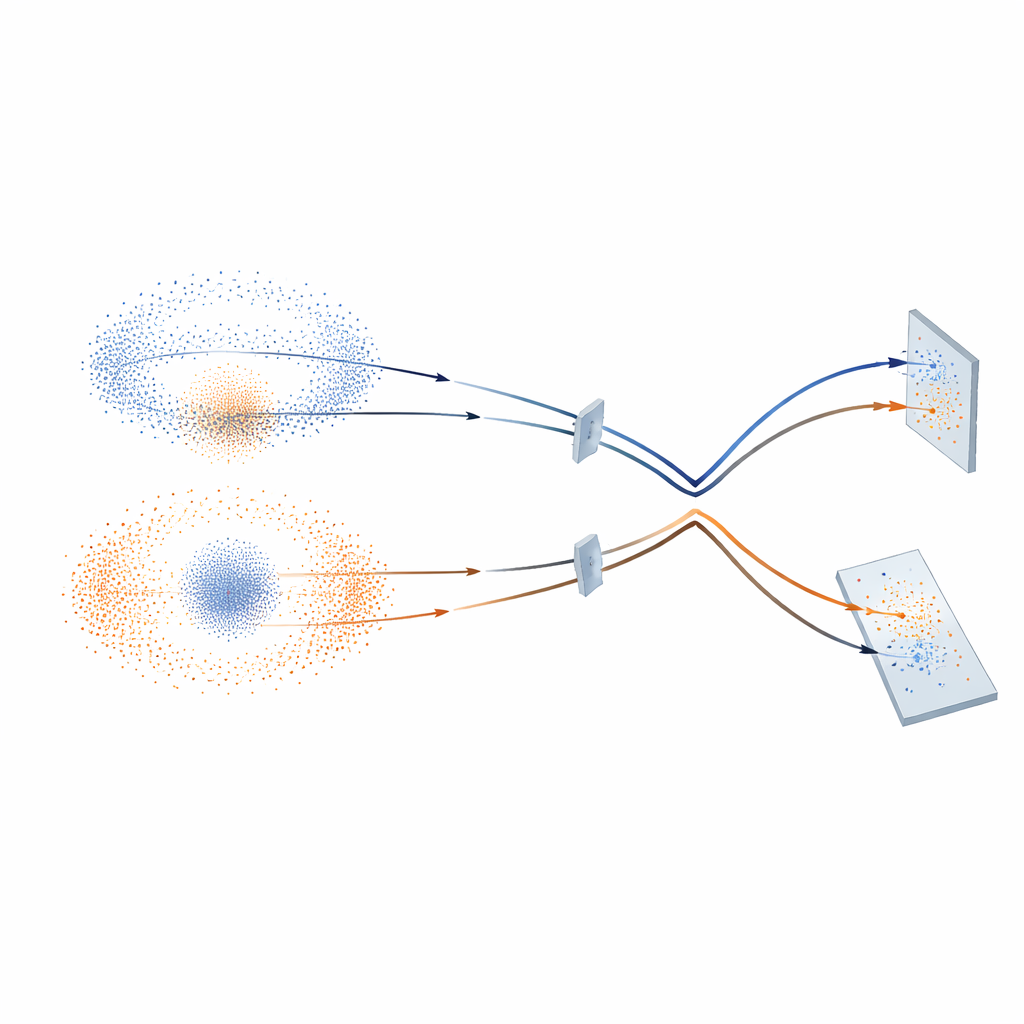
To tackle this challenge, the researchers start with an extremely cold cloud of helium atoms, cooled into a special state of matter known as a Bose–Einstein condensate. In this state, the atoms behave collectively, almost like a single giant matter wave. Carefully timed laser pulses first prepare the atoms in a magnetically quiet internal state and then gently kick portions of the cloud so that they move with different momenta. These moving pieces of the cloud collide, and when they do, pairs of atoms scatter out in opposite directions, forming nearly spherical “halos” of particles in momentum space. Each pair on a halo is born back-to-back, so that if one atom flies off in one direction, its partner flies off in the exactly opposite direction, linking their motions in a quantum way.
Turning scattered atoms into a quantum interferometer
The team then uses additional laser pulses as tools to steer and mix these flying atoms, in direct analogy to how mirrors and beamsplitters guide light in an optical interferometer. In their matter-wave version of the Rarity–Tapster setup, they pick out four momentum modes from the two halos – two on the “left” side and two on the “right” – that form a quartet of strongly correlated paths. Further laser pulses play the roles of mirrors and beamsplitters, redirecting and combining the paths so that an atom can reach a detector by more than one indistinguishable route. By adjusting the relative phase of the laser beams, the experimenters control how these different routes interfere, which in turn changes how often particular combinations of atom pairs are detected together at the output.

Reading quantum patterns in the detection clicks
With a highly sensitive detector capable of registering individual helium atoms, the researchers reconstruct the full three-dimensional momenta of the scattered particles. They first confirm that the halos indeed contain very strongly correlated back-to-back pairs, with correlation strengths high enough to support a Bell test. Then they measure how often atoms are detected in each of the four output combinations as they vary the interferometer’s phase. The joint detection probabilities oscillate in a clean, out-of-phase pattern between different output pairs, just as expected if the atoms started in a nearly ideal entangled “Bell state.” From these probabilities they build a Bell-type correlation function that follows a smooth cosine curve with a large amplitude, in remarkable agreement with theoretical predictions that account for the finite number of atoms per mode.
Crossing the line between classical and quantum worlds
To translate these patterns into a statement about the nature of reality, the authors apply a steering inequality, a test designed to rule out a broad class of models in which one side might still be described by ordinary local hidden properties. Their data show a clear violation of this bound, by almost four standard deviations, meaning that the observed correlations between distant atoms cannot be explained by such classical pictures. While the current setup does not yet close every loophole required for a definitive Bell test – in particular, it still needs independently tunable phases on widely separated regions – it proves that heavy atoms in motion can display Bell-type nonlocality. This paves the way toward future experiments that use entangled matter waves to probe gravity, test foundational ideas about decoherence, and power new quantum sensing and imaging technologies.
Citation: Athreya, Y.S., Kannan, S., Yan, X.T. et al. Bell correlations between momentum-entangled pairs of 4He* atoms. Nat Commun 17, 2357 (2026). https://doi.org/10.1038/s41467-026-69070-3
Keywords: quantum entanglement, Bell correlations, ultracold atoms, Bose–Einstein condensate, atom interferometry