Clear Sky Science · en
Sensory encoding and memory retrieval are coordinated with propagating waves in the human brain
Why our wandering minds may be a feature, not a bug
Every few seconds, your attention drifts: one moment you are taking in sights and sounds around you, the next you are replaying a memory or planning tomorrow. This study suggests that such mental switching is not just daydreaming, but is driven by slow, wave‑like patterns that sweep across the brain. These waves appear to coordinate when we are best at absorbing new information from the outside world and when we are best at pulling information back from memory.
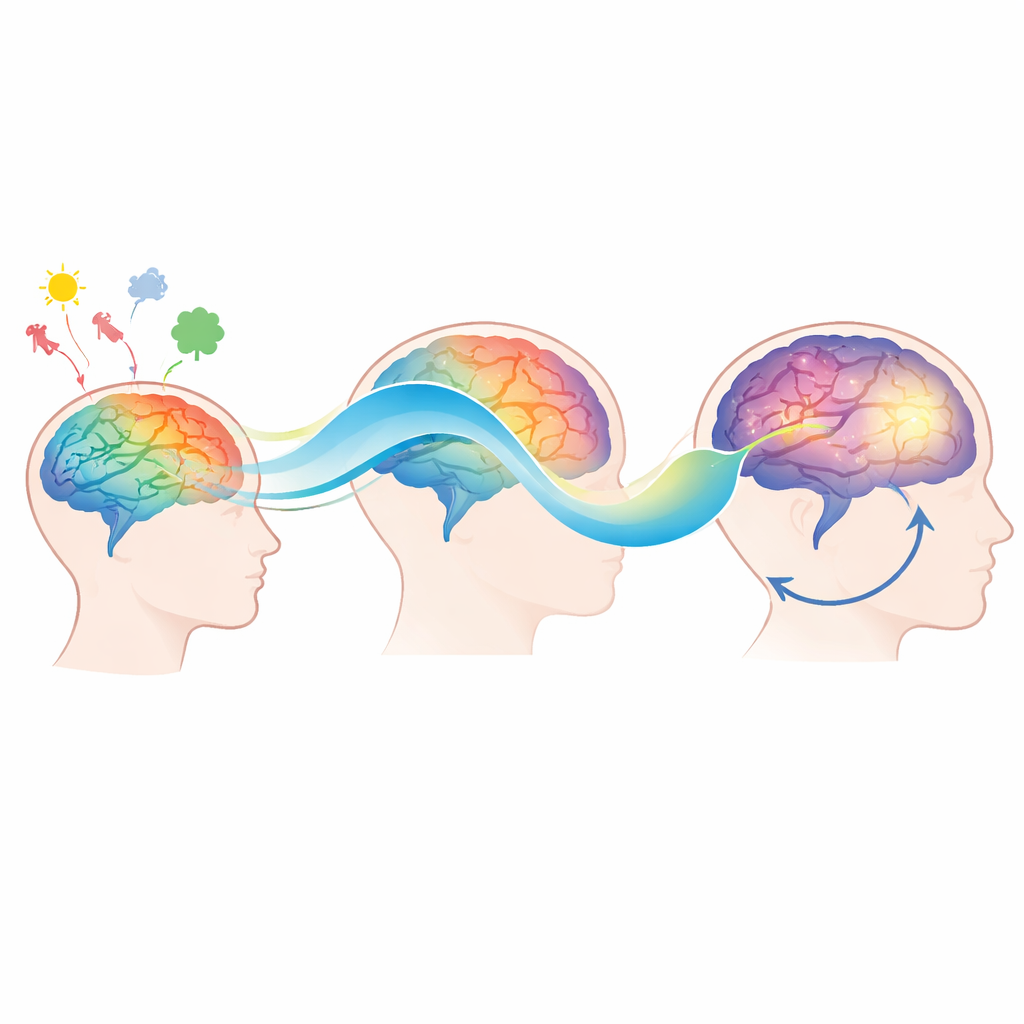
Slow tides in the resting brain
Even when we are sitting still with our eyes open, brain activity gently rises and falls. Using brain‑imaging data from large groups of people, the researchers found that these ups and downs are not random flickers. Instead, they form waves that start in regions that handle touch, movement, and vision, then travel toward deeper, more inward‑focused regions collectively known as the “default mode” network. Similar waves have been seen at the level of individual nerve cells in mice, hinting that this is a basic operating rhythm of mammalian brains.
Linking brain waves, arousal, and the pupil
To understand what these waves might be doing, the team tracked tiny changes in pupil size, a convenient window onto moment‑to‑moment arousal. In both mice and humans, brief dilations of the pupil lined up with large, brain‑wide events. In mice, those events took the form of “spiking cascades,” when most recorded neurons fired in a sweeping order. In humans, they appeared as slow fMRI waves sweeping from sensory‑motor areas to the default mode network and associated deep structures. This shared timing suggests that a common arousal system may be setting the pace for these global brain rhythms.
Reading thoughts from brain scans
Next, the researchers asked whether these waves influence how well the brain encodes what we see. They turned to a massive dataset in which volunteers viewed thousands of natural images while lying in an MRI scanner. Using a modern artificial‑intelligence model, they trained a decoder that took each person’s brain response to an image and generated a text caption for that image. When the decoded caption closely matched the true caption, the team treated that trial as a sign that the person’s brain had accurately captured the meaning of the picture.
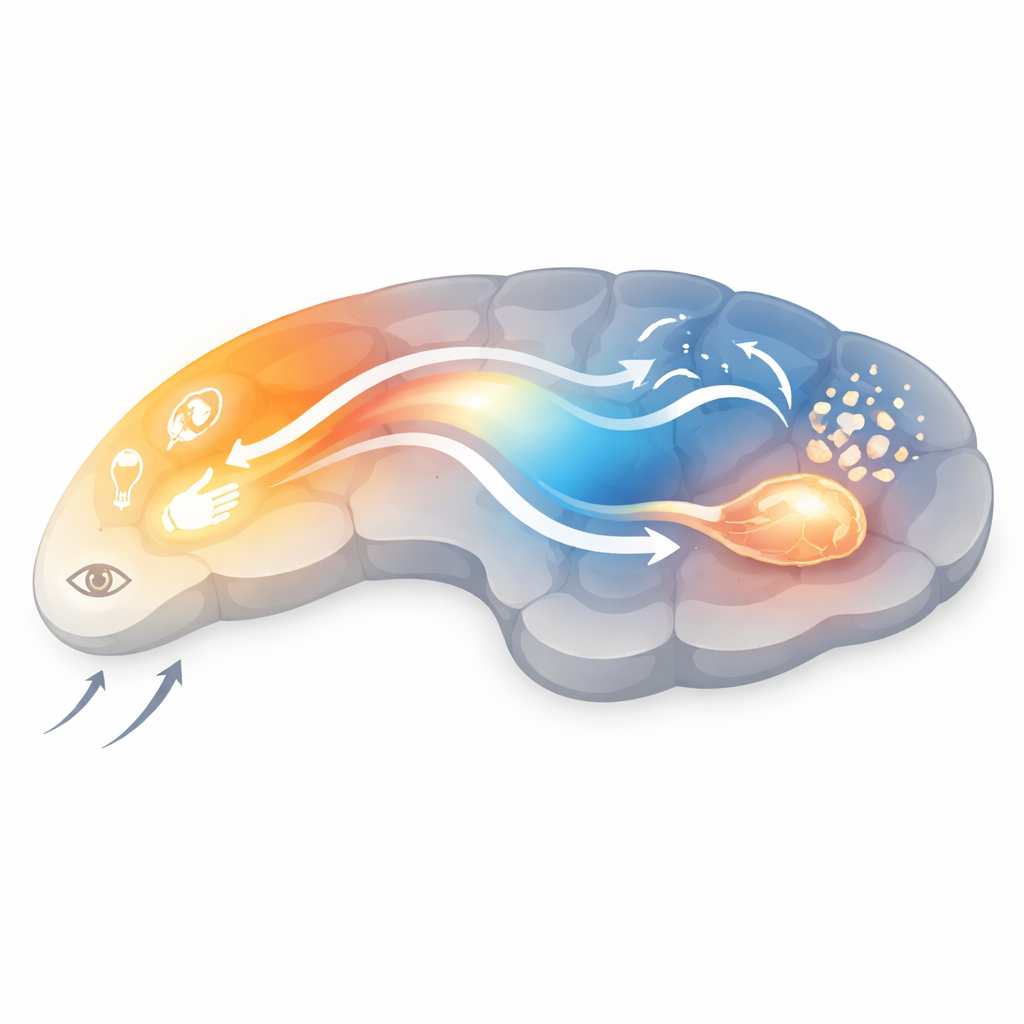
When seeing is best, remembering waits—and vice versa
Because every image in the experiment was shown three times, the team could measure both how well it was first stored and how well it was later recognized. They found that these abilities rose and fell across each slow wave. When the wave was in a phase where outer sensory‑motor regions were most active, the decoder did its best job, and people were more likely to form a lasting memory of a new picture. Later in the same wave, when default‑mode and memory‑related regions, including the hippocampus, were most active, people became better at recognizing images they had seen before, even as encoding of new pictures weakened. Matching analyses in mice showed a similar alternation between strong sensory encoding and events linked to memory replay.
A shared rhythm for taking in and replaying experience
To a non‑specialist, the key message is that the brain seems to run on a slow internal clock, switching every few seconds between two complementary modes: one optimized for taking in the outside world, and another tuned for drawing on stored memories. These switches travel as waves from outward‑facing to inward‑facing brain regions and are tied to subtle shifts in arousal. Rather than interfering with thinking, this infra‑slow rhythm may help the brain balance learning from the present with revisiting the past, a balance that could shape everyday attention, learning, sleep, and even disorders of memory.
Citation: Yang, Y., Leopold, D.A., Duyn, J.H. et al. Sensory encoding and memory retrieval are coordinated with propagating waves in the human brain. Nat Commun 17, 2343 (2026). https://doi.org/10.1038/s41467-026-69068-x
Keywords: brain waves, memory, sensory processing, fMRI, arousal