Clear Sky Science · en
Integrated action for skin NTDs: Deconstructing transmission, addressing knowledge gaps, and championing one health strategies
Why Hidden Skin Diseases Matter
Across many low-income, rural communities, slow-healing sores, rashes, and ulcers on the skin are more than cosmetic problems. These neglected tropical skin diseases can lead to severe infections, disability, and even early death, while also draining family finances and fueling stigma. This review article explains why these conditions cluster in the world’s poorest areas, how they spread through tangled links between people, animals, and the environment, and why a joined-up “One Health” strategy could transform how we prevent, detect, and treat them.
Many Diseases, One Visible Warning Sign
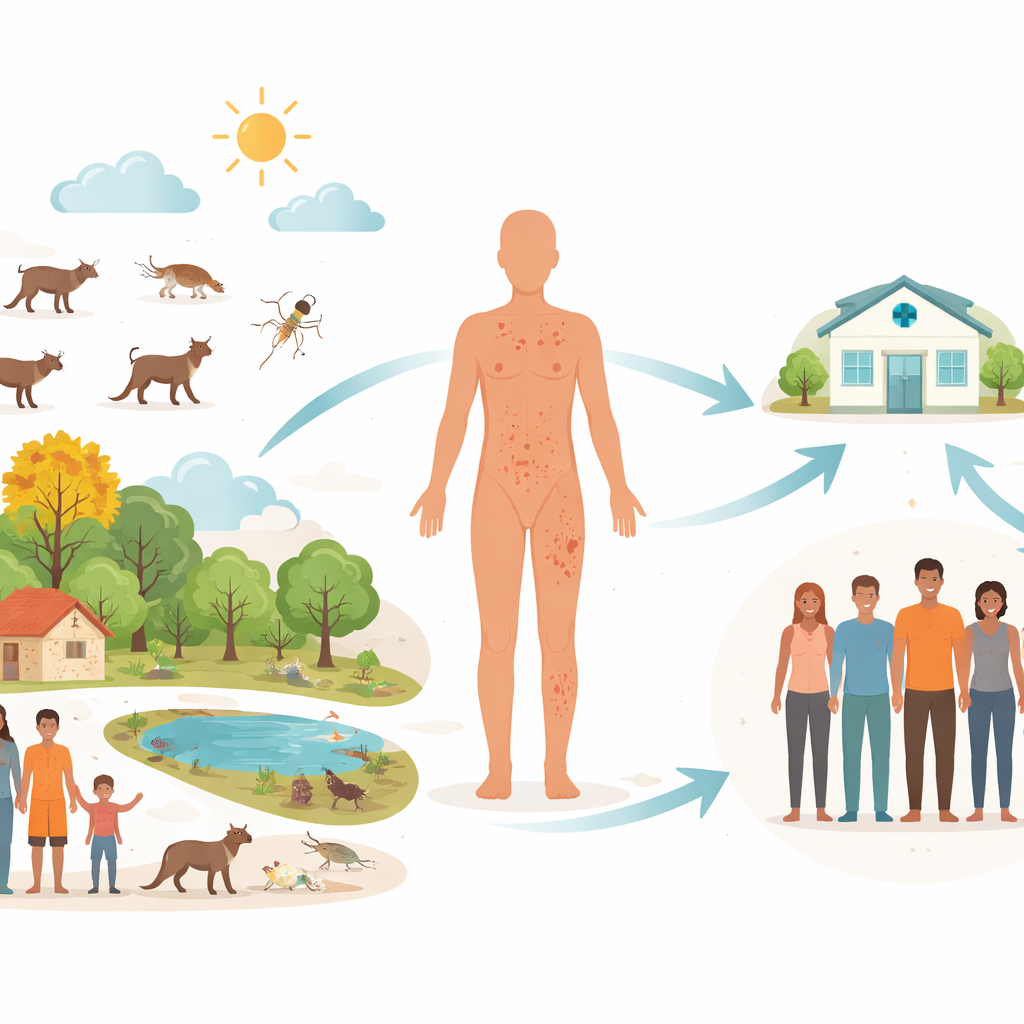
The authors focus on “skin NTDs” – a group of neglected tropical diseases that show up on the skin as ulcers, nodules, swellings, or intense itching. Examples include leprosy, Buruli ulcer, river blindness, cutaneous leishmaniasis, yaws, scabies, lymphatic filariasis, tungiasis, and several deep fungal infections. These illnesses are common in low- and middle-income countries, especially in rural areas with poor housing, limited clean water, and scarce medical care. Because they are so visible, they cause deep shame and mental distress, which often keeps people from seeking help. At the same time, their visibility offers an unusual advantage: a trained health worker can spot several of these diseases at once during a single skin examination, allowing integrated case-finding instead of one disease at a time.
Why an All-in-One Approach Is Needed
Skin NTDs rarely occur alone. In many villages, several of them are found side by side, and they often overlap with other major infections like malaria, HIV, and tuberculosis. Treating each disease in isolation strains fragile health systems and misses chances to identify patients early. The World Health Organization now calls for an integrated approach in its 2021–2030 roadmap and a recent resolution naming skin diseases a global public health priority. The review argues that programs should combine training, diagnosis, and care for multiple skin conditions, strengthen local health centers, and improve surveillance so that countries can finally measure the true scale of these diseases and track progress over time.
People, Animals, and the Environment Are Linked
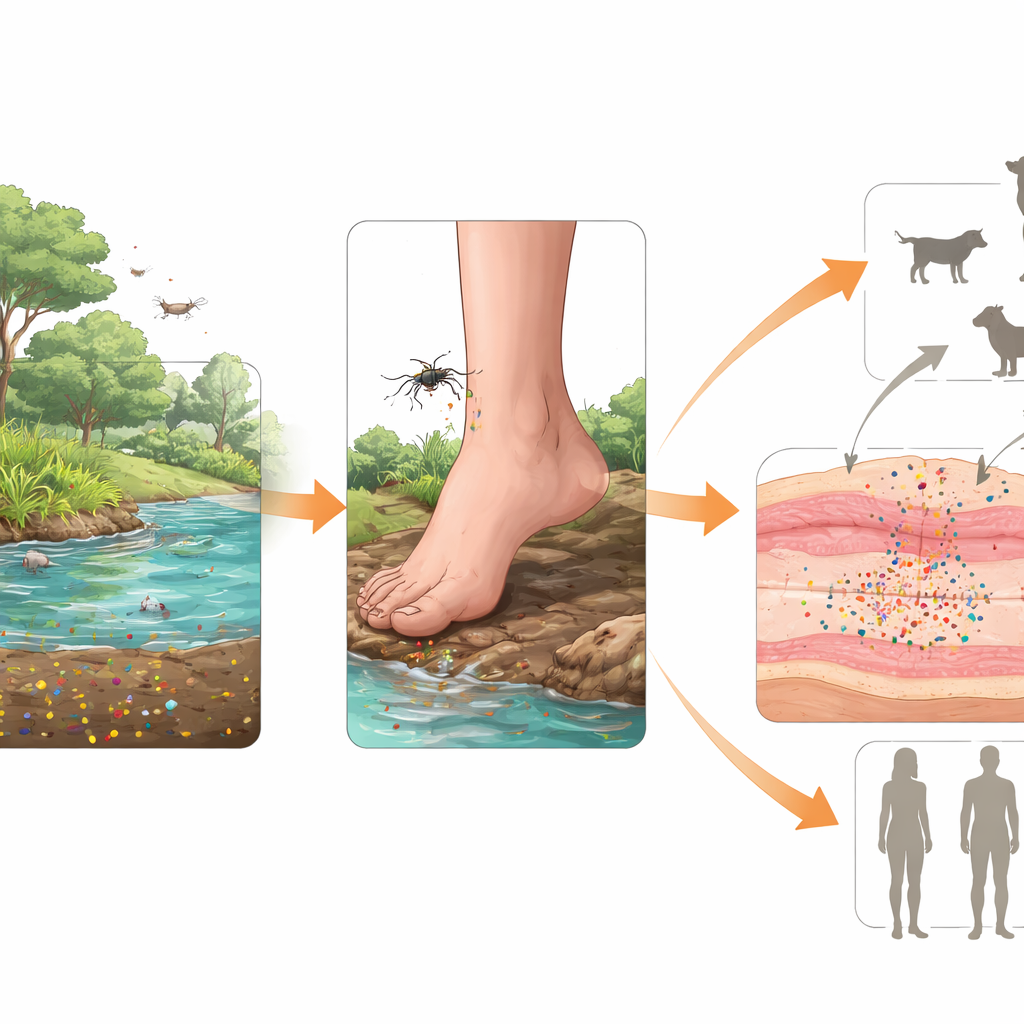
A central theme of the article is the One Health idea: human health is tightly connected to the health of animals and the environment. For some skin NTDs such as river blindness, lymphatic filariasis, cutaneous leishmaniasis, yaws, and scabies, the main routes of spread are fairly clear—through blackflies, mosquitoes, sandflies, or close skin contact. Even so, climate, land use, animal hosts, and different strains of the germs can strongly shape who gets sick and where. For others, like Buruli ulcer, leprosy, mycetoma, chromoblastomycosis, and sporotrichosis, big pieces of the puzzle are still missing. These diseases appear to involve a mix of water bodies, soil, plants, wildlife, domestic animals, and minor skin injuries, but the exact pathways from environment to person are not fully understood. The authors argue that only cross-cutting research that spans ecology, medicine, and social science can untangle these complex chains.
Using Data and Models to Guide Action
The review highlights how better data and shared laboratory standards can speed progress. Networks such as BU LabNet and the newer SkinNTD LabNet are creating common testing methods for conditions like Buruli ulcer, leprosy, yaws, cutaneous leishmaniasis, and mycetoma. These shared protocols allow results from different countries to be compared and fed into mathematical models. Such models can estimate how many people are affected, predict where cases will appear, and test which control strategies will have the biggest impact for the lowest cost. The authors emphasize that models must also factor in stigma, travel costs, lost income, and other social burdens that keep patients from getting care.
Steps Toward Fairer Care for Neglected Skin Conditions
In closing, the article calls for three main shifts: coordinated research that links human cases to animal and environmental sources, global expansion of standardized diagnostic networks, and systematic tracking of the financial and social costs of skin NTDs. By viewing these diseases through a One Health lens and by using the skin as a common entry point for diagnosis, health systems can move from scattered, disease-by-disease campaigns to smarter, integrated strategies. For lay readers, the message is clear: treating the skin we see can reveal hidden connections among people, animals, and the places they share, opening the door to lasting relief for some of the world’s most overlooked patients.
Citation: Mosi, L., Acharya, B., Asiedu, K. et al. Integrated action for skin NTDs: Deconstructing transmission, addressing knowledge gaps, and championing one health strategies. Nat Commun 17, 2271 (2026). https://doi.org/10.1038/s41467-026-69065-0
Keywords: neglected tropical diseases, skin infections, One Health, global health, disease transmission