Clear Sky Science · en
Diketopyrrolopyrrole-based two-dimensional poly(arylene vinylene)s with high charge carrier mobility
Why ultra-fast plastic electronics matter
Today’s electronic devices mostly rely on rigid, inorganic materials like silicon. But chemists are learning how to build wafer-thin "plastic" sheets that can move electrical charges almost as well—and sometimes in ways silicon cannot. This paper reports a new class of such materials: carefully designed, two-dimensional polymers that conduct charges with remarkable efficiency, opening doors to flexible electronics, advanced sensors, and light-harvesting technologies.
Building flat molecular sheets like Lego tiles
Instead of single molecules or long tangled chains, the researchers focus on two-dimensional conjugated polymers—molecular sheets that extend in all directions like a chicken wire fence. These organic layers are attractive because they are lightweight, tunable by chemistry, and can absorb light over a wide range of colors. The catch has been that charges often hop sluggishly from site to site, limiting device performance. Much of the problem comes from imperfect connections within the sheet and poor electronic contact between stacked layers.
Pairing electron givers and takers
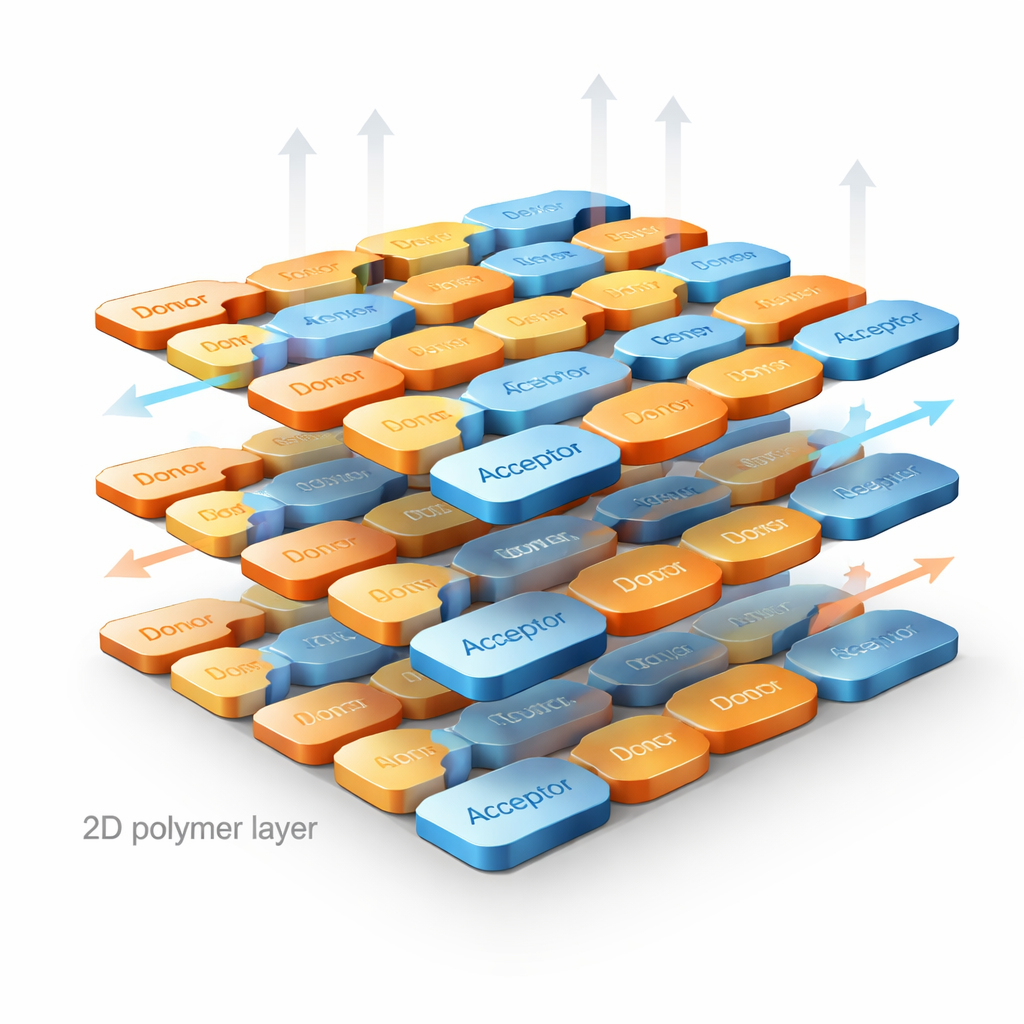
To overcome these limitations, the team uses a "donor–acceptor" strategy. They link an electron-rich building block (thienyl-benzodithiophene) with a strongly electron-hungry unit (diketopyrrolopyrrole, or DPP) into a repeating checkerboard pattern. A short carbon–carbon bridge called a vinylene bond keeps the whole backbone flat and rigid, allowing electrons to spread out rather than being trapped in localized pockets. Computer calculations show that this design produces very smooth electronic energy bands and extremely light-moving charge carriers within the plane of the sheets—conditions that favor rapid charge motion along the layer and much slower motion between layers.
From computer design to real materials
Guided by these predictions, the authors synthesize two versions of the new polymer by a high-temperature solid-state reaction that stitches the building blocks into crystalline powders. The two materials differ only in small side groups attached to the DPP unit—short methyl chains in one case and longer hexyl chains in the other. X-ray diffraction and electron microscopy reveal that both form well-ordered layered structures, with rods of stacked sheets extending over micrometer distances. Spectroscopic measurements confirm that the vinylene links are in place and that the sheets remain largely flat, features that are crucial for letting charges roam freely.
Seeing charges move with terahertz flashes
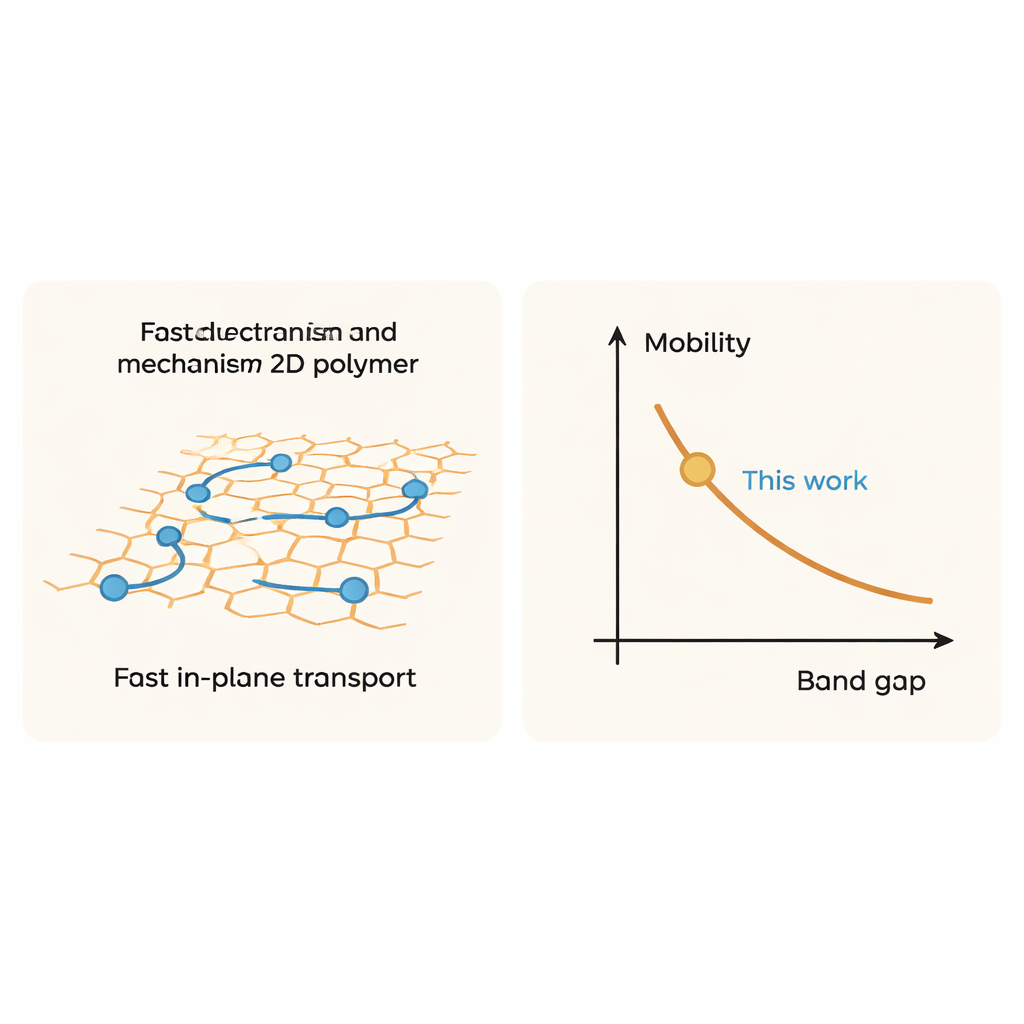
To actually measure how well charges travel, the team uses ultrafast terahertz spectroscopy, a contact-free method that watches how a brief electromagnetic pulse interacts with photoexcited charges. After a laser flash creates mobile electrons and holes, a terahertz pulse probes their motion on a trillionth-of-a-second timescale. The response reveals long scattering times—meaning charges travel relatively far before being deflected—and exceptionally high room-temperature mobilities. One of the polymers reaches a mobility of about 310 square centimeters per volt-second in powder form, a record for this family of organic two-dimensional materials and higher than many previously studied frameworks and polymers.
What this means for future technologies
In simple terms, these new polymers act like very efficient organic highways for electrical charges: they absorb light over a broad range, have unusually small energy gaps, and let electrons move quickly along ultra-thin molecular sheets. By carefully pairing electron-donating and electron-withdrawing units and controlling side chains, the authors show that it is possible to tune both structure and performance. While these results are still at the materials stage rather than in finished devices, they point toward flexible, lightweight components for future transistors, photodetectors, and energy-harvesting systems built from precisely engineered molecular sheets.
Citation: Zhao, R., Yu, H., Zhang, H. et al. Diketopyrrolopyrrole-based two-dimensional poly(arylene vinylene)s with high charge carrier mobility. Nat Commun 17, 1348 (2026). https://doi.org/10.1038/s41467-026-69061-4
Keywords: two-dimensional polymers, organic semiconductors, charge carrier mobility, donor-acceptor materials, covalent organic frameworks