Clear Sky Science · en
Local alkalinity enables high-performance pure water anion exchange membrane electrolysis
Why making clean hydrogen is harder than it sounds
Hydrogen is often hailed as a clean fuel for planes, factories and power plants, but making it without producing carbon pollution is still expensive and technically challenging. Today’s most advanced water-splitting systems rely on rare and costly metals, and cheaper designs stumble when asked to run on ordinary pure water. This paper reports a clever way to sidestep one of the biggest bottlenecks by reshaping the microscopic environment right where water is split, pointing toward more affordable, large-scale green hydrogen.
The promise and problem of cheaper water splitters
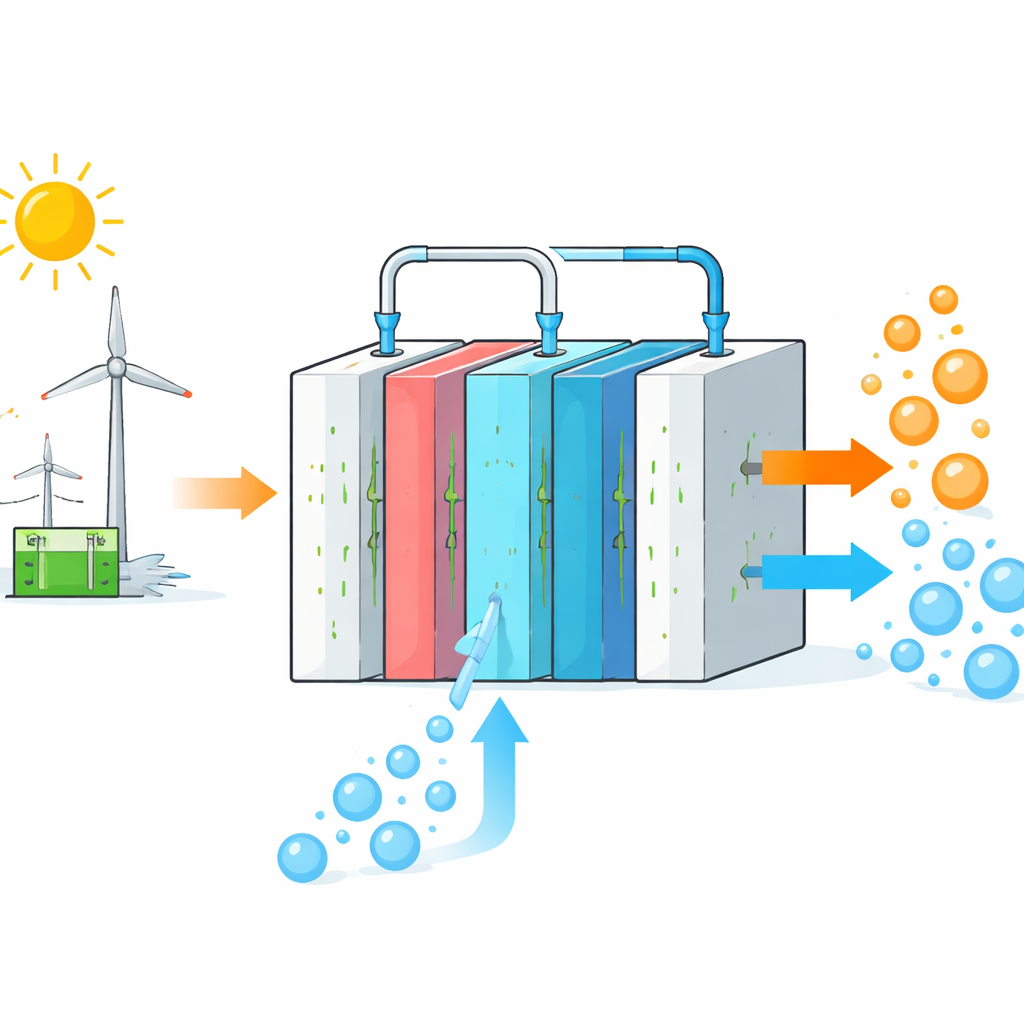
Industrial electrolyzers that split water into hydrogen and oxygen usually fall into two camps. Proton exchange membrane devices work well and can be powered directly by renewable electricity, but depend on scarce precious metals like iridium and platinum. Anion exchange membrane systems, by contrast, can use abundant nickel-based catalysts and cheaper hardware. However, when these cheaper devices are fed with pure water instead of a strong alkaline solution, their hydrogen output is much lower. The main culprit is sluggish movement of hydroxide ions through the membrane, which starves the oxygen-producing side of the cell and causes the local acidity to rise, damaging both catalysts and membrane.
Seeing inside the working device
To understand this bottleneck, the researchers built a typical anion exchange membrane electrolyzer using nickel–iron and nickel–molybdenum catalysts, then probed its internal chemistry while it was running. They used a miniature pH sensor mounted on a scanning electrochemical microscope to map acidity and alkalinity inside the thin catalyst layers at both electrodes. These measurements revealed a stark imbalance: the hydrogen-producing side sat in a mildly alkaline region, while the oxygen-producing side became unexpectedly acidic. This mismatch slowed the reactions and corroded the non-precious metal components, explaining why performance and durability had lagged behind more expensive systems.
Creating tiny alkaline oases
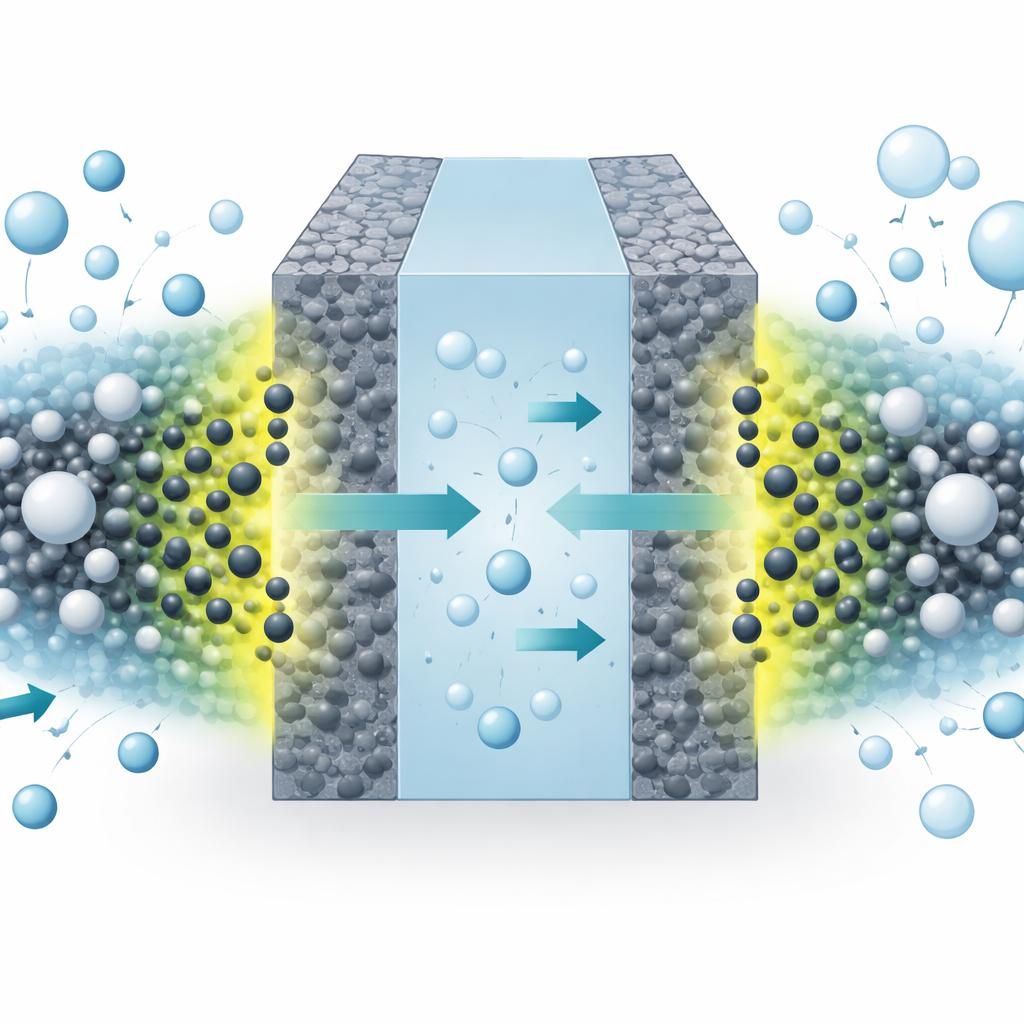
The team’s key idea was not to redesign the membrane itself, but to engineer the local environment right at the catalyst surfaces. They decorated both electrodes with extremely small titanium dioxide particles, only a few nanometers across. Using the same pH-mapping technique, they showed that when the device operated, these particles created a thin zone—just a few micrometers thick—of strongly alkaline conditions at both electrodes, even though the bulk liquid remained neutral pure water. Spectroscopic measurements and computer simulations indicated that, at the oxygen side, titanium dioxide helps split water molecules and hold onto the hydroxide ions close to the surface. At the hydrogen side, it works together with the nickel–molybdenum alloy so that hydroxide ions are produced and temporarily trapped near the catalyst, reinforcing this alkaline shell.
From microscopic changes to big performance gains
These locally alkaline pockets have several benefits. First, they speed up the chemical steps that generate hydrogen and oxygen, lowering the electrical resistance associated with moving charges and reacting molecules. Second, the accumulation of hydroxide ions near the membrane increases how many such ions the membrane carries, effectively boosting its conductivity without changing its chemistry. In practical tests, the modified device delivered hydrogen at current levels comparable to high-end proton exchange systems, reaching 3.0 amperes per square centimeter at 2.08 volts using only pure water and nickel-based catalysts. The same strategy improved performance across several different commercial membranes, indicating that it is broadly applicable rather than tied to a single material.
Keeping the device healthy for the long haul
Performance is only half the story; industrial equipment must also last for years. The authors compared how much nickel and iron dissolved from the oxygen-side catalyst under different local acidity levels and found that serious metal loss occurred under mildly acidic conditions, but became negligible when the titanium dioxide coating pushed the local environment to strongly alkaline. Chemical analysis of the membranes told a similar story: key groups responsible for carrying hydroxide ions degraded under acidic attack, while they remained intact in the engineered alkaline zones. With this protection in place, a single cell ran stably for around 1,400 hours at an industrially relevant current and a larger 10-cell stack maintained high efficiency for hundreds of hours, with projected lifetimes beyond 30,000 hours.
What this means for future green hydrogen
By turning the focus from the bulk liquid and membrane composition to the microscopic environment at catalyst surfaces, this work offers a practical route to high-performance, long-lived electrolyzers that run on plain water and inexpensive materials. The local alkalinity strategy allows anion exchange membrane systems to approach the efficiency of today’s best precious-metal-based devices while avoiding corrosive added chemicals and reducing costs. If scaled further, such designs could make clean hydrogen more affordable and accessible, strengthening its role in a low-carbon energy system.
Citation: Guo, J., Wang, R., Yang, Y. et al. Local alkalinity enables high-performance pure water anion exchange membrane electrolysis. Nat Commun 17, 2335 (2026). https://doi.org/10.1038/s41467-026-69053-4
Keywords: green hydrogen, water electrolysis, anion exchange membrane, catalyst microenvironment, titanium dioxide nanoparticles