Clear Sky Science · en
Experimental realization of dice-lattice flat band at the Fermi level in layered electride YCl
Electrons That Sit Still
In most materials, electrons zip around like cars on a highway. But in some special crystals, whole groups of electrons barely move at all. These so-called flat bands can dramatically boost the effects of electron–electron interactions, potentially giving rise to unusual states such as superconductivity or magnetism. This paper reports the first real material that hosts a long-sought kind of flat band called a “dice-lattice” flat band, realized in a layered compound made of yttrium and chlorine, known as YCl. 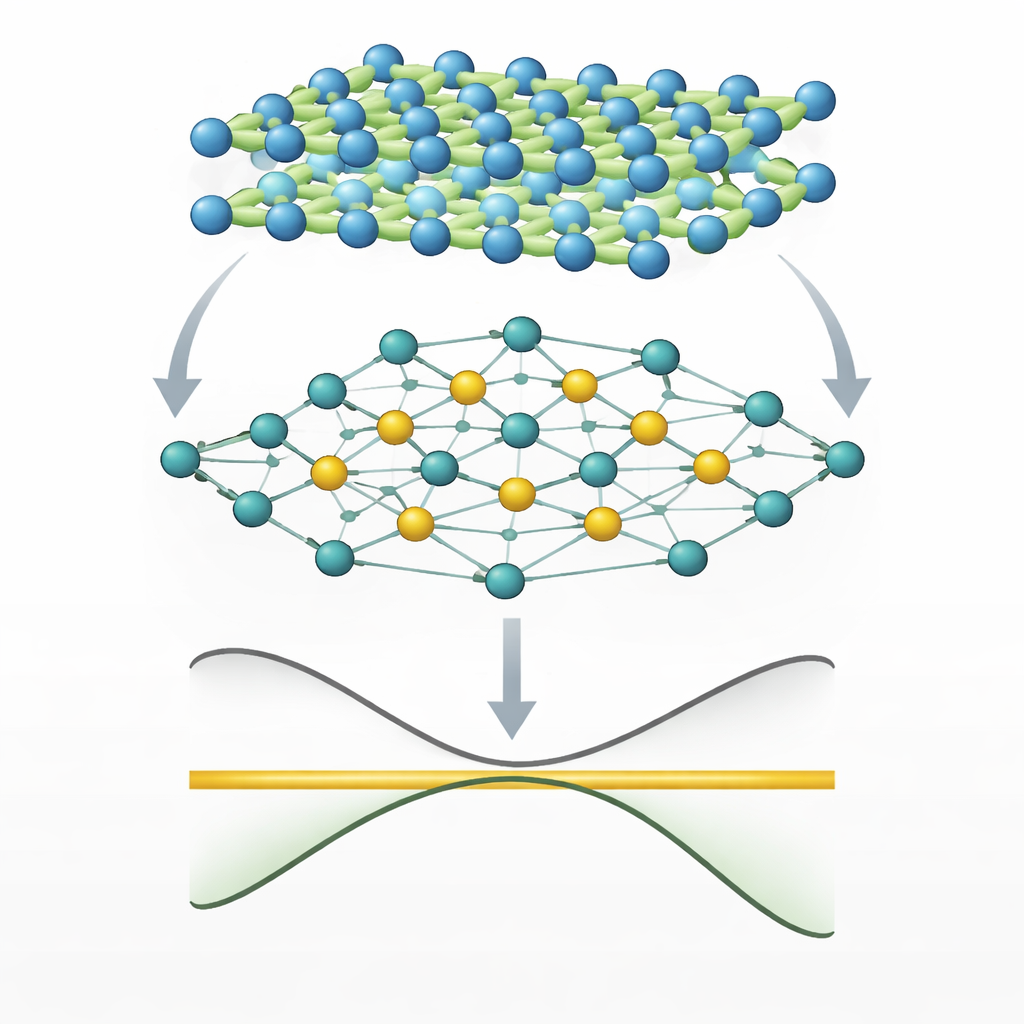
A New Playground for Quiet Electrons
Flat bands are energy levels where electrons have almost no kinetic energy, so their motion is strongly constrained. When such bands sit exactly at the Fermi level—the energy that separates filled from empty states at low temperature—electron interactions can dominate and trigger exotic quantum phases. For years, researchers have engineered special patterns of atoms, or lattices, to create flat bands, focusing mainly on kagome and moiré lattices. The dice lattice, a neat geometric pattern in which some sites connect to three neighbors and others to six, has been theoretically known for decades as an ideal host of perfectly flat bands and unusual topological behavior. Until now, however, no naturally occurring crystal had been shown to realize this dice-lattice band structure in practice.
Electrons as the Lattice Itself
The key twist in this work is that the lattice is not defined by atoms, but by electrons themselves. YCl is a “van der Waals electride,” a layered material in which some electrons leave their parent yttrium ions and settle into empty spaces between the atomic layers. These “interstitial anionic electrons” act like negatively charged particles sitting at regularly spaced sites inside the crystal’s voids. First-principles calculations show that in YCl, these electrons arrange into three distinct kinds of positions—called A, B, and C sites—that together form the dice lattice pattern. Importantly, the electrons can hop easily between A or B and the central C sites, but direct hopping between A and B is strongly suppressed, which is exactly the condition needed to generate a flat band in the dice lattice model.
Seeing the Flat Bands Directly
To test this picture, the authors used angle-resolved photoemission spectroscopy (ARPES), a powerful technique that maps out how the energy of electrons in a solid depends on their momentum. The ARPES measurements on YCl revealed two sets of bands with the characteristic dice-lattice shape: each set contains a nearly dispersionless (flat) band intersected by more steeply sloped, dispersive bands. Crucially, one of these flat bands lies right at the Fermi level, meaning that the “quiet” electrons are the ones that govern the low-energy behavior of the material. The observed band structure closely matches detailed computer calculations based on density functional theory and a simplified three-site tight-binding model built from the A, B, and C electron positions. 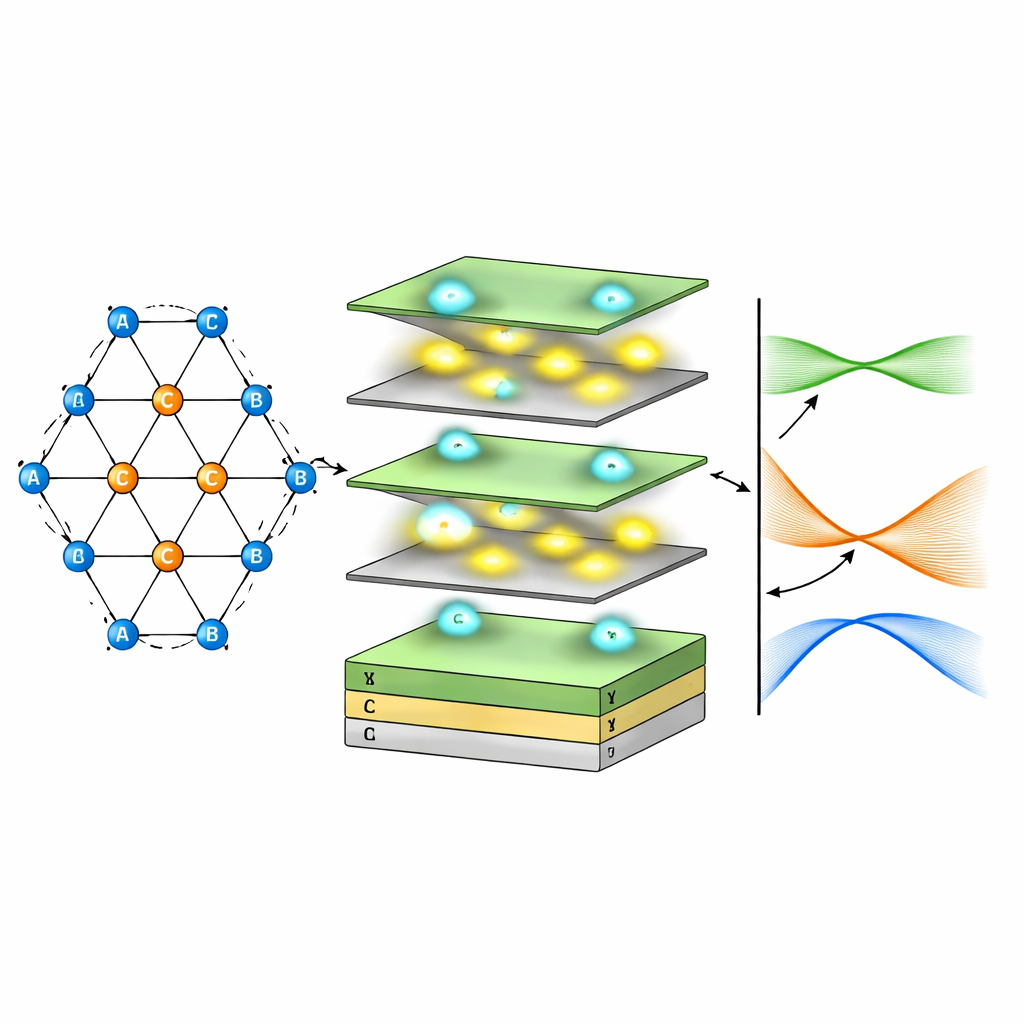
A Simple Yet Powerful Electronic Landscape
Unlike many complex quantum materials, where different atoms and orbitals crowd the low-energy spectrum, YCl offers a remarkably clean stage. Near the Fermi level, the electronic states come almost entirely from the interstitial electrons, with chlorine states pushed far away in energy. This isolation makes it much easier to compare experiment with theory and to connect specific features—like the flat bands and their slight deviations from perfect flatness—to details of the dice-lattice geometry. The ARPES data even show that the highest flat band is flatter than predicted by theory, indicating that direct hopping between A and B sites is extremely weak in the real material, placing YCl very close to the ideal dice-lattice limit.
A Prototype for Dice Metals
By combining precise experiments and theory, the authors demonstrate that YCl is the first known example of a “dice metal,” a crystal where an electron-formed dice lattice produces flat bands at the Fermi level. They further show, through calculations on related rare-earth halide electrides, that similar behavior should appear in a broader family of materials, especially those based on scandium and yttrium. To a non-specialist, the key message is that researchers have finally found a real solid where electrons arrange themselves into a designer lattice and sit in nearly motionless energy levels. This achievement opens the door to exploring new quantum phases driven by interacting flat-band electrons and suggests that electrides—materials where electrons themselves act as ions—are a promising toolkit for building other exotic electronic structures in the future.
Citation: Geng, S., Wang, X., Guo, R. et al. Experimental realization of dice-lattice flat band at the Fermi level in layered electride YCl. Nat Commun 17, 2213 (2026). https://doi.org/10.1038/s41467-026-69049-0
Keywords: flat bands, dice lattice, electride materials, quantum materials, angle-resolved photoemission