Clear Sky Science · en
Dynamic plastic deformation delocalization in FCC solid solution metals
Why spreading out damage makes metals last longer
From airplanes and rockets to bridges and wind turbines, many critical structures rely on metals that are both strong and long‑lasting. Yet there is a hidden weakness: when a metal is pushed and pulled over and over, the damage often concentrates in tiny zones, leaving the rest of the material almost untouched. These microscopic hot spots act as incubators for cracks and can cause parts to fail much earlier than their impressive strength would suggest. This study uncovers a previously unknown way in certain advanced alloys to spread out that damage as it forms, dramatically improving their resistance to fatigue failure.
The usual problem: strength that comes with a cost
Modern structural metals are carefully engineered so that their internal grains and defects block the motion of dislocations, the tiny line defects that carry plastic deformation. This design strategy makes metals very strong, but it also pushes deformation into narrow bands where those dislocations pile up. Under repeated loading, such concentrated plastic slip creates steep steps at the surface and highly damaged zones inside the metal, which become ideal places for fatigue cracks to start. As a result, many high‑strength alloys can fail at cyclic stresses that are only a quarter of the stress needed to permanently deform them in a single pull. The long‑recognized trade‑off is clear: as strength goes up, fatigue efficiency usually goes down.
Discovering metals that deform more evenly
To see whether this trade‑off is truly unavoidable, the researchers examined several single‑phase face‑centered cubic alloys with similar grain structures but different chemistries, including medium‑ and high‑entropy alloys like CrCoNi and CrMnFeCoNi, as well as FeNi36, VCoNi and stainless steel 316L. Using high‑resolution digital image correlation, they mapped how strain built up over areas roughly a square millimeter in size with tens‑of‑nanometer resolution after small amounts of deformation. Most alloys behaved as expected: plasticity appeared as sharp, narrow bands, and measurements showed high localization intensities. But a few combinations of alloy and temperature stood out as striking outliers: their strain maps showed plasticity spread smoothly across entire grains, with no individually resolvable events and average localization values up to three times lower than in conventional cases. 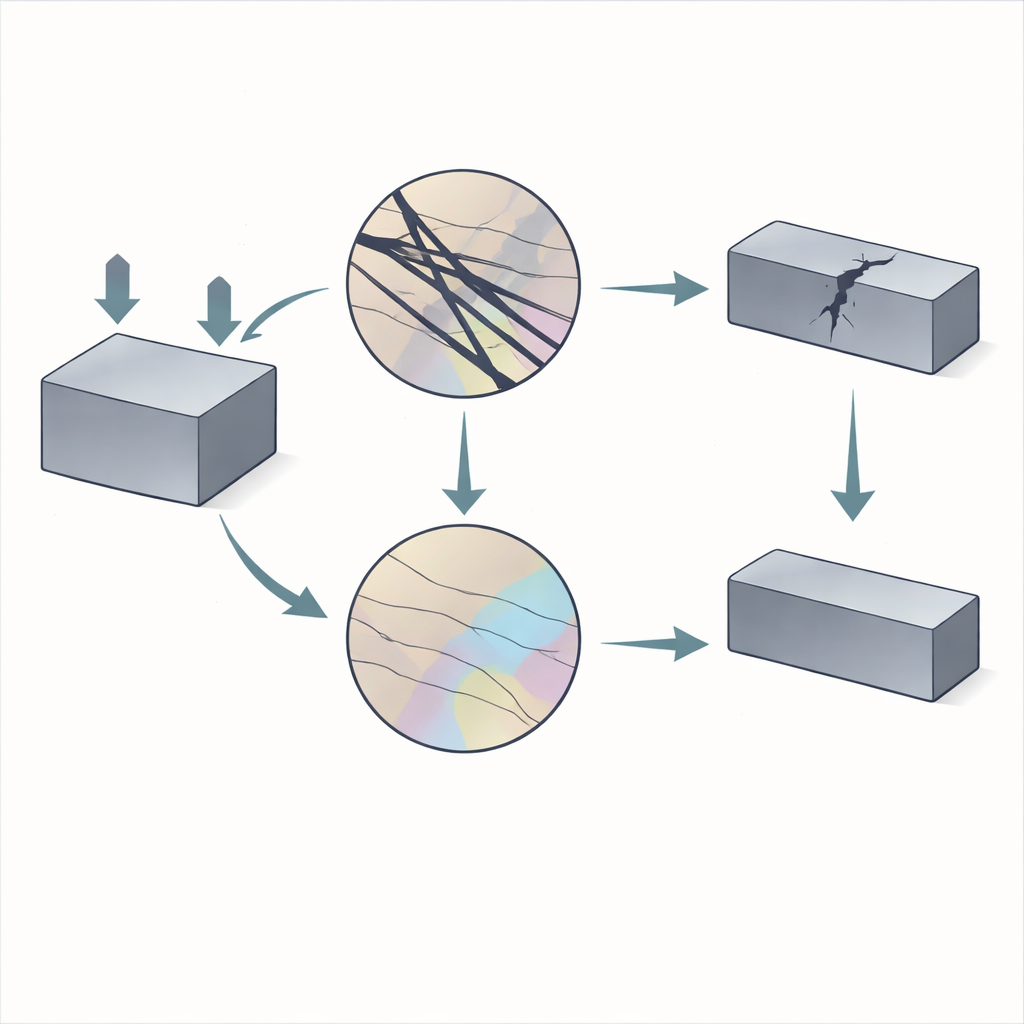
Hidden nanoscale structures that smooth out deformation
To understand this unusual behavior, the team cut site‑specific thin foils from regions with either strongly localized or homogeneous deformation and examined them using advanced electron microscopy, from standard imaging down to atomic resolution. In grains that showed strong localization, the microstructure was dominated by ordinary dislocations and, at low stacking‑fault energy, by long deformation twins—features well known to produce large surface steps. In grains with homogenized plasticity, however, they consistently found dense fields of extremely thin planar defects: stacking faults, tiny hexagonal pockets, and especially nanoscale twins only a few nanometers thick. These features appeared only inside the deformation bands and forced dislocations to glide on many closely spaced planes instead of a single one, effectively thickening each event into a broad, diffuse zone rather than a sharp line.
A narrow window where competition keeps damage in check
The authors then used quantum‑mechanical and atomistic calculations to determine how the energy cost of forming stacking faults changes with temperature for each alloy. Plotting the measured localization intensity against this stacking‑fault energy revealed a clear pattern: the alloys and temperatures that showed homogenized plasticity all fell into a narrow intermediate range of values. At high energies, dislocations remained undivided and produced classic sharp slip bands. At very low energies, deformation favored long, thick twins that again localized strain. Only in the middle window did a dynamic competition arise: nanoscale planar defects formed during loading, interacted with gliding dislocations, repeatedly turned sources on and off, and encouraged slip to spread onto several neighboring planes. When the researchers pushed the CrCoNi alloy to colder conditions or much higher strain so that extended twins dominated, the metal reverted to strongly localized deformation, confirming that the delocalizing mechanism is both dynamic and fragile. 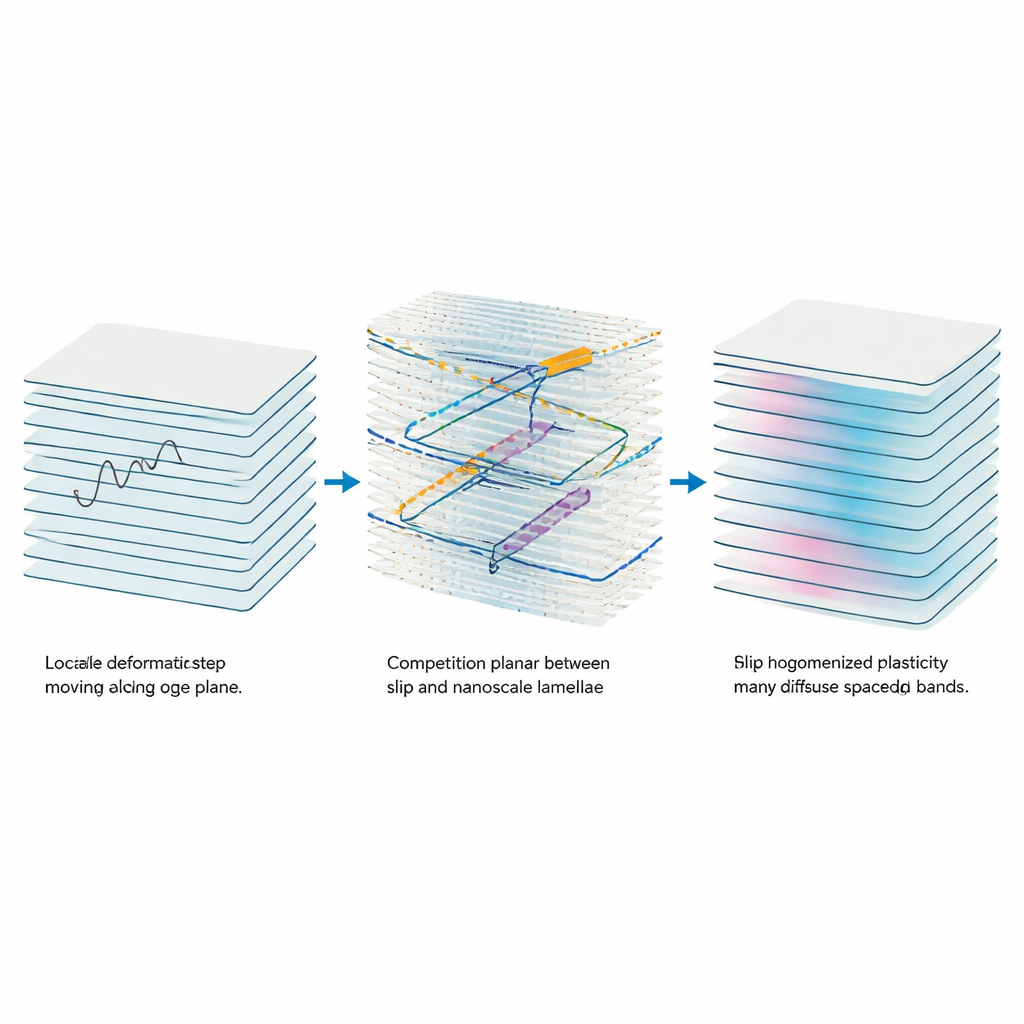
From microscopic smoothing to longer fatigue life
Finally, the team linked this microscopic behavior to practical performance by measuring very‑high‑cycle fatigue properties of CrCoNi, CrMnFeCoNi and 316L stainless steel at room temperature, and by comparing them with data from other face‑centered‑cubic alloys. As expected, the alloy with the most intense localization, CrMnFeCoNi, showed relatively poor fatigue efficiency, similar to more traditional materials. In contrast, CrCoNi—tested under conditions where dynamic delocalization is active—proved to be a remarkable positive outlier: for its strength level, it endured cyclic loading at significantly higher stress fractions than typical alloys and often survived the full test without failure. This shows that spreading plasticity across many gentle slip bands can decouple fatigue resistance from strength.
What this means for future metal design
The work introduces the concept of dynamic plastic deformation delocalization: a self‑organized smoothing of damage that emerges from the interplay between dislocations and nanoscale planar defects in a specific energetic window. For engineers, this opens a new design knob beyond conventional microstructure tuning. By choosing alloy chemistries and operating temperatures that place face‑centered‑cubic metals in this intermediate regime, it may be possible to design components that are both very strong and unusually resistant to fatigue, reducing unexpected failures in demanding applications from aviation to energy infrastructure.
Citation: Anjaria, D., Heczko, M., You, D. et al. Dynamic plastic deformation delocalization in FCC solid solution metals. Nat Commun 17, 2262 (2026). https://doi.org/10.1038/s41467-026-69046-3
Keywords: fatigue resistance, high-entropy alloys, deformation mechanisms, stacking fault energy, crack initiation