Clear Sky Science · en
Hierarchical design and scalable production of radiative cooling film featuring multispectral camouflage
Staying Cool While Staying Hidden
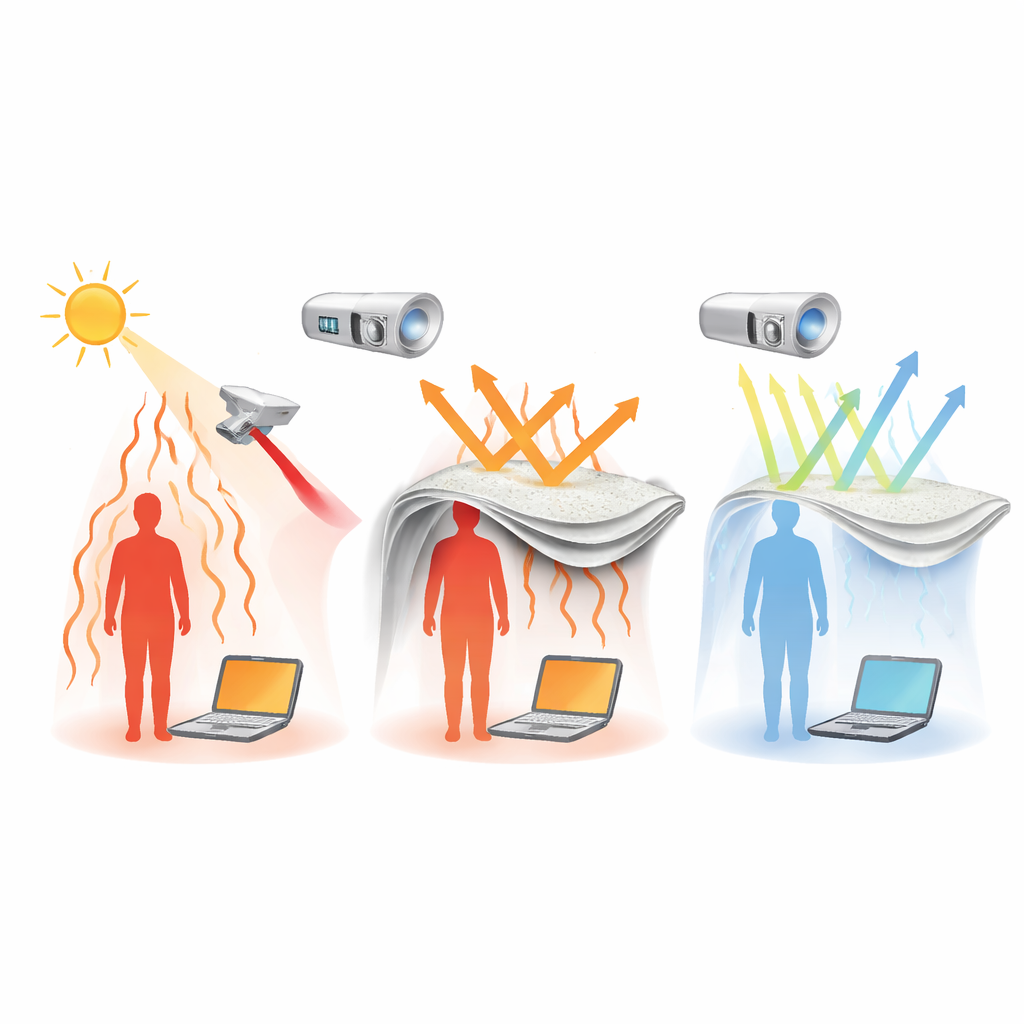
As heat waves grow more frequent and surveillance technologies become more sophisticated, there is a growing need for materials that can both keep people and equipment cool and help them avoid detection. This study reports a new kind of thin plastic-and-metal film that can shed heat into space while disguising its infrared and laser signatures, and can even be colored to blend into everyday surroundings such as walls, sand, or shrubs.
The Challenge of Heat and Hiding
Objects outdoors, from people and tents to electronic devices, face two competing demands. For comfort and safety, they should release excess heat, especially as global temperatures rise. At the same time, many situations require camouflage from thermal cameras and laser-based detectors that look for heat or laser reflections in specific infrared bands. Conventional cooling materials shine brightly in the very wavelengths that thermal imagers watch, making targets easy to spot. Conversely, traditional stealth coatings often trap heat, leading to overheating or extra energy use for cooling.
A Film Built from Molecules Up
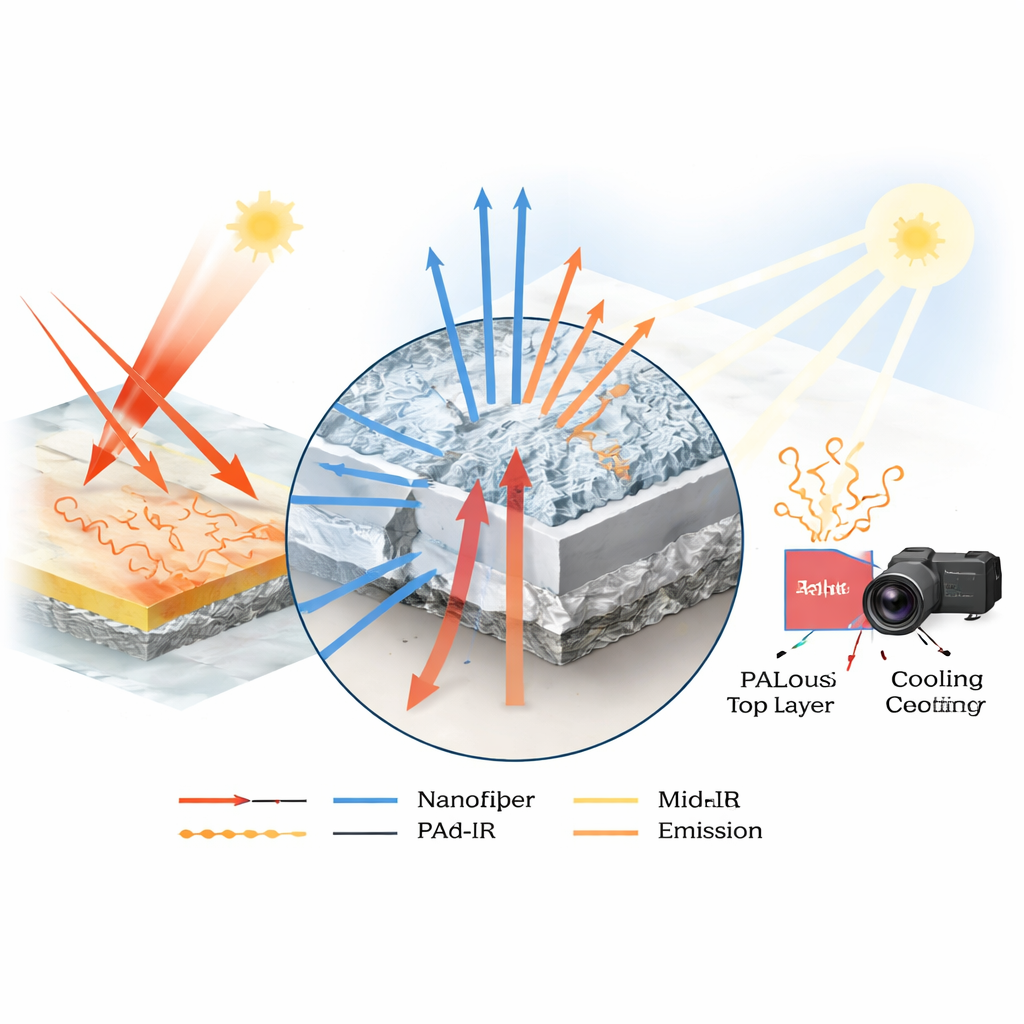
The researchers approached this conflict by designing a material that is selective about which infrared wavelengths it emits and reflects. They first screened common organic building blocks to find polymer chemical groups whose bond vibrations absorb and emit mainly in “non-detection” infrared windows, while remaining quiet in the wavebands most used for thermal sensing. This led them to a familiar polymer: polyamide 66, also known as nylon 66. When processed appropriately, nylon 66 shows strong infrared activity only in carefully chosen ranges and has an additional absorption feature close to a common military laser wavelength of 10.6 micrometers, ideal for weakening laser returns.
From Nanofibers to Large-Scale Rolls
Using roll-to-roll electrospinning, the team produced meter-scale “X-films” consisting of a very thin, randomly tangled mat of nylon 66 nanofibers laid atop an aluminum foil substrate. The nanofibers are about 100 nanometers in diameter, small enough that they barely scatter mid-infrared light; instead, the nylon’s molecular vibrations shape the spectrum. Measurements show that by tuning the nylon thickness, the films strongly reflect in the main thermal-imaging bands, strongly emit in the non-atmospheric bands that dump heat to space, and absorb efficiently at 10.6 micrometers for laser camouflage. Because the fibers are randomly stacked, the infrared response changes very little from −60° to 60° viewing angles, an advantage for moving observers and targets.
Color, Comfort, and Camouflage
To make the films practical in real landscapes, the authors added visible pigments that barely interact with mid-infrared light. By spraying tiny amounts of iron-based pigments onto the white film, they generated a palette of colors—red, yellow, blue, browns, and greens—while preserving the selective infrared behavior. Lab and outdoor tests with heated plates showed that all X-films reduced their apparent temperature on thermal cameras compared with bare surfaces, yet still cooled 5–12 °C more than plain aluminum foil by radiating heat through the non-detection windows. The best balance between camouflage and cooling came from nylon layers 30–75 micrometers thick. When mounted onto cotton garments and worn by heated mannequins and a human subject, the X-film fabrics simultaneously matched shrubbery in visible images, blended into the background in thermal images, and kept underlying “skin” cooler than aluminum-coated fabrics.
Standing Up to Real-World Use
For field deployment, durability is as important as optical performance. The team laminated the films with a thin polyethylene cover, which is transparent in the mid-infrared and does not disturb the tailored spectrum. These encapsulated films survived extreme cold and heat, acidic and alkaline solutions, water flushing, UV exposure, and strong wind with less than 1% mass change and almost no shift in infrared reflectance. Scratch and abrasion tests similarly showed that the coated films can withstand handling and wear, supporting their suitability for clothing, coverings for electronics, tents, and other outdoor gear.
What This Means Going Forward
In plain terms, the authors have created a flexible, low-cost sheet that lets heat escape in “safe” infrared bands while hiding in the bands that thermal cameras and lasers use to spot targets. Because it can be rolled out in large areas, colored to match different surroundings, and viewed from many angles without losing its effect, this radiative cooling film points to a practical new family of materials for staying cool and unseen in a warming, sensor-filled world.
Citation: Jiang, Y., Wang, B., An, Y. et al. Hierarchical design and scalable production of radiative cooling film featuring multispectral camouflage. Nat Commun 17, 2253 (2026). https://doi.org/10.1038/s41467-026-69045-4
Keywords: radiative cooling, infrared camouflage, multispectral stealth, polymer films, thermal management