Clear Sky Science · en
Harmonic non-Hermitian skin effect
Music of Many Notes from a Single Tone
Imagine playing a single pure tone on a flute and finding that it mysteriously reshapes itself into several new tones that each rush toward opposite walls of the concert hall. This paper explores a similarly counterintuitive effect in specially designed acoustic structures: a single sound at one frequency can spawn multiple new tones, each of which “flows” to different edges of the system. Understanding and controlling this behavior could help guide sound, light, or even quantum particles with remarkable precision in future technologies.
Waves That Prefer the Edge
Most of us are used to waves—whether sound, water, or light—spreading out across space. In certain engineered systems, however, waves do something unusual: instead of filling the whole structure, they pile up at its boundary. This phenomenon, known as the non-Hermitian skin effect, arises when motion in one direction is favored over the other, for example by adding gain or loss or by making couplings between elements asymmetric. The result is that many different “bulk” states of the system collectively migrate toward one edge, as though the boundary were a wave magnet. Such edge-loving behavior has attracted intense interest because it breaks standard expectations about how waves behave in crystals and devices.
Shaking the System in Time
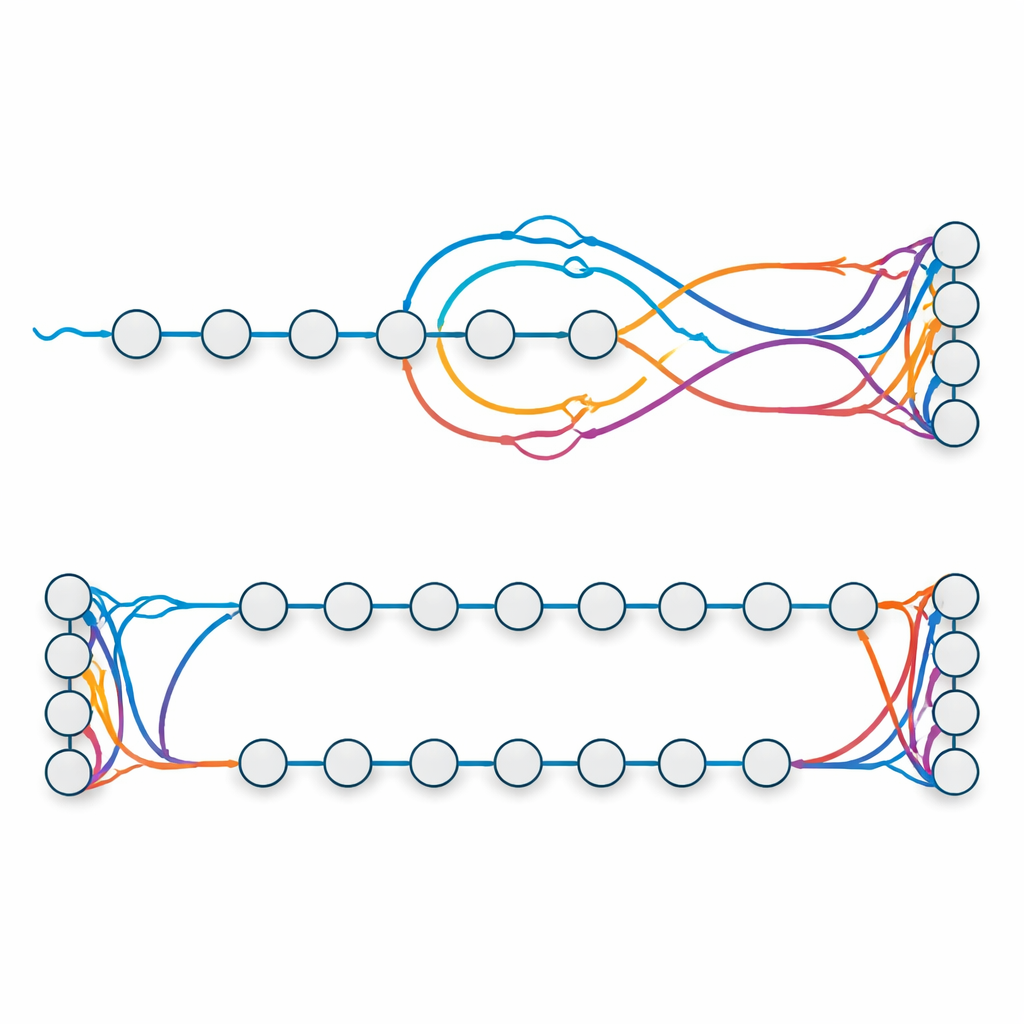
The authors focus on systems that are not only asymmetric in space but also deliberately shaken in time. By periodically modulating how neighboring sites in a lattice talk to each other—a strategy called Floquet engineering—they create an environment where a simple single-frequency input naturally generates extra frequency components, or harmonics, much like the overtones of a musical instrument. The key insight of this work is that each of these harmonics can experience its own version of the skin effect. In their theory, the way the system’s frequencies trace loops in a complex plane determines whether a given harmonic spreads out or piles up at an edge, and crucially, whether it chooses the left or the right boundary.
Unipolar and Bipolar Edge Gathering
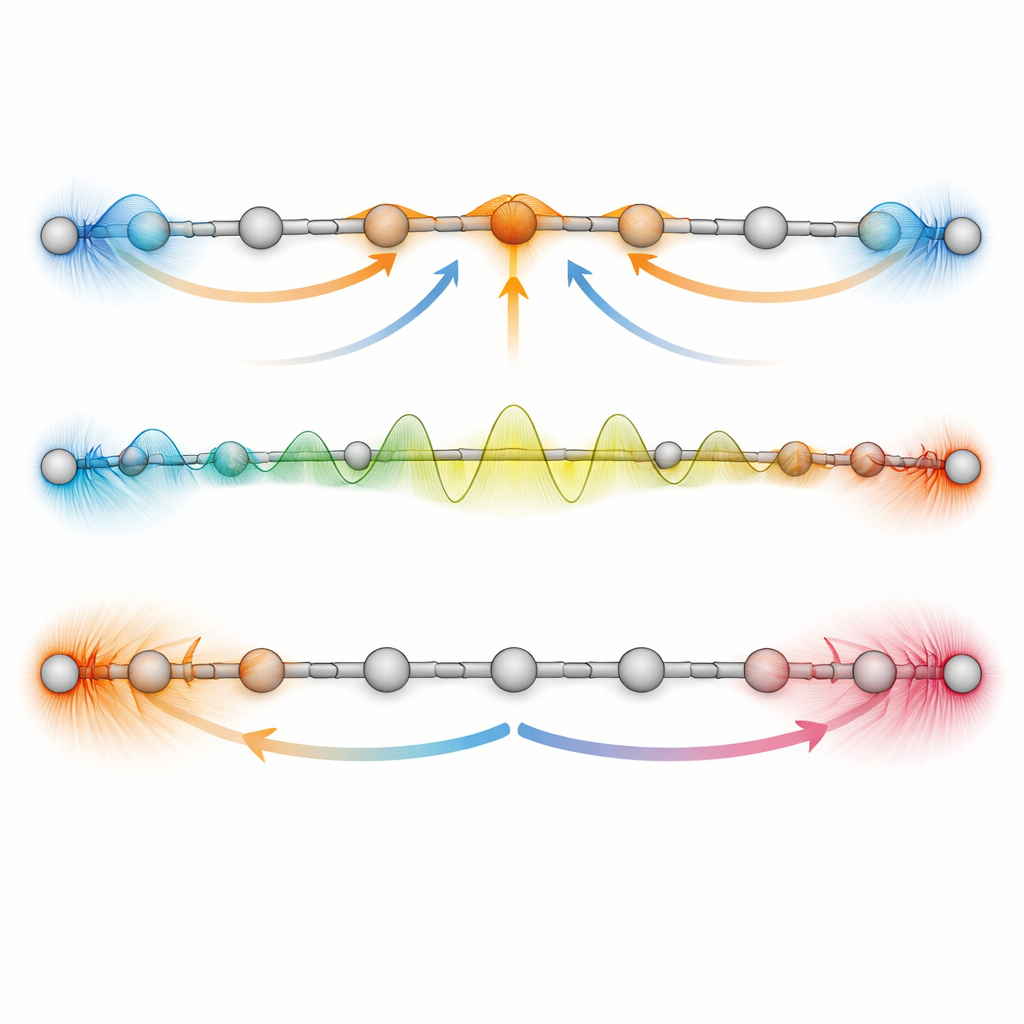
Starting from a classic model of biased hopping on a one-dimensional chain, the team first shows a “unipolar” case, in which the main wave and its harmonics all drift toward the same side of the sample. Here, the frequency loops encircle a reference point in a uniform direction, and all relevant harmonics share a common tendency to accumulate at one boundary. They then design a more elaborate “long-range” version of the lattice, where connections extend beyond nearest neighbors. In this regime, the loops twist, with some circling clockwise and others counterclockwise. As a result, the central frequency can remain broadly distributed across the chain, while the first higher and lower harmonics choose opposite edges, creating a striking “bipolar” pattern of edge localization.
Building a Time-Shaken Acoustic Lattice
To move beyond theory, the researchers construct an acoustic analog of these lattices using air-filled cavities connected by narrow tubes. Microphones and loudspeakers between neighboring cavities serve as programmable, one-way couplers whose strength is switched on and off in time with an electronic square wave. This setup lets them realize both the simpler and the long-range lattices in a lab-friendly way. By sending in a pure tone at one cavity and periodically modulating the couplings, they record how sound at the original frequency and at the newly generated harmonics distributes itself across the chain. In the unipolar configuration, all three prominent frequency components clearly build up at the same side. In the bipolar configuration, higher and lower harmonics reliably gather at opposite ends, while the original tone can remain almost flat or develop its own preferred direction depending on the chosen parameters.
Dialing the Strength of Each Harmonic
Beyond simply turning edge localization on or off, the authors show that they can tune how strongly each harmonic participates. By adjusting the fraction of time that the couplers are active during each modulation cycle—the duty ratio—they selectively enhance or suppress the intensity of different harmonics, without fundamentally changing which edges those harmonics prefer. This offers a powerful “mixer” capability: the same physical device can be reprogrammed so that most of the energy flows as a fundamental edge mode, or instead as a higher harmonic that hugs one boundary, while others fade away. Their measurements closely track theoretical predictions, demonstrating precise control over multi-frequency wave steering in a real-time modulated, asymmetric system.
Why This Matters
For non-specialists, the takeaway is that shaking a biased wave system in time does more than just jiggle it—it causes a single input tone to blossom into a family of new frequencies, each with its own preferred edge. This “harmonic skin effect” opens a route to devices that route different colors of light, different tones of sound, or different quantum excitations to different places, all starting from a simple input. Because the underlying ideas are general, they could be applied to photonics, electronics, mechanical structures, and cold-atom platforms. In essence, the work shows how temporal modulation and directional bias can work together to sculpt where waves go and which notes they play, offering a new toolkit for future wave-based technologies.
Citation: Zhang, Q., Xiong, L., Tong, S. et al. Harmonic non-Hermitian skin effect. Nat Commun 17, 2198 (2026). https://doi.org/10.1038/s41467-026-69043-6
Keywords: non-Hermitian skin effect, Floquet engineering, harmonic generation, acoustic lattice, topological waves