Clear Sky Science · en
Multifunctional lithium niobate platform for photodetection and photoacoustic and thermoelastic gas sensing
Smaller Sensors for a Breathable World
From city smog to industrial leaks, many of the gases that affect our health and climate are present at levels too low for ordinary instruments to catch. Today’s most sensitive gas analyzers are often bulky, power-hungry machines that live on lab benches, far from the factory floor or the roadside. This article introduces a new kind of tiny chip, carved from a crystal called lithium niobate, that can listen to, feel, and directly sense light from trace gases all at once, paving the way for pocket-sized instruments that monitor the air we breathe in real time.
One Crystal, Many Sensing Tricks
At the heart of the work is a fork-shaped sliver of lithium niobate, a material already popular in advanced optics. This crystal is special because it couples electricity, heat, mechanical motion, and light very strongly: when it is warmed or bent, electrical charges appear; when light is absorbed, tiny expansions ripple through it. The researchers designed a “multi-functional platform” on this single crystal, so that it can perform three different sensing roles: it can detect pressure waves in gas (photoacoustic sensing), feel tiny temperature changes caused by light absorption (thermoelastic sensing), and act directly as a light detector. Unlike conventional quartz-based devices that usually do only one job, this lithium niobate design is carefully shaped and wired to exploit all of these effects at once.
Listening to Whisper-Quiet Gas Signals
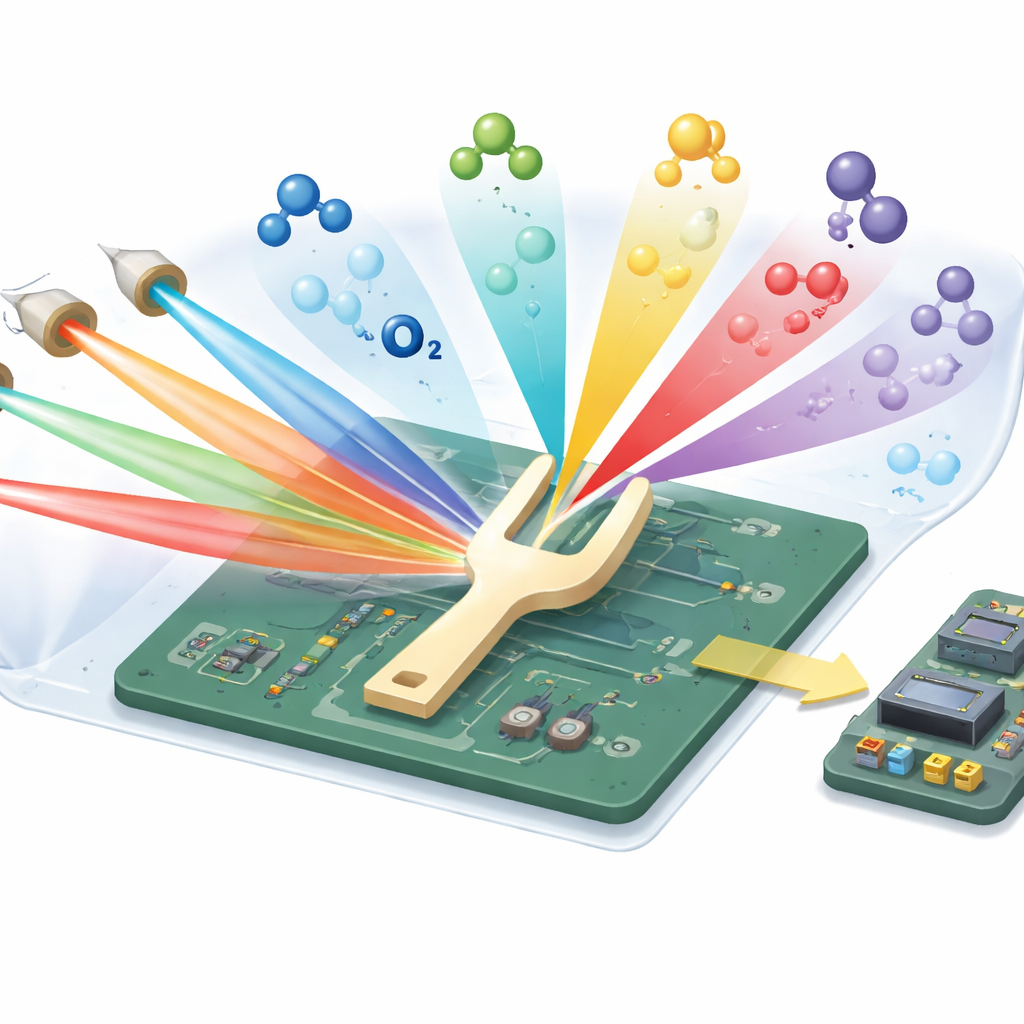
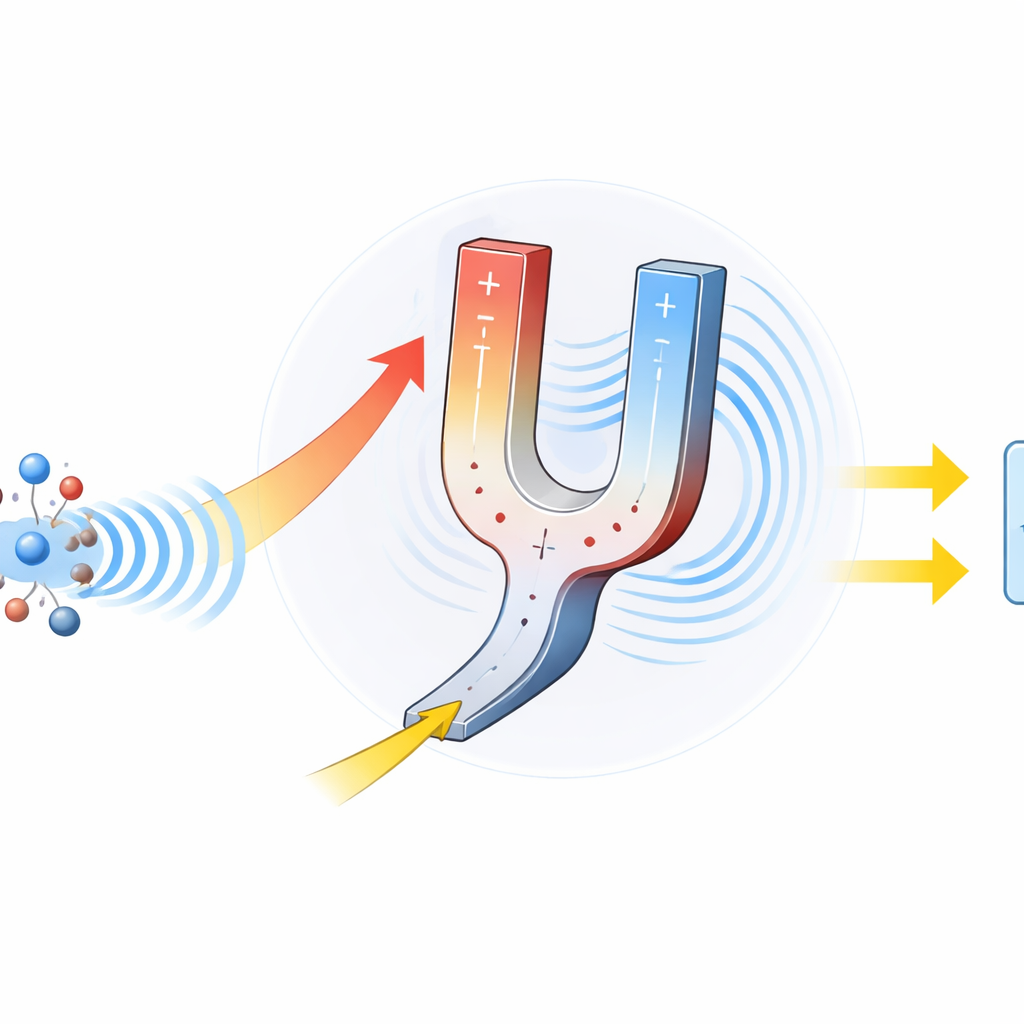
To turn gas into a readable signal, the team first used the chip as a kind of microscopic tuning fork for sound. When a gas absorbs modulated light, it heats and cools in rhythm, creating pressure waves—essentially a very quiet sound. Placing the light beam in the gap between the crystal tines lets the gas “sing” directly to the fork. Because the fork vibrates most strongly at its resonance frequency, these faint waves are greatly amplified and converted into an electrical signal. Using light sources that span from blue light to long-wave infrared, the researchers measured important gases including nitrogen dioxide, water vapor, acetylene, carbon dioxide, methane, and ammonia. They reached detection limits down to parts per billion, with stable performance over long averaging times, showing that this single, tiny device can rival large lab instruments for sensitivity.
Feeling Heat Instead of Sound
The same chip can also sense gases without needing to be surrounded by them, an advantage in harsh or sealed environments. In this “light-induced thermoelastic” mode, the gas absorbs a modulated laser beam before it reaches the crystal surface. The warmed gas then heats a spot on the crystal itself, causing it to expand and contract in sync with the light. Thanks to the crystal’s built-in electrical polarization and the tuned fork geometry, these minute flexings create a measurable voltage. Using this contact-based approach, the team again probed the same set of gases across visible to infrared wavelengths. Although the path length was kept very short—only a few centimeters—they still achieved practical detection limits and excellent linearity, and they showed that the same hardware can switch between sound-based and heat-based sensing depending on the application.
Turning Light Directly into Electrical Signals
Beyond sound and heat, the lithium niobate fork also works as a broadband photodetector. When light is absorbed in the crystal, it produces tiny thermal and electrical changes that the device converts into an output voltage, especially when driven at its resonance. The researchers systematically measured its response from 450 nanometers (blue light) all the way to nearly 10 micrometers (deep infrared). They found that the detector is particularly sensitive in the long-wave infrared region, where many gases have strong molecular “fingerprints.” At around 9.7 micrometers, the chip’s responsivity outperformed several commercial mid-infrared detectors, despite operating at room temperature without cooling, highlighting its promise as a compact alternative for demanding applications.
Bringing the Lab onto a Circuit Board
To show that this crystal fork is more than a lab curiosity, the team co-packaged it with a mid-infrared quantum cascade laser and readout electronics on a small printed circuit board, only a few centimeters across. The laser sits just a tiny distance from the gap between the tines, so its beam passes directly through gas flowing over the module and into the sensing region. Even without lenses or bulky optics, the combined module successfully measured carbon monoxide at useful concentrations using a standard gas-flow setup. This demonstration points toward future chips where light sources, waveguides, and multifunctional detectors are all built from lithium niobate in a single, factory-produced device.
Toward Pocket-Sized Spectroscopy
In everyday terms, the study shows that a single, specially shaped crystal can act like a stethoscope, thermometer, and camera for light and gases, all at once. By uniting three sensing methods on one lithium niobate chip and proving it works across a wide range of important gases and colors of light, the work shifts the focus from squeezing out incremental sensitivity gains to creating a new, all-in-one sensing platform. With further integration of on-chip lasers and waveguides, this approach could shrink today’s room-filling spectrometers into robust, low-cost modules small enough for hand-held environmental monitors, bedside diagnostic tools, and on-site chemical analyzers.
Citation: Lin, H., Zheng, H., Zhu, W. et al. Multifunctional lithium niobate platform for photodetection and photoacoustic and thermoelastic gas sensing. Nat Commun 17, 2296 (2026). https://doi.org/10.1038/s41467-026-69042-7
Keywords: gas sensing, lithium niobate, photoacoustic, spectroscopy, integrated photonics