Clear Sky Science · en
Geometry of neural dynamics along the cortical attractor landscape reflects changes in attention
How Our Wandering Minds Follow Hidden Paths
We all know the feeling of being deeply absorbed in a task versus casually watching a show. This study asks a simple but powerful question: does the brain’s large-scale activity move differently in these situations, as if it were traveling over a landscape with hills and valleys? By treating brain activity as a moving point in this landscape, the researchers show that changes in attention—whether we are focused on a demanding task or engaged in a sitcom—are closely tied to how the brain’s activity flows across this hidden terrain.

A Landscape of Brain States
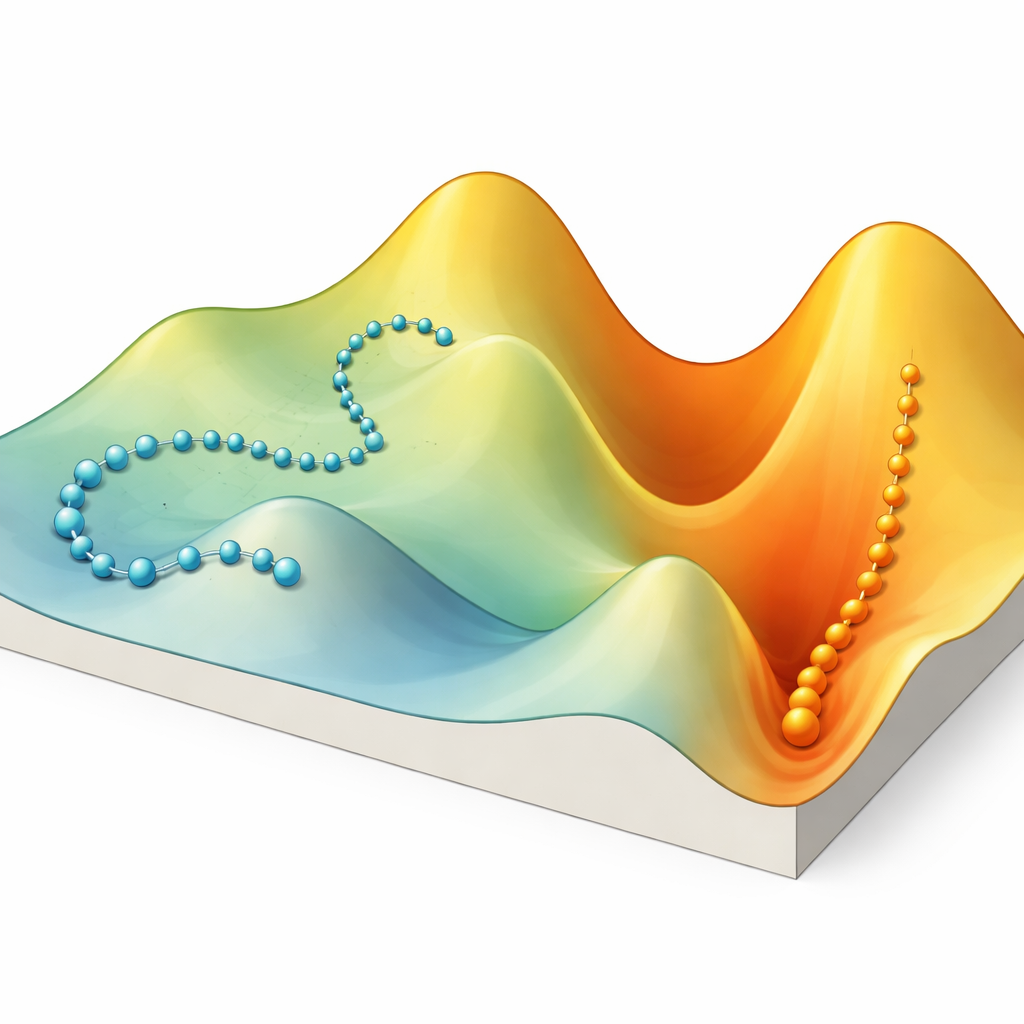
The authors imagine the brain’s overall activity as a point moving through a “state space,” where each position reflects how active different brain regions are. In this space, some patterns of activity are especially stable and tend to pull the brain’s activity toward them, like valleys in a hilly landscape. These valleys, called attractors, correspond to recurring large-scale patterns of brain activity, or “brain states.” Using mathematical models applied to functional MRI data from hundreds of runs of rest, tasks, and movie-watching, the study shows that most of the time the brain’s activity would, in the absence of new influences, slide into a small set of these valleys rather than wander endlessly.
Mapping Stable Patterns Across the Cortex
To pin down where these valleys lie, the researchers fit a dynamical systems model to brain data from two public datasets. The model separates internal influences—how different brain regions affect each other—from external influences, such as sights and sounds. They then simulated what would happen if they let the modeled brain activity run forward in time from many different starting points. These simulations almost always settled into a few stable patterns. When they grouped these patterns, they found that the resulting attractors lined up with well-known large-scale networks in the brain: regions involved in internal thought (often called default-mode areas), and regions handling sensory inputs and movement. In other words, the “valleys” in the landscape are largely set by the brain’s basic wiring and known functional networks.
Attention Changes the Brain’s Path, Not the Landmarks
Even though the main valleys stayed in roughly the same places, the brain did not always move across the landscape in the same way. The team examined, moment by moment, how quickly and in what direction the modeled brain activity moved relative to the nearest attractor. They distinguished between motion driven by internal brain dynamics and motion nudged by incoming stimuli. During demanding attention tasks—where participants had to respond reliably to rapidly presented images—the brain’s internal dynamics pointed straight toward a particular attractor associated with the default-mode network and moved quickly down into it, as if that part of the landscape had become steeper and more funnel-like. By contrast, during sitcom watching, when participants reported being highly engaged, the brain’s internal dynamics tended to move more slowly and away from attractors, roaming in a flatter, more central region of the landscape.
Different Contexts, Different Slopes
These contrasting patterns suggest that attention is not simply “high” or “low,” but is expressed differently depending on what we are doing. In effortful tasks, being attentive corresponds to the brain quickly settling into a task-relevant valley, making its dynamics more stable and directed. During engrossing stories, attentive engagement instead seems to coincide with the brain hovering in a shallower area between valleys, less pulled toward any one fixed state. Importantly, these changes were driven by the brain’s intrinsic dynamics, not by the raw strength of sensory inputs, implying that internal mechanisms—possibly involving chemical signaling systems in the brain—reshape how the landscape is experienced without moving the underlying valleys themselves.
What This Means for Understanding Focus
For a layperson, the takeaway is that your brain’s “map” of possible states is fairly stable, but how you travel across that map changes with your state of attention and the situation you are in. When you concentrate on a demanding task, your brain’s activity quickly falls into a particular deep groove that supports stable, accurate performance. When you are absorbed in a movie, the brain instead glides over a flatter region, staying flexible and less locked into any single pattern. By modeling these dynamics as motion over a landscape, this work offers a geometric way to understand how shifting internal states like attention arise from large-scale patterns of brain activity.
Citation: Song, H., Chen, R., Botch, T.L. et al. Geometry of neural dynamics along the cortical attractor landscape reflects changes in attention. Nat Commun 17, 2673 (2026). https://doi.org/10.1038/s41467-026-69041-8
Keywords: attention, brain networks, neural dynamics, attractor landscape, fMRI