Clear Sky Science · en
The bacterial RNA polymerase-associated CarD protein couples promoter activity to DNA supercoiling
How Bacteria Tune Their Genes to Life’s Ups and Downs
Inside every bacterial cell, the DNA is constantly being twisted, untwisted, and read. This paper explores how a small helper protein, called CarD, works together with the physical twisting of DNA to turn essential genes up or down. Understanding this partnership reveals how bacteria adjust their basic “housekeeping” activities—like making ribosomes and proteins—when conditions change, such as during rapid growth or stress.
The Challenge of Opening DNA
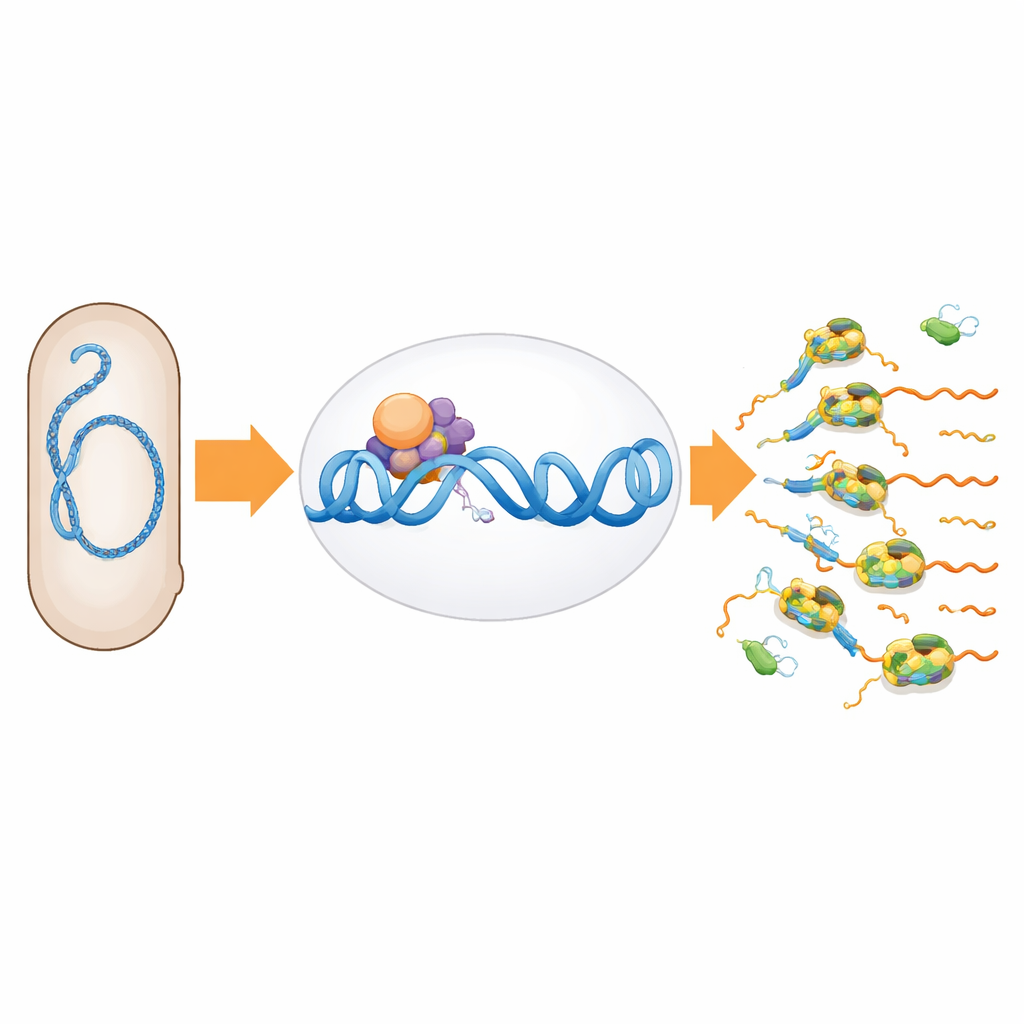
To read a gene, a bacterial enzyme called RNA polymerase must first pry open a short stretch of the DNA double helix at a control region known as a promoter. Many bacteria use a standard DNA pattern at these promoters that makes opening relatively easy. Rhodobacter sphaeroides, a photosynthetic bacterium, is unusual: more than half of its promoters are missing a key DNA letter at a crucial position. On its own, this defect would make opening the DNA much harder, yet these promoters still drive strong expression of vital genes, including those for the cell’s protein-making machinery.
A Helper Protein Fills in for Broken Switches
The authors show that Rhodobacter solves this problem with the CarD protein, which binds next to RNA polymerase at promoters. CarD presses into the DNA like a wedge, helping separate the two strands so transcription can start. By mapping thousands of starting points where transcription begins, and where CarD and RNA polymerase are bound across the genome, the researchers found that CarD is tightly linked to promoters with the defective DNA pattern. These faulty switches effectively recruit CarD as a built-in support, allowing genes to be turned on despite their weaker sequences.
Twisted DNA as a Second Control Knob
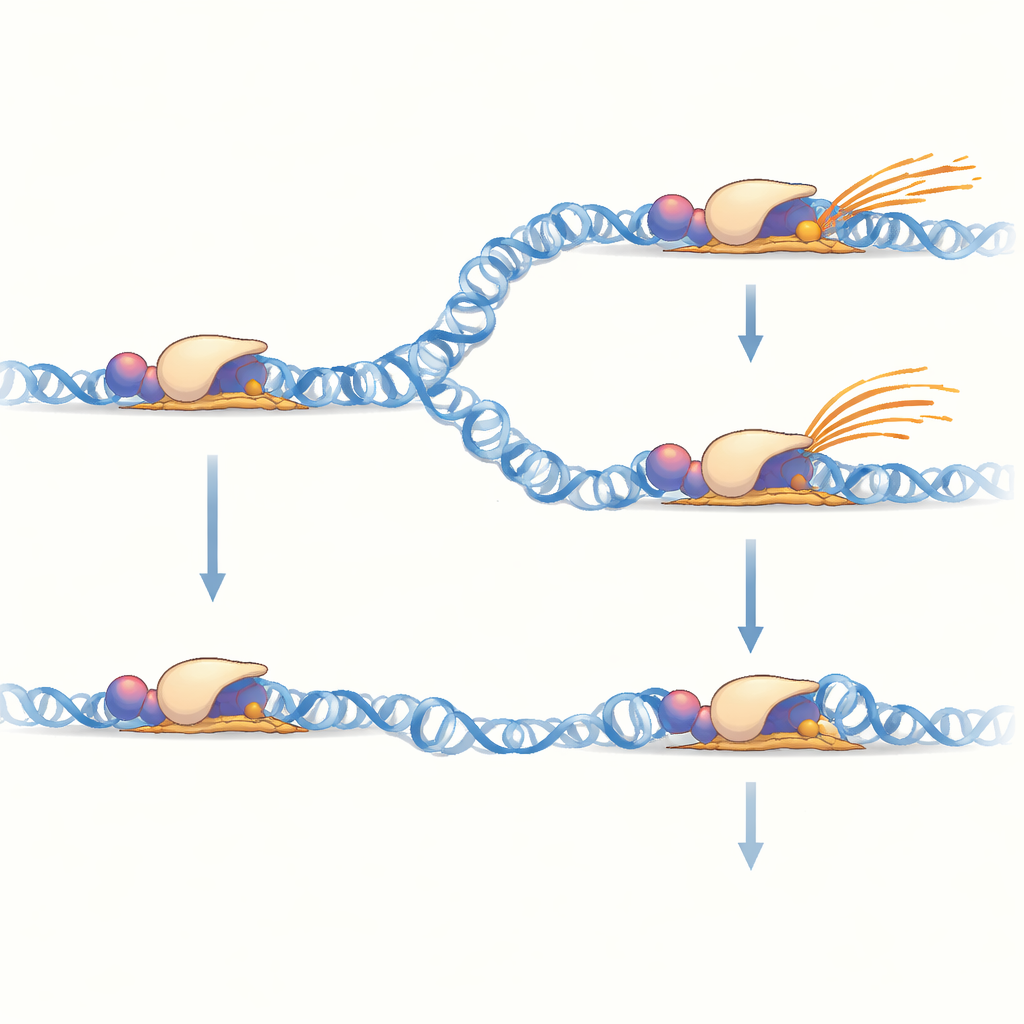
DNA inside cells is not a relaxed straight ladder; it is often over‑ or under‑twisted, a property known as supercoiling. Under‑twisted (negatively supercoiled) DNA opens more easily, while relaxed DNA resists unwinding. Using a technique that tags under‑wound stretches of DNA, the authors created a genome‑wide map of supercoiling and discovered that CarD‑bound promoters sit in especially under‑twisted regions. When they treated cells with a drug that relaxes DNA by blocking an enzyme that normally adds negative twists, these CarD‑bound promoters lost both CarD and RNA polymerase and their nearby genes were mostly turned down. This showed that CarD’s ability to help open DNA depends strongly on the surrounding DNA being in a suitably twisted state.
Rebuilding Promoters and Watching Them Respond
To test cause and effect more directly, the team recreated key promoters on circular DNA molecules and systematically altered both the DNA sequence and its twist in test‑tube reactions. For an important ribosomal promoter that normally needs CarD, they found that CarD could only boost activity when the DNA was sufficiently under‑twisted. If the researchers repaired the missing DNA letter in the promoter, CarD could now activate even on relaxed DNA, and heavy supercoiling became less critical. Conversely, for the promoter that controls the carD gene itself, CarD and strong negative twisting together could actually over‑stabilise the opened DNA and suppress transcription, while on relaxed DNA the same protein switched to an activating role. By building hybrid promoters that mix pieces from these different switches, the authors showed that subtle sequence features and DNA shape can tilt CarD’s effect toward activation or repression.
Connecting Growth, Stress, and Core Cellular Work
When the authors examined which genes depend on both CarD and negative DNA supercoiling, they found many involved in fundamental processes such as making ribosomes and transfer RNAs—parts of the machinery that drives rapid growth. In slow‑growing or stressed cells, global DNA becomes more relaxed, and CarD binds less strongly at these sites, reducing expression of these energy‑intensive genes. In this way, CarD and DNA supercoiling together act as a mechanical sensor that couples basic gene expression to the cell’s physical and environmental state.
Why This Matters for Understanding Bacteria
To a layperson, this study shows that bacteria do not just rely on genetic “software” (DNA sequences) to control their lives; they also use the physical “hardware” of how DNA is twisted, plus helper proteins like CarD, to fine‑tune which genes are active. In Rhodobacter sphaeroides, many promoters are deliberately made weak and then rescued by CarD, but only when DNA is twisted in a way that signals good growth conditions. When DNA relaxes during stress, these same genes naturally quiet down. This built‑in link between DNA mechanics and gene control likely operates in many bacteria, helping them swiftly adapt their core housekeeping work to changing environments.
Citation: Forrest, D., Warman, E.A. & Grainger, D.C. The bacterial RNA polymerase-associated CarD protein couples promoter activity to DNA supercoiling. Nat Commun 17, 2295 (2026). https://doi.org/10.1038/s41467-026-69038-3
Keywords: DNA supercoiling, bacterial transcription, CarD protein, gene regulation, Rhodobacter sphaeroides