Clear Sky Science · en
Continuous-variable fault-tolerant quantum computation under general noise
Why taming noisy light matters
Quantum computers promise to crack problems that overwhelm today’s machines, from simulating complex molecules to optimizing global logistics. Many of the most scalable hardware platforms for these devices are based on light, where information is carried not by individual particles but by the continuous wiggles of an electromagnetic wave. The challenge is that real-world light is noisy: tiny jitters, losses, and distortions can quickly overwhelm delicate quantum information. This paper shows, for the first time in a rigorous way, that even under very general and realistic kinds of noise, a light-based quantum computer can still run reliably—provided it is built in the right way.
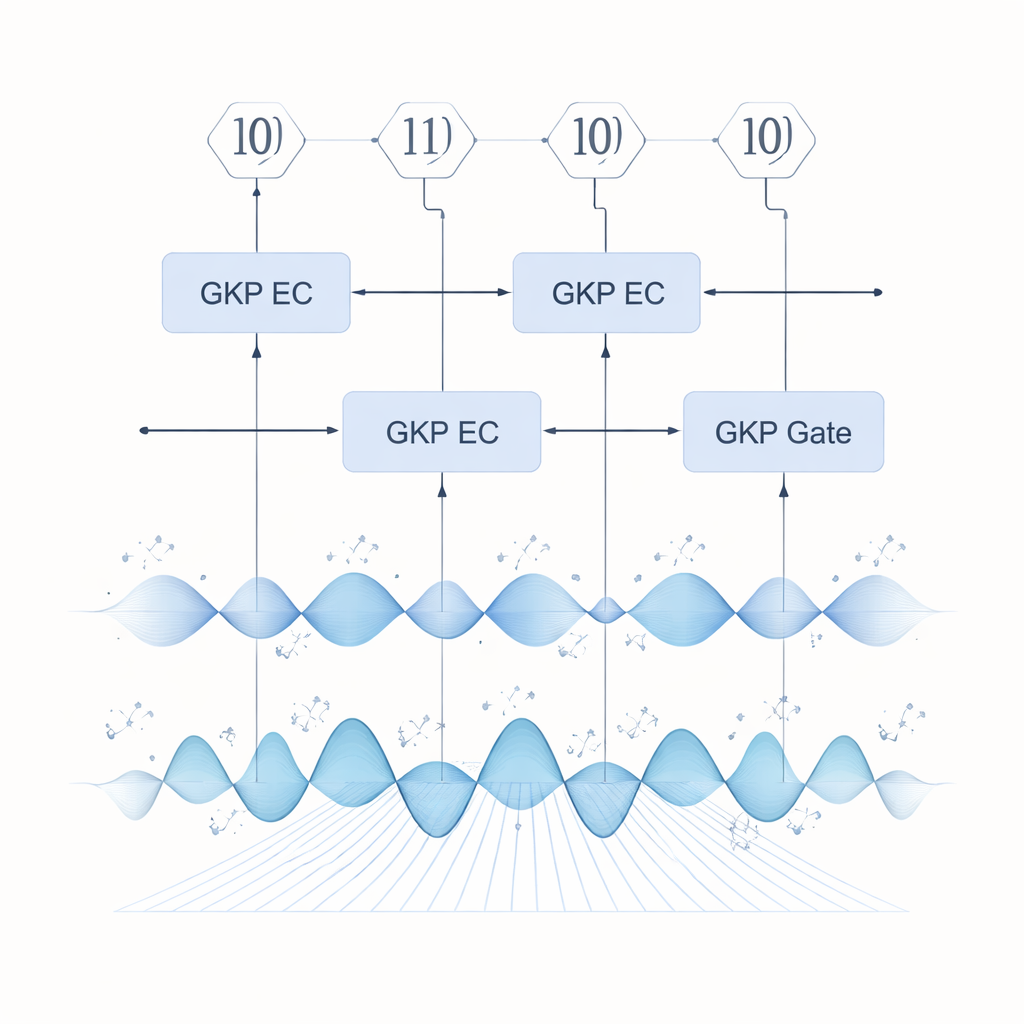
From smooth waves to digital quantum bits
In optical “continuous-variable” systems, information is stored in the strength and phase of a light field, which can vary smoothly. This makes it easy to generate and manipulate large networks of entangled light beams, an attractive route to scalable quantum hardware. But most theory of reliable quantum computation was developed for discrete two-level systems—qubits—and for relatively simple error models. A central tool for bridging this gap is the Gottesman–Kitaev–Preskill (GKP) code, which cleverly embeds a single qubit inside the continuous degrees of freedom of an oscillator. The code arranges quantum states so that small shifts in the light’s amplitude or phase behave like familiar qubit errors that can, in principle, be corrected. Previous analyses, however, only worked for very special noise, such as purely Gaussian random shifts, and often relied on idealized, physically impossible code states.
Redefining what counts as a correctable error
The authors’ first step is to give a more realistic description of GKP-encoded states and errors that does not lean on unphysical assumptions. They use a mathematical framework called stabilizer subsystem decomposition, which splits the light’s full state space into two parts: one that carries the logical qubit and another that records “syndrome” information about errors. Within this picture they define an “r-filter,” which effectively asks how far the state has wandered from the no-error region in this syndrome space. An approximate GKP state is then characterized not by a perfect grid of delta-function peaks, but by how tightly it is confined within a small square patch around the origin. As long as the state stays within this patch, the encoded qubit can still be interpreted as clean, even though the underlying wavefunction may be messy.
Keeping both noise and energy under control
Real optical systems face two intertwined problems: errors accumulate over time, and the energy of the light field can grow without bound as gates are applied. Standard measures of noise, used for qubits, assume access to arbitrarily energetic test states and therefore judge even tiny phase slips in light as “maximally bad.” To avoid this unrealistic verdict, the authors adopt an energy-constrained notion of distance between physical processes, which only compares how channels act on states below a fixed photon-number threshold. They then design a specific kind of error-correction step, based on quantum teleportation, that repeatedly transfers the logical information into freshly prepared, moderate-energy GKP states. This “Knill-type” procedure not only corrects displacement-like errors but also continually resets the energy, ensuring that the encoded states never become arbitrarily fragile.
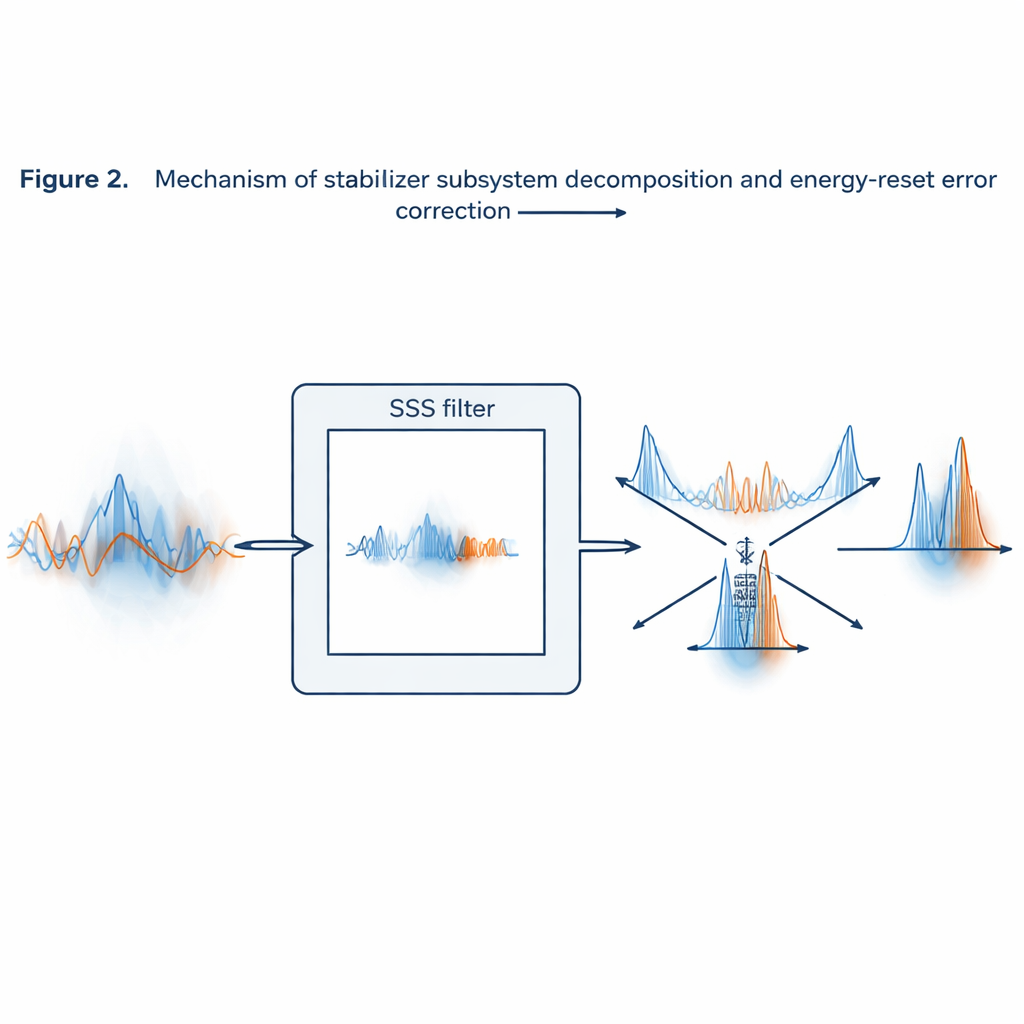
From messy laboratory noise to neat logical errors
With these tools in hand, the paper defines a broad class of physically realistic noise—independent and Markovian, but otherwise quite general. Each optical mode may suffer loss, random phase rotations, imperfect GKP state preparation, finite detector resolution, or other non-Gaussian distortions, as long as their overall strength is bounded in the energy-constrained sense and does not add more than a limited amount of extra displacement. The authors show that, when such noise acts on a fault-tolerant GKP-based circuit, its complicated continuous effects translate into an effective noise model on the logical qubits that is local and Markovian, just like the standard setting where powerful threshold theorems already exist. Crucially, they bound how strong this logical noise can be in terms of a few experimentally meaningful parameters: the maximum allowed displacement, the tolerated error strength, and an energy cap.
A true threshold for light-based quantum computing
Combining their translation of physical noise into logical qubit noise with known results for concatenated qubit codes, the authors prove a full threshold theorem for continuous-variable quantum computation. In plain terms, there exists a nonzero level of general optical noise below which one can, by encoding and layering error-correcting codes, make the overall computation as reliable as desired, with only polylogarithmic overhead in resources. The work also highlights a qualitative difference between light-based and qubit-based architectures: in continuous-variable systems, careful energy management is not just an engineering detail but a core requirement for fault tolerance. This rigorous framework now offers experimentalists a concrete set of targets—on squeezing, loss, phase stability, and detector performance—to guide the construction of scalable, fault-tolerant quantum computers built from noisy light.
Citation: Matsuura, T., Menicucci, N.C. & Yamasaki, H. Continuous-variable fault-tolerant quantum computation under general noise. Nat Commun 17, 1709 (2026). https://doi.org/10.1038/s41467-026-69036-5
Keywords: continuous-variable quantum computing, GKP code, quantum error correction, fault tolerance, optical quantum systems