Clear Sky Science · en
Master field equations for spherically symmetric gravitational fields beyond general relativity
Why taming black holes matters
Black holes, the cosmic monsters predicted by Einstein’s theory of general relativity, hide a troubling secret at their cores: a “singularity,” where known physics breaks down. This mathematical glitch keeps us from fully understanding how black holes form, evolve and ultimately interact with quantum physics. The article introduces a new mathematical framework that reshapes how we describe highly symmetric gravitational fields, opening a path toward models of black holes without such destructive infinities. 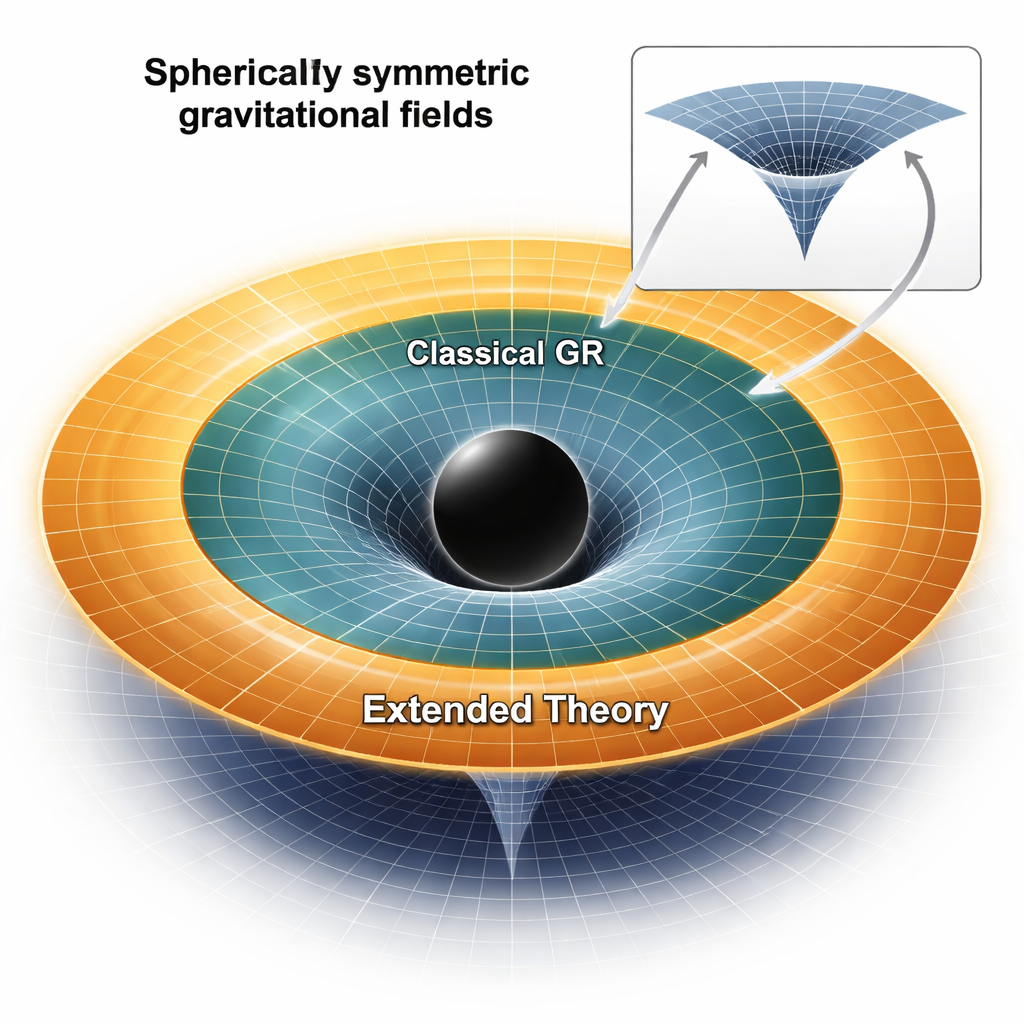
From simple spheres to complex questions
Physicists often start with highly symmetric situations to crack hard problems. For gravity, one of the simplest yet most powerful cases is a perfectly spherical distribution of matter, like an idealized star or black hole. Einstein’s equations in this setting have given us many famous solutions that underpin modern cosmology and black hole physics. However, these same equations predict that, under extreme collapse, spacetime can tear itself into a singularity. This signals that general relativity, while extremely successful, is incomplete at the highest energies and curvatures.
Building a broader rulebook for gravity
The paper tackles a key missing step in going beyond Einstein: a clean, general set of equations that describe how spherically symmetric spacetimes actually evolve, not just how they look in static snapshots. The author constructs what are called “master field equations” for spherical gravity, derived from an underlying action (a compact way of encoding physical laws) and restricted so that only up to second derivatives of the metric appear. Within these rules, he defines the most general possible gravitational tensor that is automatically conserved and reduces to Einstein’s familiar form in the appropriate limit. This tensor governs how matter and gravity talk to each other when space retains perfect spherical symmetry.
Guaranteeing stable, static exteriors
A striking payoff of this framework is a general proof of the Birkhoff–Jebsen theorem for this broad family of theories. In essence, this theorem says that if you have a spherically symmetric vacuum outside some matter, the spacetime outside must be static and determined by just one parameter (like mass), regardless of how the interior evolves. The paper shows that as long as you keep to second-order equations, don’t add extra gravitational fields and avoid non-local behavior, this property survives beyond general relativity. To break it, you must introduce higher derivatives, new gravitational ingredients or non-local effects. This result neatly organizes which kinds of modifications to gravity can preserve familiar black hole behavior and which necessarily lead to more exotic dynamics.
Designing regular black holes without singularities
Perhaps the most eye-catching application is to so-called “regular” black holes—models in which the crushing singularity is replaced by a smooth core. Using the master equations, the author shows how to systematically reverse-engineer gravitational laws that make specific regular black hole geometries (such as the well-known Bardeen and Hayward models) arise as exact vacuum solutions, much like the Schwarzschild solution does in Einstein’s theory. The method relies on encoding the spacetime geometry into a potential-like function, from which the modified gravitational terms are generated. This offers an effective, theory-agnostic way to capture possible quantum gravity corrections in a simple lower-dimensional language, then lift them back to a full four-dimensional spacetime. 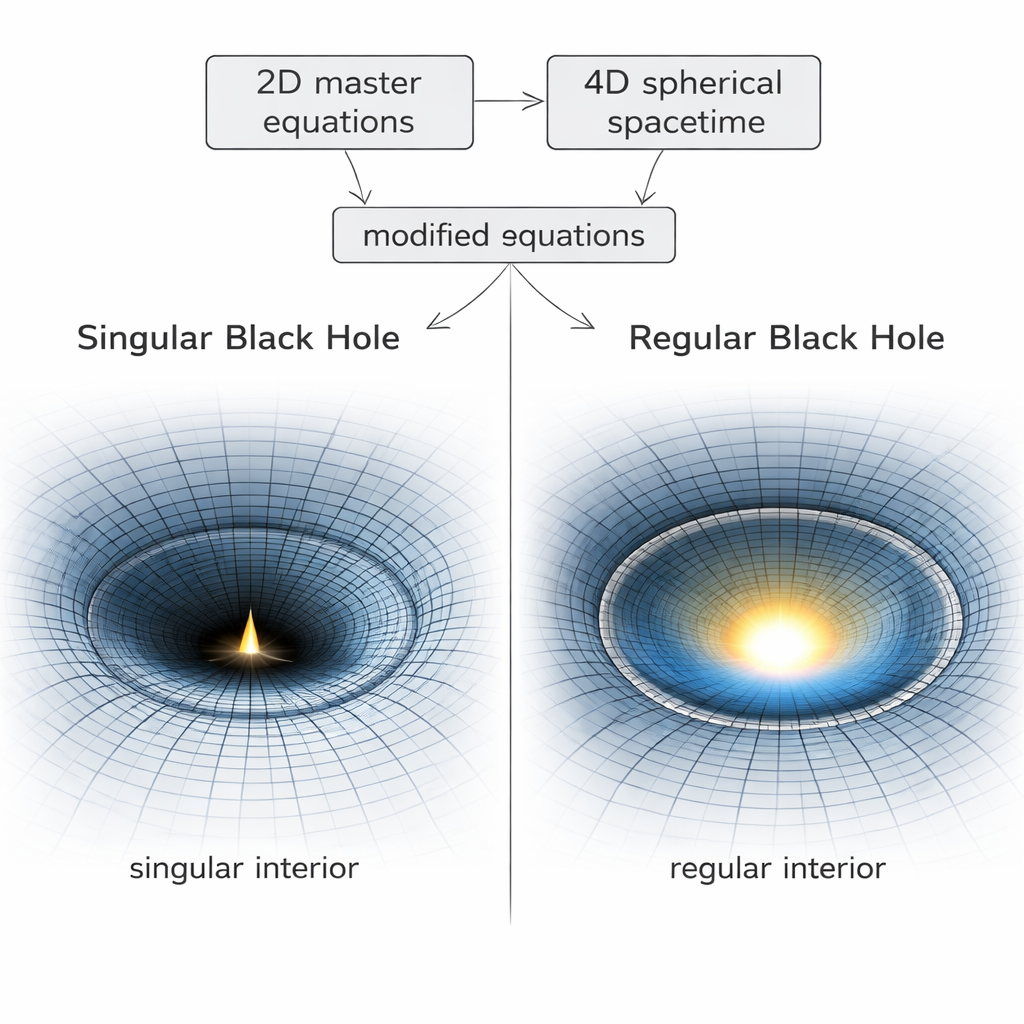
Toward a non-singular picture of collapse
Seen from a lay perspective, the article shows how to rewrite the rules of gravity, in symmetric situations, so that black holes need not contain a breakdown point where physics stops making sense. Instead, under broad conditions, one can have black holes with well-behaved interiors that still look familiar from the outside. The new master equations provide a common stage on which many candidate theories of quantum gravity can be compared, tested and used to simulate realistic processes such as gravitational collapse and black hole evaporation. While important technical challenges remain—such as ensuring that these equations lead to mathematically well-posed and physically consistent evolutions—the work marks a significant step toward a complete, singularity-free description of black hole physics.
Citation: Carballo-Rubio, R. Master field equations for spherically symmetric gravitational fields beyond general relativity. Nat Commun 17, 1399 (2026). https://doi.org/10.1038/s41467-026-69035-6
Keywords: black holes, general relativity, modified gravity, spherical symmetry, regular black holes