Clear Sky Science · en
Subjective nature of path information in quantum mechanics
Why this strange quantum story matters
In everyday life, we assume that if something happens, we can always say where it came from. A raindrop fell from a cloud; a sound came from a loudspeaker. In quantum physics, however, this seemingly simple idea breaks down. This article reports an experiment with single particles of light that shows a surprising twist: even when physicists have what they would normally call "full path information" about those particles, they still cannot consistently say which source created them. The result forces us to rethink what we mean by "where" a quantum particle has been.
Waves, particles, and a rule about what you can know
For more than a century, quantum mechanics has told us that tiny objects like photons behave both like waves and like particles, but not in the same experiment. If you arrange things so that they make clear ripples—a pattern of bright and dark stripes called interference—then you must give up knowing which precise path each photon took. If instead you find out which path it followed, the interference pattern disappears. This balance is captured by a well tested rule: as interference visibility increases, path information must decrease, and vice versa. That rule has been verified many times with light passing through two paths or two slits.
Adding a third source changes the story
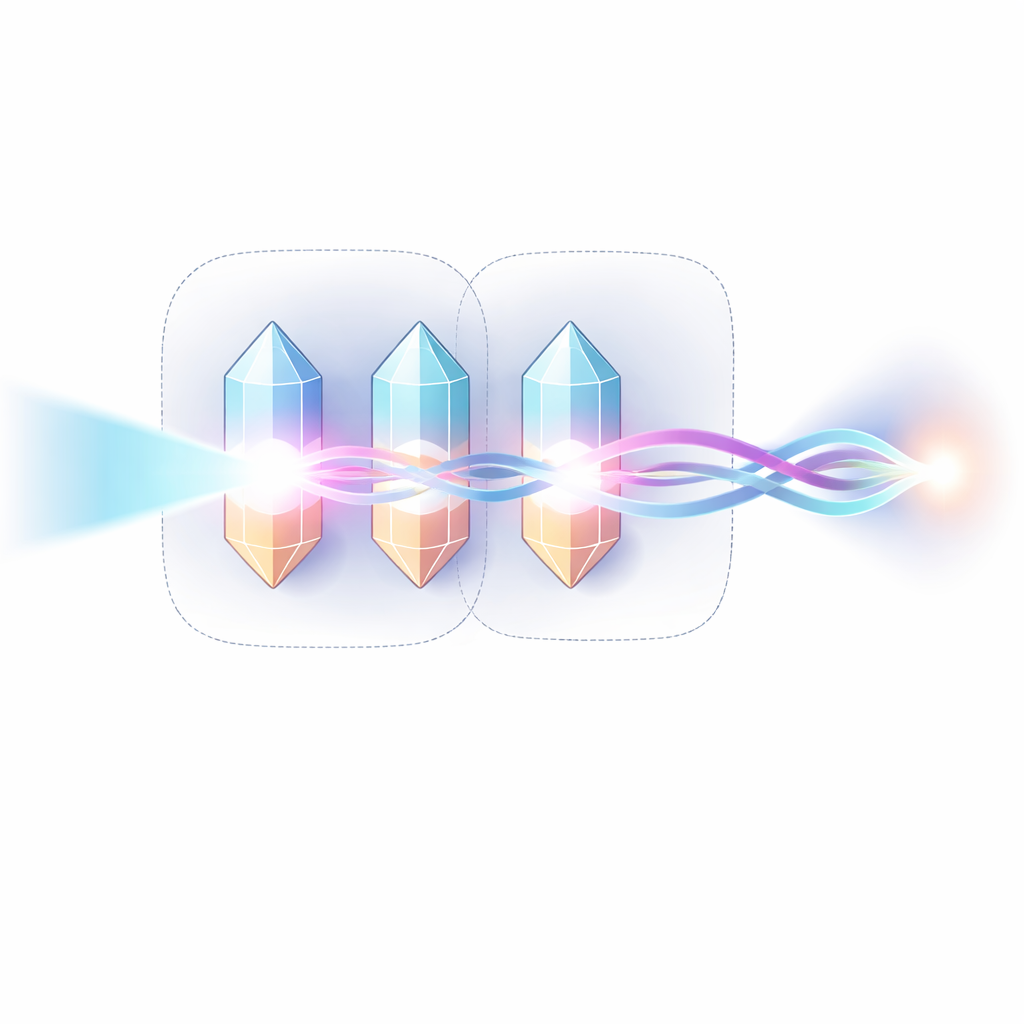
The new work explores what happens when there are not just two, but three possible ways for pairs of photons to be created. The team used three nearly identical nonlinear crystals, each of which can convert a violet pump beam into a pair of redder photons. The crystals were aligned so that the photons from all three followed exactly the same paths to the detectors, making them physically indistinguishable. By inserting transparent plates between the crystals, the researchers could finely tune the relative phases of the light waves, which determines whether their contributions add up or cancel out. In this carefully engineered setup, the overall rate of detected photon pairs could be high, low, or anything in between, depending on those phases.
When grouping paths gives clashing answers
The key idea in the experiment is that you are free to group alternatives in different ways. With three crystals, you might choose to treat the first two crystals together as a single "effective" source and the third as another. By adjusting one phase, the contribution from the combined first pair can be tuned to cancel out, so that mathematically their joint probability amplitude becomes zero. In that description, it looks as if all observed photons must have come from the third crystal, and the usual rule then says you have full path information and no interference. But nothing in the laboratory has changed except a phase shift: the crystals themselves are still there, and individually they are capable of producing photons.
Two equally good stories that cannot both be true
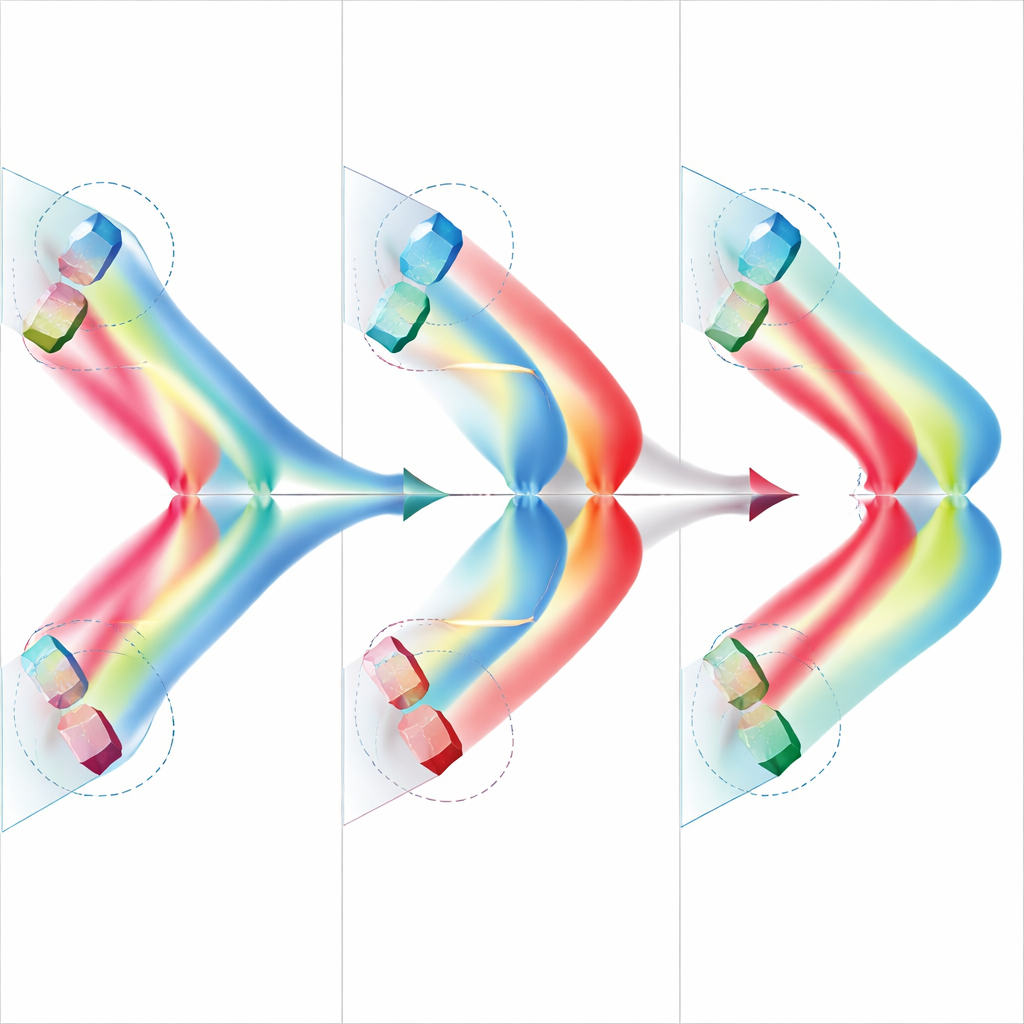
The researchers then regrouped the very same physical setup in a different way: now the first crystal stood alone, and the second and third crystals were treated as one combined source. With a different but compatible choice of phase, the joint contribution of the second and third crystals could be made to cancel. In this alternative description, it appears that all photons must have come from the first crystal instead. Both ways of grouping lead to self-consistent predictions, both satisfy the standard trade-off between interference and path knowledge, and both can describe one and the same run of the experiment. Yet they imply opposite answers about which crystal "really" produced the photons—a logical clash if we try to interpret path information as an objective fact about each photon’s origin.
What this means for our picture of quantum reality
The experiment shows that in a three-source scenario, you can arrange things so that there is no visible interference and yet no unique, context-free answer to the question, "Which crystal did the photons come from?" The mathematical description of the whole system is precise and objective, but the way we carve it up into alternative paths, and thus what we call "path information," depends on our chosen viewpoint. In that sense, path information in quantum mechanics is not an absolute property of the particles alone; it is partly shaped by how we describe the experiment. This insight sharpens our understanding of quantum complementarity and suggests that even familiar notions like "where a particle was" can be subtly, but fundamentally, subjective in the quantum world.
Citation: Jiang, X., Hochrainer, A., Kysela, J. et al. Subjective nature of path information in quantum mechanics. Nat Commun 17, 2433 (2026). https://doi.org/10.1038/s41467-026-69034-7
Keywords: wave-particle duality, quantum interference, photon pairs, which-path information, quantum foundations