Clear Sky Science · en
Theory-independent monitoring of the decoherence of a superconducting qubit with generalized contextuality
Why this matters for future quantum technologies
Quantum computers and sensors rely on fragile quantum effects that easily fade away when a device interacts with its surroundings. To build reliable technology, we need ways to watch this fading—or decoherence—happen in real time, and to do so without blindly trusting that our theoretical description of the device is perfectly correct. This article reports an experiment that tracks how a superconducting quantum bit (qubit) gradually loses its distinctly quantum behavior and becomes effectively classical, using only observed measurement statistics rather than assuming that standard quantum theory is right from the start.
Watching a single quantum device without assuming the rules
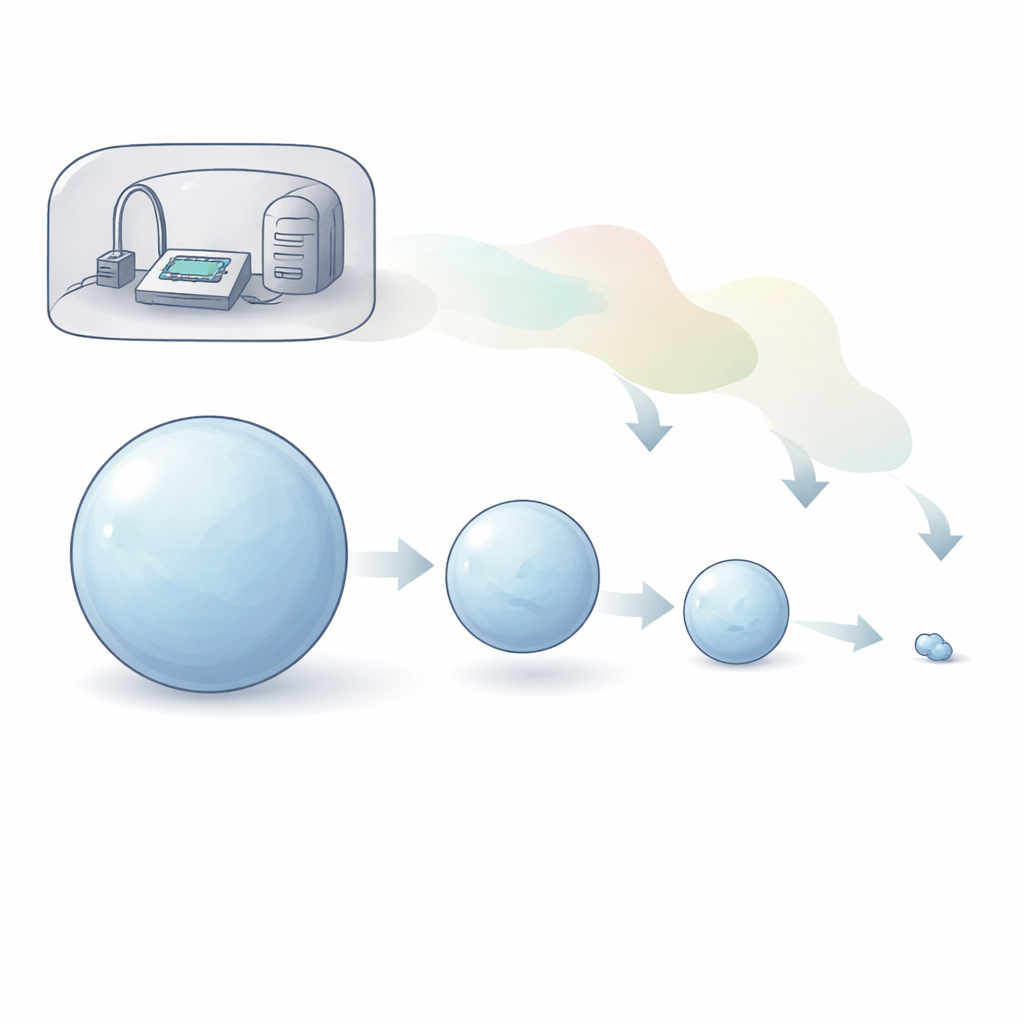
The researchers study a single superconducting qubit formed by a tiny electrical circuit cooled to near absolute zero. Instead of describing it directly with the usual mathematics of quantum mechanics, they treat the experiment as a black box: many different ways of preparing the qubit and many different ways of measuring it, with recorded outcome frequencies for each combination. From these numbers alone, they reconstruct the most economical abstract model that can explain all the data. In this framework, the possible states of the system form a geometric object—an abstract “state space”—and the possible measurement outcomes form a matching “effect space.” Quantum theory is just one special case of such models; in principle, the data could have pointed to something more exotic.
The shape of a quantum bit and how it shrinks
For a textbook qubit, the normalized states can be visualized as points inside a solid sphere, often called the Bloch ball. By fitting their data, the authors find that the best description of their device at short times has a four-dimensional underlying structure, which corresponds to a three-dimensional ball of normalized states—just what one expects for an ordinary qubit. However, when they include how the system changes after various waiting times, they see this ball steadily contract towards a smaller region centered near a single favored state. This contraction captures, in a theory-neutral language, the physical processes of decoherence and relaxation: the qubit is losing the ability to occupy a wide variety of distinct quantum states and is being driven toward something like its ground state.
From deeply quantum behavior to effective classicality
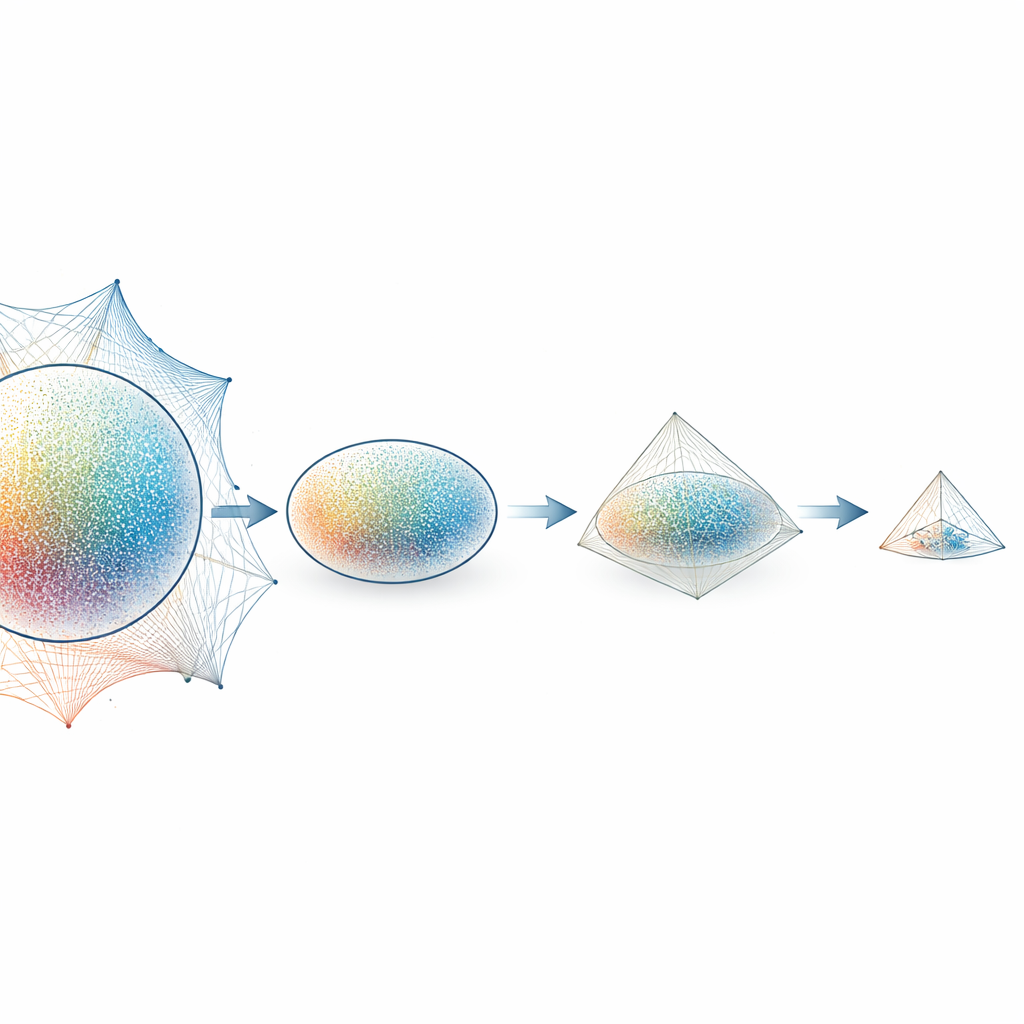
A key question is whether the system behaves in a way that fundamentally resists any classical hidden-variable explanation. Using tools from the general framework, the authors test whether the reconstructed state and measurement spaces can be embedded into an ordinary classical probability model. At early times, this is impossible: the qubit exhibits “contextuality,” meaning that no classical picture in which hidden properties explain all outcomes can match the statistics, even allowing for noise. As decoherence proceeds, the amount of contextuality decreases. Between about 10 and 15 microseconds, the analysis shows that no extra noise need be added for a classical model to work, indicating that the system has become effectively noncontextual and thus, in this sense, classical.
Tracing memory effects in the environment
Beyond simple decay, the authors look for signs that the environment sometimes feeds information back into the qubit—a hallmark of non-Markovian dynamics, where the future does not depend only on the present but also on the past. In their abstract description, this shows up as the volume of the reconstructed state space occasionally increasing after a period of shrinkage, something that cannot happen if the system’s evolution were purely memoryless. They indeed observe such a temporary expansion at late times, revealing non-Markovian behavior, again without building quantum theory explicitly into the analysis.
What this work tells us about quantum reality
By combining a flexible, theory-independent modeling framework with a highly controllable superconducting device, the authors demonstrate that central dynamical features of quantum systems—loss of coherence, disappearance of nonclassicality, and environmental memory—can be identified directly from experimental statistics. Their conclusions would remain valid even if future physics were to revise or replace quantum theory, as long as the same observed frequencies are reproduced. This approach offers a powerful new way to test quantum devices and probe the boundary between quantum and classical behavior while making as few theoretical assumptions as possible.
Citation: Aloy, A., Fadel, M., Galley, T.D. et al. Theory-independent monitoring of the decoherence of a superconducting qubit with generalized contextuality. Nat Commun 17, 2474 (2026). https://doi.org/10.1038/s41467-026-69030-x
Keywords: superconducting qubit, decoherence, contextuality, generalized probabilistic theories, non-Markovian dynamics
See more on the researcher's website: https://mpmueller.net/