Clear Sky Science · en
Estimating global bee species richness and taxonomic gaps
Why unseen bees matter to all of us
Bees are famous for pollinating crops and wildflowers, but most people don’t realize how many different kinds of bees actually exist—or how many are still unknown to science. This study asks a deceptively simple question with big consequences: how many bee species are there on Earth, and where are we missing the most? The answer affects food security, biodiversity conservation, and how we respond to global environmental change.
Counting the world’s bees
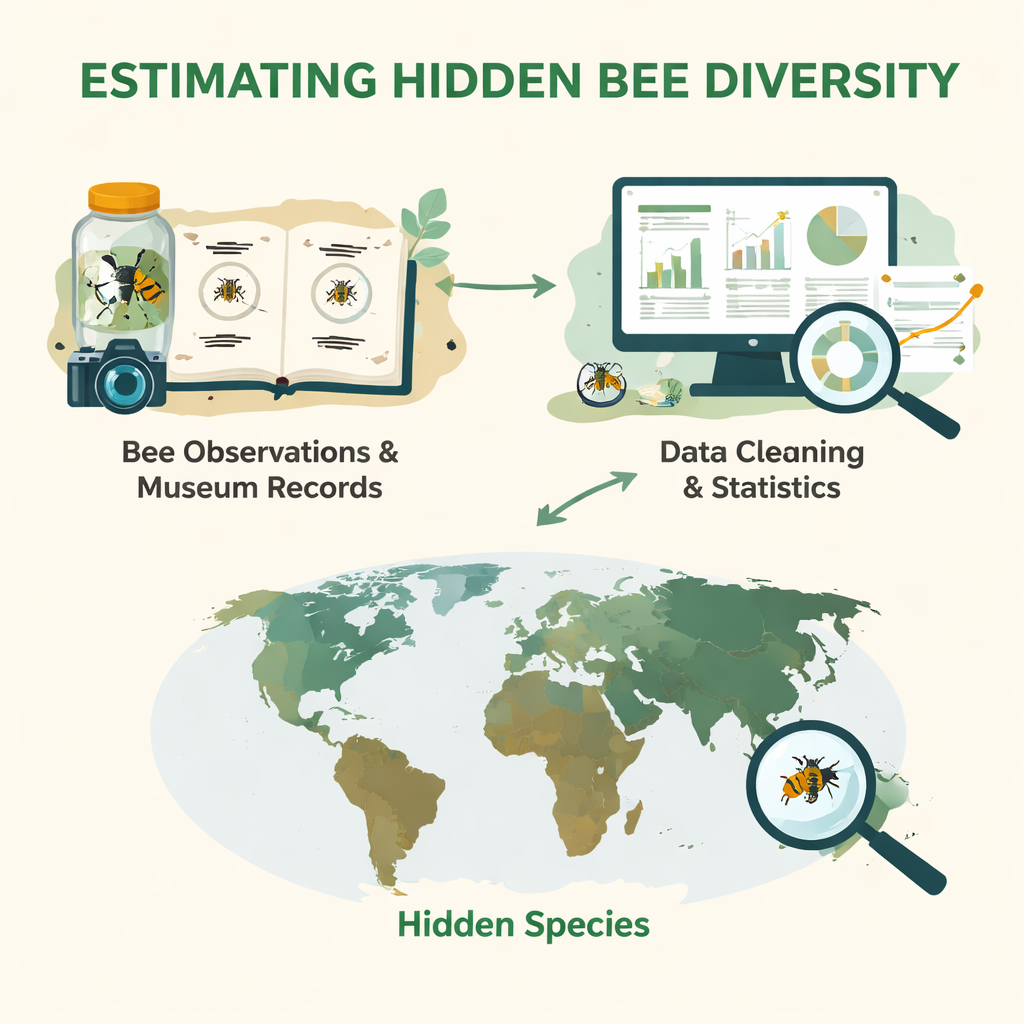
Instead of guessing, the researchers used a vast collection of data to make the first rigorous, global estimate of bee diversity. They pulled together more than 8 million bee occurrence records, a worldwide bee name list of about 21,000 recognized species, and detailed country-by-country checklists. They then applied established statistical tools—originally developed for estimating unseen species in ecological surveys—to calculate how many bee species are likely still undescribed. This allowed them to move from scattered records to quantitative estimates of how many bees we know, and how many we are still missing.
More bee species than we thought
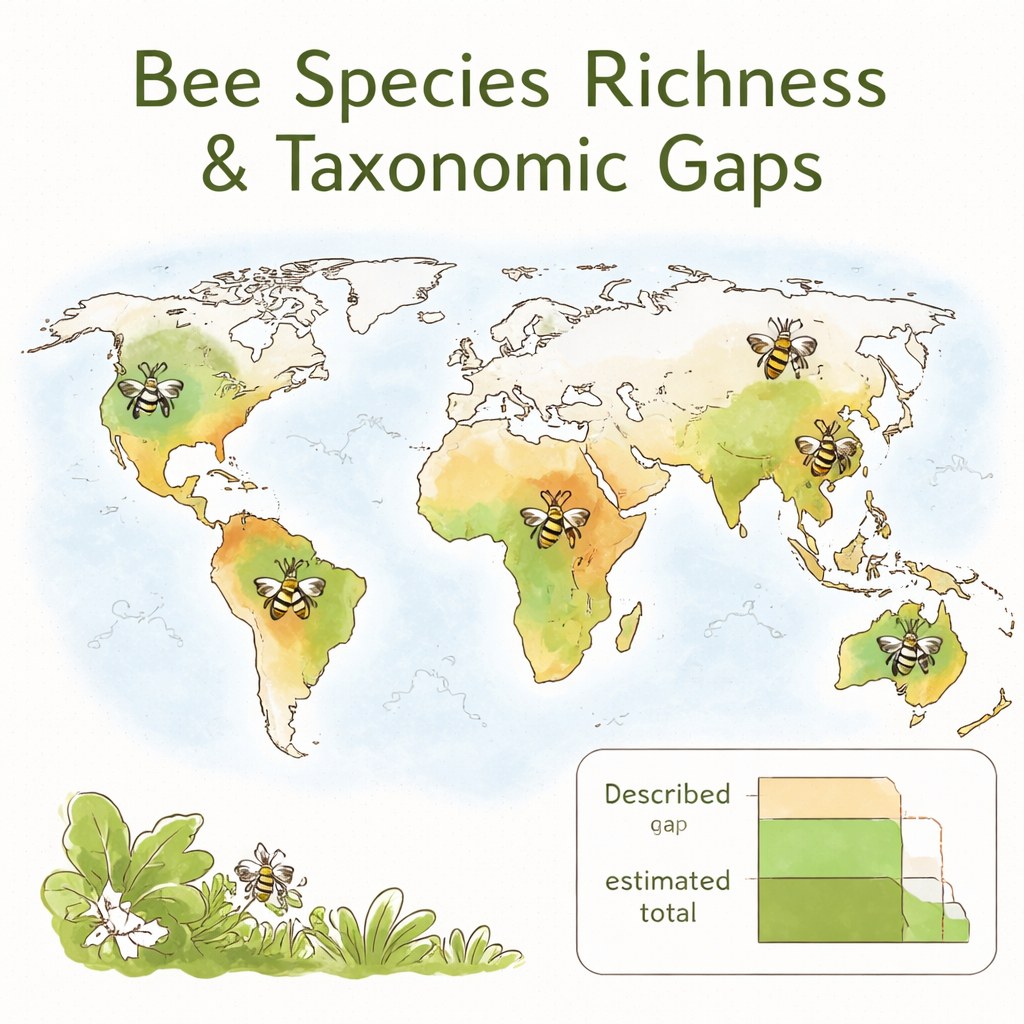
Their analysis suggests there are roughly 24,700 to 26,200 bee species worldwide, an increase of 18–25% over the ~21,000 species currently recognized. In other words, thousands of bee species are probably still unnamed. Asia shows the largest shortfall in both raw numbers and percentage, followed by Africa and the Americas. Europe and parts of North America appear relatively well studied, with smaller gaps between described and estimated diversity. Surprisingly, the models predict fewer missing species in Oceania than earlier, more speculative estimates had suggested—a result the authors suspect reflects data biases rather than a truly low diversity.
Where the gaps are largest
Zooming in, the team estimated bee diversity for 186 individual countries. Some hotspots stand out: Turkey alone may have more undiscovered bee species than all of continental Europe; China and Israel also show very large gaps. Island nations emerge as especially rich in bee species for their size, underscoring their outsized importance for evolution and conservation. Yet many of these same regions lack the taxonomic experts, museum resources, and research funding needed to discover and describe new species. The authors argue that these blind spots have real implications for protecting ecosystems and planning conservation, particularly in poorer countries.
Why money, data, and effort matter
To understand why some regions are better known than others, the researchers looked at links between the predicted taxonomic gaps and national features such as income, education levels, land size, elevation, and road access. They found that countries with higher income per person tend to have smaller bee knowledge gaps, likely because they can invest more in research and collections. Places with more recorded bee observations and more complete databases also had smaller gaps, reflecting years of fieldwork and identification. By contrast, factors like country area, elevation range, or distance from roads did not reliably predict how many bee species are still unknown. This points to human choices and capacities, rather than geography alone, as key drivers of our ignorance.
A roadmap for discovering hidden species
Based on current rates of around 117 new valid bee species described per year, the authors estimate it would take at least 32–45 years to close the current gap—if the rate stayed constant and if their estimate truly captured the lower limit of diversity. In reality, that timeline is probably optimistic, because many species are cryptic, data are uneven, and funding for taxonomy is limited. To speed progress, the team has released an open-source R software package that lets other scientists repeat their workflow for bees or apply it to completely different groups, from beetles to trees. In accessible terms, the paper’s message is that we are still far from knowing the full variety of bees that sustain our crops and ecosystems, but we now have a practical, data-driven roadmap to find them and to target conservation and research where they are needed most.
Citation: Dorey, J.B., Gilpin, AM., Johnston, N.P. et al. Estimating global bee species richness and taxonomic gaps. Nat Commun 17, 1762 (2026). https://doi.org/10.1038/s41467-026-69029-4
Keywords: bee diversity, species richness, pollinators, biodiversity gaps, conservation