Clear Sky Science · en
Plant diversity within communities, not among them, stabilizes grassland productivity across spatial scales
Why grassland variety matters for everyone
Vast grasslands on the Qinghai–Tibet and Inner Mongolia Plateaus help feed livestock, store carbon, and buffer climate extremes. This study asks a deceptively simple question with big consequences: is it more important to have many kinds of plants within each patch of grassland, or to have very different patches across the landscape, if we want steady, reliable plant growth year after year?
Looking closely at China’s great grasslands
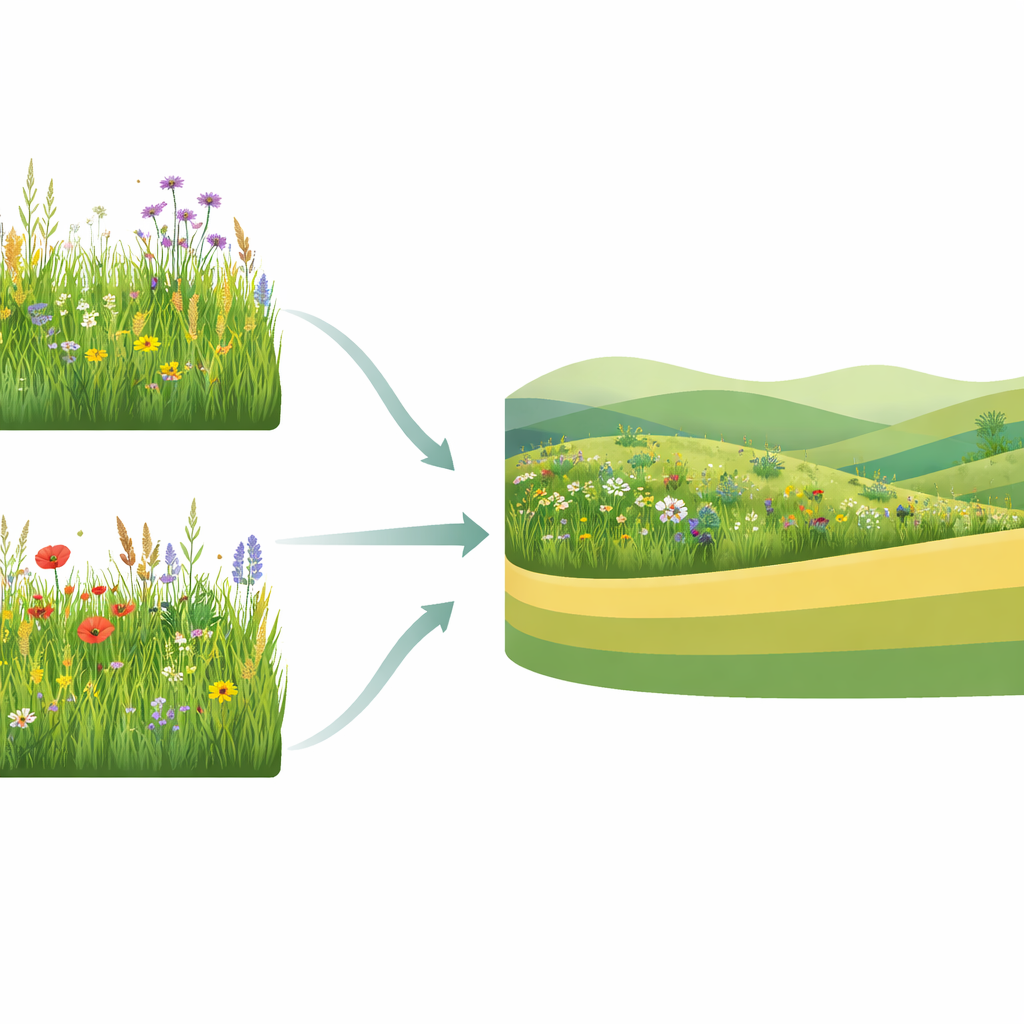
The researchers surveyed 235 grassland sites spanning huge differences in altitude, temperature, and rainfall across two iconic regions of China. In each site they marked out four small plots, identified all plant species, measured their biomass, and collected leaves and soils to characterize how plants use resources such as water and nutrients. They then combined these on-the-ground measurements with 10 years of satellite data that track how green and productive each tiny area of land was from year to year. This allowed them to estimate how stable plant production was locally and how that stability behaved when neighboring plots were considered together.
Fast plants, slow plants, and community balance
Not all plants make a living in the same way. Some grow quickly, with thin, nutrient-rich leaves that capture light and resources rapidly but may be more vulnerable to stress. Others grow slowly, with tougher leaves that invest in durability and resistance. The team summarized these differences along a “fast–slow” spectrum and asked how the mix of plant strategies and the number of species in a plot related to the steadiness of plant growth through time. They found that plots with more species tended to have more stable productivity. However, plots where the mix of leaf strategies was very diverse were, on average, slightly less stable. Communities dominated by fast-growing species, but not too functionally diverse, often showed particularly steady productivity.
Zooming out from plots to landscapes
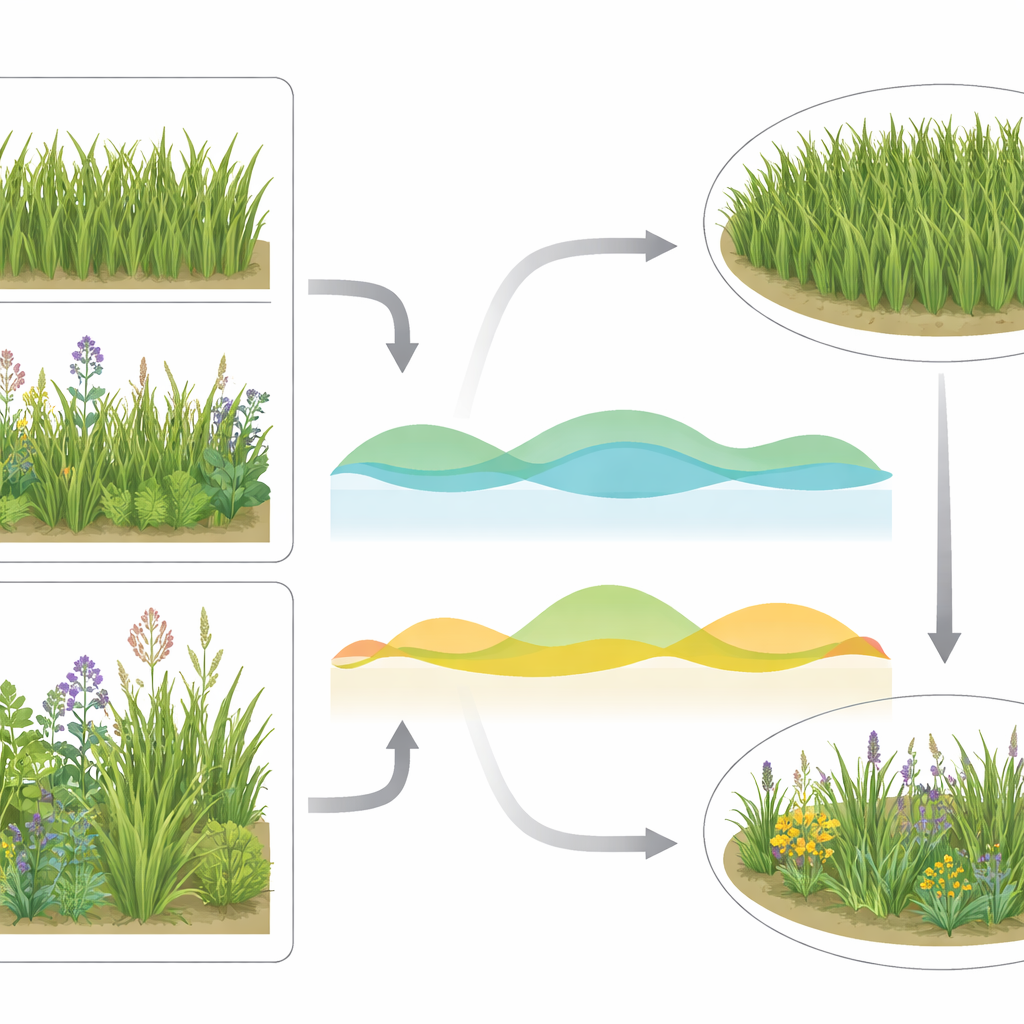
Ecologists have proposed that having different kinds of communities scattered across a landscape could act like an insurance policy: when one place has a bad year, another might have a good one, and their ups and downs would cancel out. To test this, the authors compared how much plant communities within the same site differed in species and leaf strategies, and whether those differences translated into more “out of sync” fluctuations in productivity among plots. If this idea held strongly, those differences should boost stability at the larger, multi-plot scale. Instead, the study found little evidence that variation among neighboring plots increased larger-scale stability. What mattered most for steady productivity, even when zoomed out, was the diversity within each local plot, not diversity among plots.
Climate, soils, and regional contrasts
Rain, temperature, and soil nutrients still played important roles—but differently in the two regions. In the drier Inner Mongolia Plateau, higher rainfall and richer soils tended to increase local diversity and, through that, to stabilize plant productivity, with rainfall also having a direct stabilizing effect. On the high, cold Qinghai–Tibet Plateau, local species richness itself was the strongest predictor of stability, while rainfall mainly affected how differently nearby plots fluctuated from one another. In both regions, though, the basic pattern held: more species within a plot generally meant more reliable plant growth over time, even when climate and soils were taken into account.
What this means for managing real-world grasslands
The study concludes that to keep grassland productivity steady in a changing climate, land managers should focus on maintaining and enhancing plant diversity within local communities. Having a rich mix of species in each pasture patch is more important for long-term stability than simply ensuring that patches differ from one another across the landscape. By clarifying how plant strategies and local diversity interact with rainfall and temperature, this work helps guide practical decisions about conserving and restoring grasslands so they continue to provide stable ecosystem services in the face of global change.
Citation: Huang, M., Granjel, R.R., Montoya, D. et al. Plant diversity within communities, not among them, stabilizes grassland productivity across spatial scales. Nat Commun 17, 2145 (2026). https://doi.org/10.1038/s41467-026-69028-5
Keywords: grassland ecosystems, plant diversity, ecosystem stability, remote sensing, climate impacts