Clear Sky Science · en
Topological mechanical metamaterial for robust and ductile one-way fracturing
Why breaking things on purpose can make them safer
Cracks in materials usually spell trouble: they can turn tiny flaws into sudden, catastrophic breaks in everything from bridges and airplanes to teeth and smartphone screens. This research shows that by carefully designing a material’s internal architecture, it is possible not only to decide which way a crack will go, but also to make an otherwise brittle material fail more gradually and predictably. That kind of “smart breaking” could one day make structures safer, lighter, and more reliable.
Turning random cracks into guided paths
In most ordinary solids, stress concentrates symmetrically at both tips of a crack. Which side actually grows first depends sensitively on small, uncontrollable defects, so engineers cannot reliably predict the crack’s path. The authors instead build “mechanical metamaterials” – artificial lattices made from repeating units – whose geometry is inspired by ideas from topological physics. A particular class, called Maxwell lattices, sits at the edge of mechanical stability and supports special soft deformation patterns. By cutting these lattices from thin brittle sheets and introducing a notch, the team shows experimentally and numerically that cracks no longer choose their direction randomly: they robustly propagate in only one direction, turning an abrupt failure into a controlled, stepwise process. 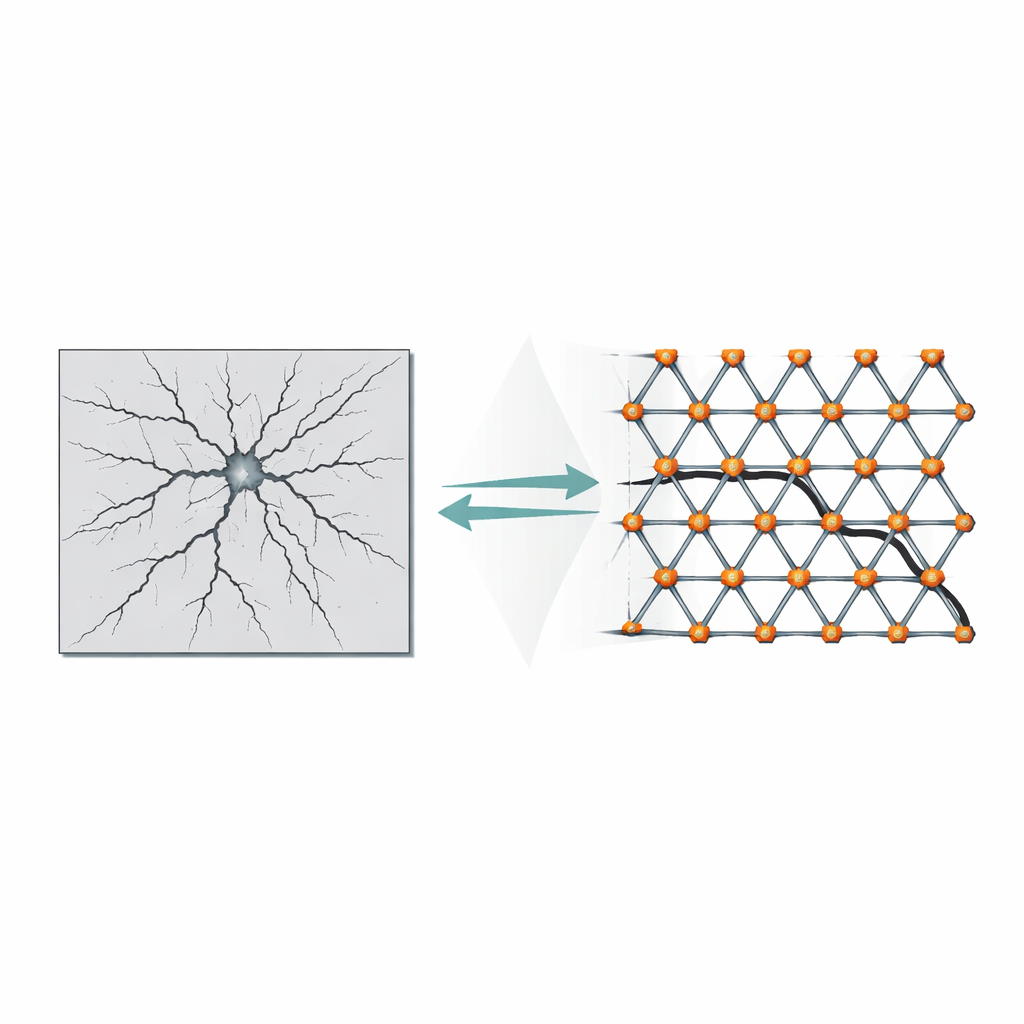
Hidden soft motions steer where cracks go
The key lies in how these lattices distribute motion and stress when stretched. In a topological mechanical metamaterial, certain low-energy deformation modes – called floppy or zero modes – are polarized: they naturally localize on one side of the structure. When a notch is introduced, these modes gather around one crack tip much more than the other. That tip’s hinges rotate and bend strongly, concentrating stress and eventually breaking one ligament at a time, while the opposite tip remains comparatively quiet. Calculations on idealized spring networks and more realistic, hinge-based models confirm that this strong left–right asymmetry is dictated by the lattice’s overall “topological” character, not by the precise shape of the notch or small fabrication imperfections.
From brittle snap to ductile, stepwise failure
To test how this plays out in practice, the authors compare several lattice types cut from the same brittle sheet: a dense triangular grid, a regular kagome lattice, a twisted kagome lattice, and their topological lattice. The dense and regular lattices behave much like ordinary solids: they are stiff and strong, but when the crack finally grows, it does so suddenly and in an unpredictable direction. The twisted kagome can steer straight cracks somewhat, but loses control when the notch shape changes. Only the topological lattice consistently sends cracks to the same side for a wide range of notch geometries and thicknesses. Remarkably, the overall stretching at failure and the total energy absorbed before complete break are much larger than in the other lattices, even though all are made of the same brittle material. The fracture process becomes a sequence of small, trackable breaking events rather than a single abrupt snap.
Choreographing cracks in complex settings
The researchers further explore how robust this guidance is. They tilt cuts, move notches to soft or stiff outer edges, and carve triangular or rectangular holes. Theory predicts, and experiments confirm, that as long as the lattice retains its topological polarization, the same side of the notch tends to carry much higher stress and initiates cracking first. At soft edges, this yields clean, straight one-way cracks; at stiff edges, the stress is more diffuse, so multiple paths can compete, leading to branched fracture patterns. By stitching together regions with opposite polarization, the team also creates built-in “walls” where stress focusses and cracks are forced to pass through in a programmable sequence. Changing the shape of these internal walls – straight or zigzag – tunes whether failure is abrupt or gradual, and how much energy the material can dissipate before losing integrity.
How this new kind of breaking could help
To a non-specialist, the main message is that the authors have found a way to use geometry, rather than special chemistry, to make brittle materials behave more kindly when they fail. Their topological mechanical metamaterial can direct cracks along a chosen path, make them travel one way instead of splitting, and stretch out the failure process into many small, warning-like steps. Because the underlying principles depend on the overall lattice pattern and not on the exact material or size, the same ideas could be applied from microscopic devices to large truss structures. In future, such designs may help engineers build lighter components that fail in controlled, predictable ways instead of shattering without warning. 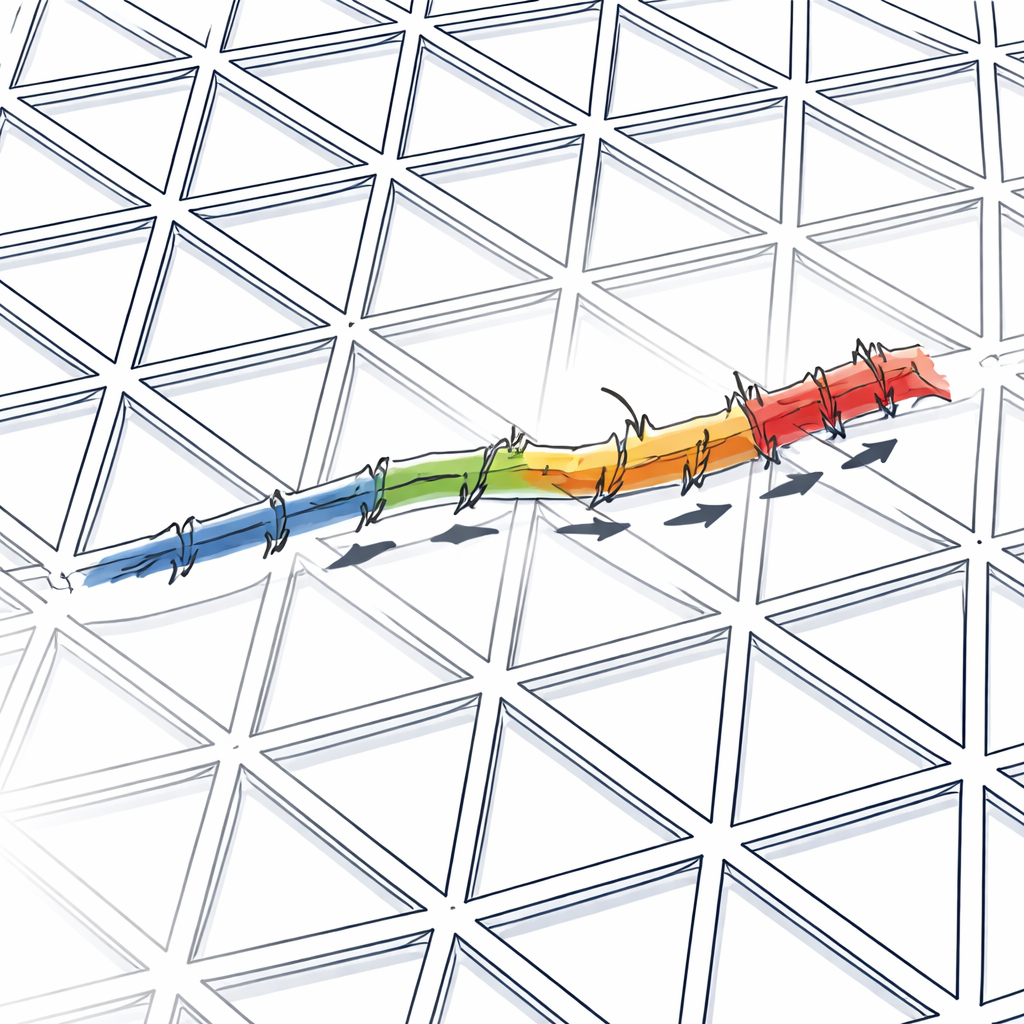
Citation: Wang, X., Sarkar, S., Gonella, S. et al. Topological mechanical metamaterial for robust and ductile one-way fracturing. Nat Commun 17, 2420 (2026). https://doi.org/10.1038/s41467-026-69026-7
Keywords: mechanical metamaterials, fracture control, topological mechanics, crack propagation, Maxwell lattices