Clear Sky Science · en
The focal adhesion kinases regulate leptin action and the weight reducing effect of HDAC6 inhibition
Why this research matters for weight control
Many people living with obesity have plenty of the hormone leptin, which is supposed to tell the brain that the body has enough fat and should eat less. Yet their brains often ignore this signal, a state called leptin resistance. This study uncovers two little-known enzymes in the brain that act like key “signal boosters” for leptin, and shows how experimental drugs that target another enzyme, HDAC6, tap into this pathway to restore leptin’s power to reduce appetite and body weight in obese mice.
The body’s appetite signal and why it fails
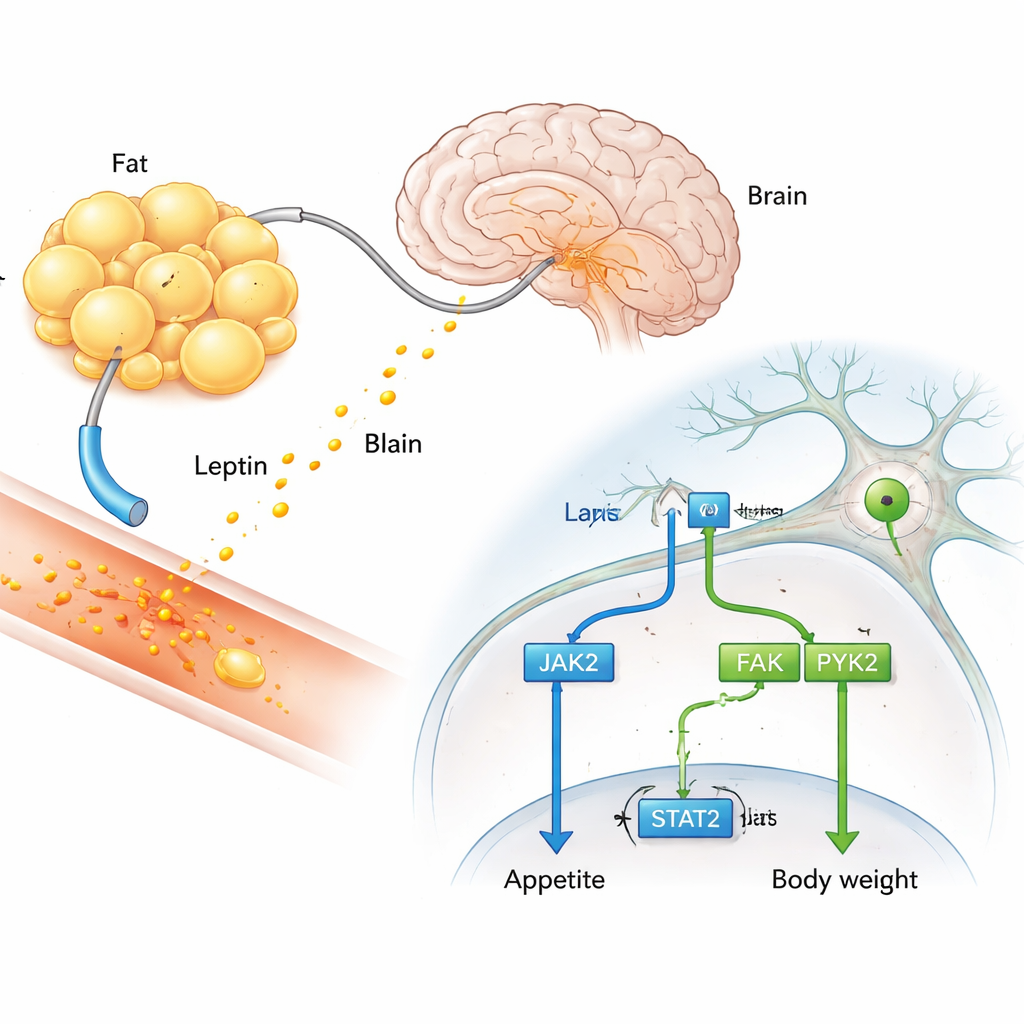
Leptin is made by fat cells in proportion to how much fat we carry. When leptin reaches the brain, especially regions in the hypothalamus, it normally activates a protein called STAT3 that switches on genes to curb hunger and increase energy use. In obesity, blood leptin levels are high but the leptin signal in the brain is weak, so appetite remains high. Earlier work showed that blocking an enzyme called HDAC6 outside the brain can unexpectedly make the brain sensitive to leptin again and cause weight loss, but the crucial steps inside brain cells that translate this signal into action were unclear.
New players in leptin’s message to the brain
The authors used large gene-expression databases to compare brain changes caused by leptin and by an HDAC6-blocking drug, Tubastatin A, in obese mice. They looked for molecules whose activity pattern was strongly linked to restored leptin sensitivity. This search highlighted a pair of enzymes called focal adhesion kinases, FAK and PYK2, which are best known for helping cells sense their physical environment. The team found that these kinases are widely present in leptin-responsive neurons in key appetite centers of the hypothalamus, suggesting they might help carry leptin’s message inside the cell.
How FAK and PYK2 strengthen leptin’s signal
In cell experiments, the researchers showed that FAK and PYK2 physically bind to STAT3 and can add a phosphate “on-switch” to it, a step normally credited to another enzyme, JAK2. Even in cells lacking JAK2, leptin could still activate STAT3 when FAK and PYK2 were present. When the scientists reduced FAK or PYK2 levels, or blocked their activity with a drug, leptin’s ability to turn on STAT3 and its target genes dropped sharply. This indicates that FAK and PYK2 act as important partners that help leptin fully activate STAT3, working alongside or in place of JAK2.
From brain chemistry to eating behavior
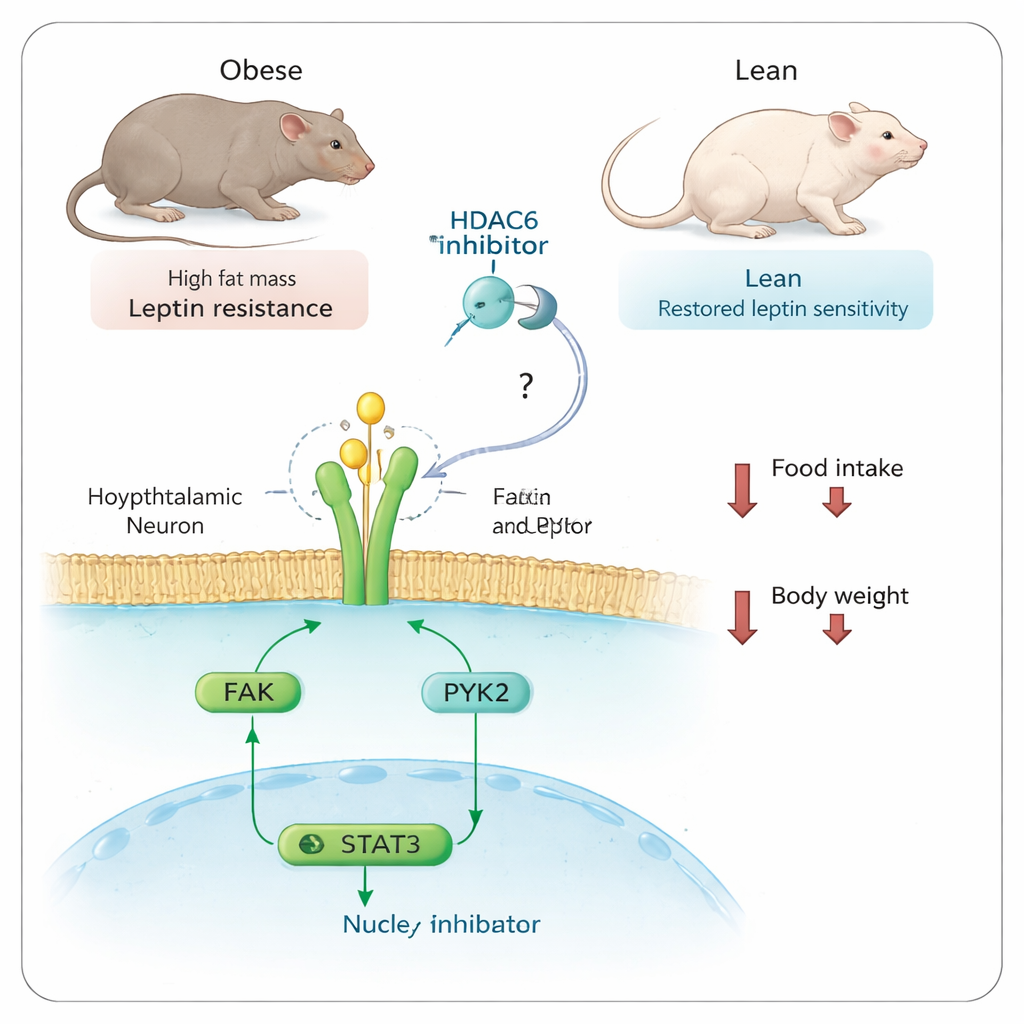
To test the impact in living animals, the team blocked FAK and PYK2 in the brains of mice. Lean mice given leptin normally eat less after a fast, but when the focal adhesion kinases were inhibited, this appetite-suppressing effect was blunted and brain STAT3 activation was weaker. Mice genetically lacking PYK2 showed similar partial resistance to leptin and to weight loss from Tubastatin A treatment. When both FAK and PYK2 were knocked down specifically in the hypothalamus of adult mice, the animals became hyperphagic—they ate more, gained fat, and developed higher blood sugar—even on regular chow. These mice also lost the usual weight-reducing response to HDAC6 inhibitors, showing that focal adhesion kinases are required for these drugs to work.
Connecting body fat, the blood, and the brain
The findings support a two-step model. First, blocking HDAC6 in peripheral tissues, especially fat, leads to release of an as-yet unidentified factor into the blood. Second, this factor reaches the brain and boosts the expression and activity of FAK and PYK2 in leptin-sensitive neurons. With these kinases engaged, leptin is better able to activate STAT3, which in turn dampens food intake and promotes weight loss. When FAK and PYK2 are missing or inhibited in the hypothalamus, HDAC6-blocking drugs no longer help, because leptin’s signal cannot be fully amplified.
What this means for future obesity therapies
For a layperson, the main message is that this work pinpoints a crucial “amplifier circuit” for the body’s own appetite-control hormone. FAK and PYK2 act as molecular helpers that allow leptin to effectively tell the brain, “You’ve had enough; you can stop eating now.” Drugs that safely tweak this pathway—by targeting HDAC6 in the body and focal adhesion kinases in the brain—could one day complement diet and exercise to treat obesity by restoring, rather than replacing, the body’s natural weight-control system.
Citation: Hadley, C.K., Galgano, L., Gui, Y. et al. The focal adhesion kinases regulate leptin action and the weight reducing effect of HDAC6 inhibition. Nat Commun 17, 1212 (2026). https://doi.org/10.1038/s41467-026-69008-9
Keywords: leptin resistance, obesity, hypothalamus, STAT3 signaling, HDAC6 inhibitors