Clear Sky Science · en
Continuous fabrication of Janus liquid crystal elastomer fibers with programmable actuation
Smart threads that move like muscles
Imagine clothes that tighten to keep you warm, or hair‑thin threads that curl to grab and move objects like tiny robot muscles. This study introduces a new kind of fiber that can twist, coil, crawl, and even steer small robots—all while being strong enough to weave into everyday fabrics.
Learning from climbing plants
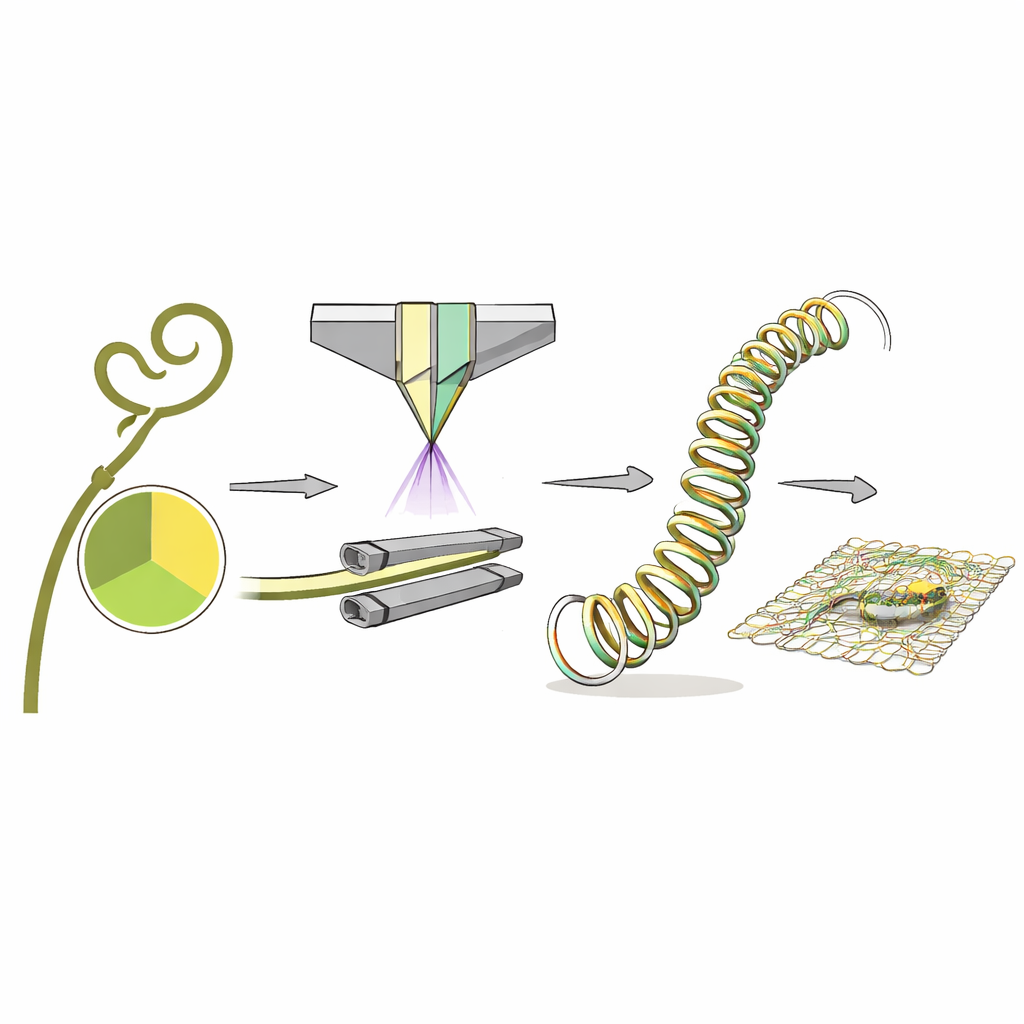
Climbing plants such as tendrils curl and coil because the material inside their stems is not the same on all sides. One side stiffens more than the other, creating built‑in imbalance that makes the stem bend and spiral. The researchers borrow this idea to design “Janus” fibers—named after the two‑faced Roman god—where each half of the cross‑section behaves differently. One side is a liquid crystal elastomer, a rubbery material whose internal order changes with heat or light and can contract like a muscle. The other side is a dynamic polyurethane network that is tough and slightly reconfigurable, providing strength and a way to lock in new shapes.
How the new fibers are made
To turn this concept into something that can be produced by the meter, the team built a continuous extrusion system. Two liquid precursors, one for each side of the fiber, are pushed through a special nozzle that joins them into a single, two‑colored strand. As soon as the strand emerges, ultraviolet light starts to solidify both halves at nearly the same speed, so the internal boundary between them stays clean and flat instead of mixing or breaking up. The fiber then passes through rollers that pull it, aligning the liquid crystal segments along the length. A second round of ultraviolet exposure “locks in” this alignment, and gentle heating later allows the dynamic bonds in the supporting half to reorganize and strengthen the overall structure.
Strong, tunable artificial muscles
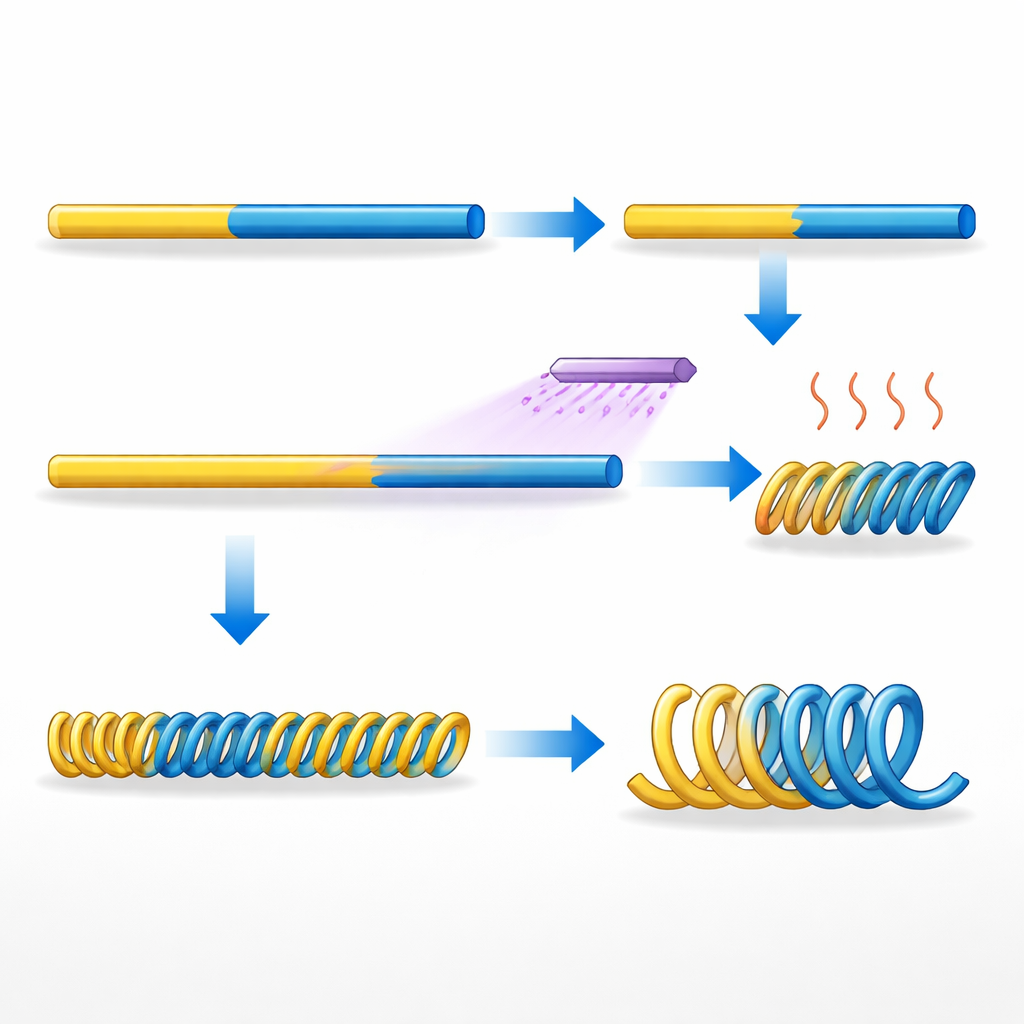
The result is a slim hybrid fiber whose properties can be tuned by adjusting how fast it is extruded, how much it is stretched, and the relative flow of each component. Tests show that these fibers are not only much stronger than conventional liquid crystal fibers, but can also sustain large deformations without breaking. When heated above a certain temperature, the liquid crystal side contracts while the other side resists, causing the fiber to bend and coil into springs with large and fast length changes. Because the supporting network contains bonds that can rearrange at higher temperatures, the same piece of fiber can be “reprogrammed” into different helical shapes—looser or tighter coils, straight sections next to coiled ones—simply by stretching, heating, and cooling under controlled conditions.
Tiny robots and shape‑shifting fabrics
With these programmable behaviors, the authors demonstrate several miniature devices. Single fibers can curl around and lift hot wires many thousands of times heavier than themselves. When coated with light‑absorbing particles, bundles of fibers act as legs for a small water‑walking robot that can move forward or rotate depending on which side is illuminated with infrared light. Other fibers are shaped into gradient springs that inch along narrow tubes when cycled between hot and cool conditions, mimicking the crawling of an inchworm. Finally, the fibers are woven into cloth using standard textile techniques. When the fabric is stretched, embedded fibers coil and fluff up the weave, trapping more air and improving insulation; mild heating returns the fabric to its original, flatter state, reducing warmth on demand.
Why this matters
For non‑experts, the key message is that the researchers have found a way to continuously manufacture hair‑thin, two‑sided fibers that are both strong and smart. One side provides muscle‑like motion, while the other offers toughness and the ability to “remember” new shapes. Because these fibers can be made in long lengths and survive normal handling, they can serve as building blocks for soft robots, moving textiles, and adaptive devices that respond to heat or light. In essence, the work brings us closer to everyday materials that quietly reshape themselves to grip, walk, or regulate our comfort—all powered by the hidden intelligence of their fibers.
Citation: Xu, J., Wan, H., Fang, Z. et al. Continuous fabrication of Janus liquid crystal elastomer fibers with programmable actuation. Nat Commun 17, 2254 (2026). https://doi.org/10.1038/s41467-026-68992-2
Keywords: soft robotics, smart textiles, artificial muscle fibers, liquid crystal elastomers, programmable materials