Clear Sky Science · en
Pantropical moist forests are converging towards a middle leaf longevity
Why leaf lifespans in rainforests matter
Pantropical moist forests—those lush green belts across the Amazon, Congo, and Asian tropics—are some of the planet’s hardest-working ecosystems. Their tree leaves act as billions of tiny solar panels, drawing carbon dioxide from the air and helping to stabilize climate. This study asks a deceptively simple question with big consequences: how long do those leaves live, and is that changing as the climate warms? By tracking leaf “careers” from birth to fall across continents, the authors reveal that tropical forests are gradually shifting toward a shared, medium-length leaf lifespan, with important implications for productivity, diversity, and resilience.
Different forests, different leaf life stories
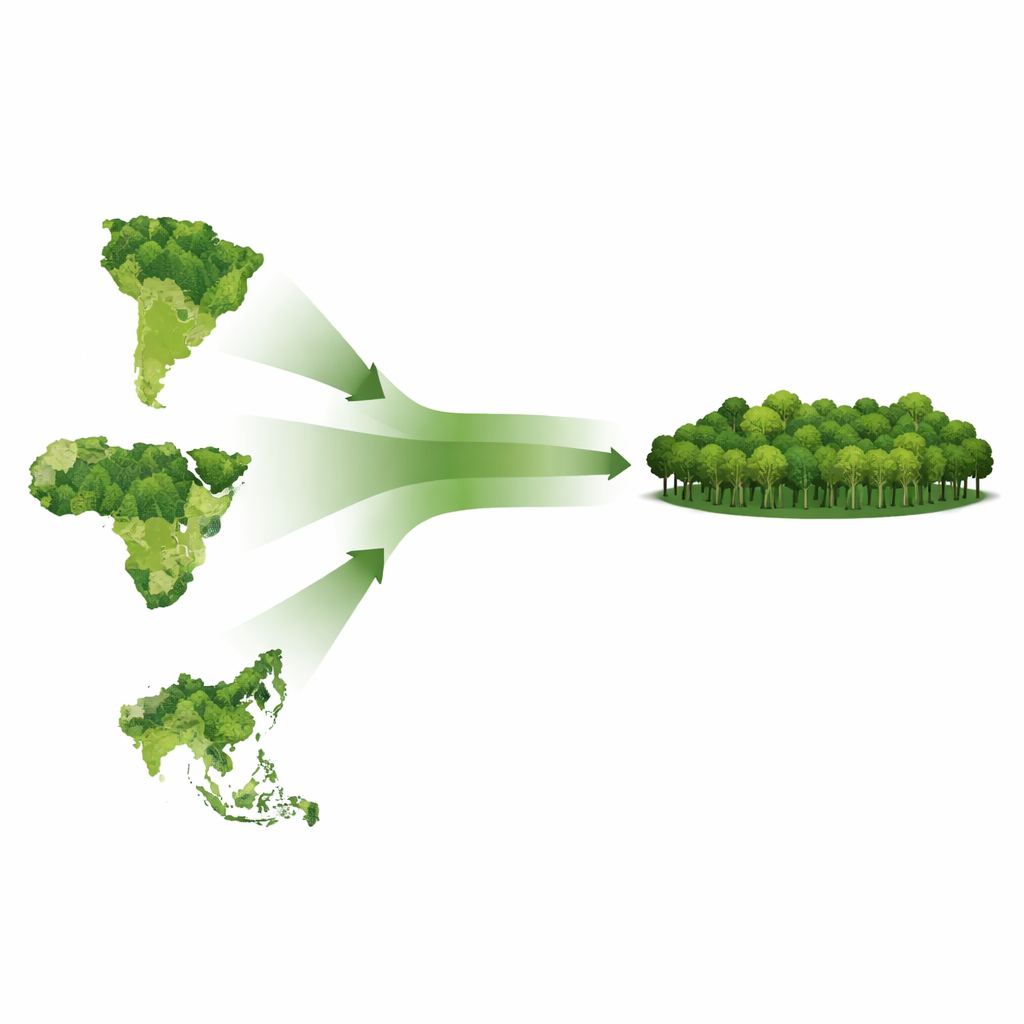
Leaves do not all live the same amount of time. Some trees replace their foliage in less than a year, while others keep the same leaves for several years. Using both on-the-ground measurements and a new satellite-based method that separates young and old foliage in the forest canopy, the researchers mapped average leaf lifespans from 2001 to 2023 across moist tropical regions. They found clear geographic contrasts: forests in the Amazon and tropical Asia tended to have long-lived leaves—typically more than about 1.8 years—while forests in the Congo Basin and subtropical Asia had short-lived leaves, closer to a year or less. These patterns reflect how trees balance the gains from keeping a leaf photosynthesizing against the costs of building and maintaining it.
A surprising move toward a middle ground
Over the two-decade record, leaf lifespans did not simply lengthen or shorten everywhere. Instead, forests at the two extremes moved in opposite directions and began to converge. In regions where leaves started out long-lived, especially the Amazon, lifespans shortened by several weeks per decade. In regions where leaves were originally short-lived, such as the Congo, they tended to lengthen. When the authors grouped pixels into short, moderate, and long lifespan classes and tracked how they shifted over time, they saw a strong flow out of the very short and very long categories into an intermediate band centered around roughly 1.8 years. The result is a kind of “middle-longevity trap,” where a growing share of tropical forests now sits in a similar, medium leaf lifespan range.
How changing climate nudges leaf lifespans
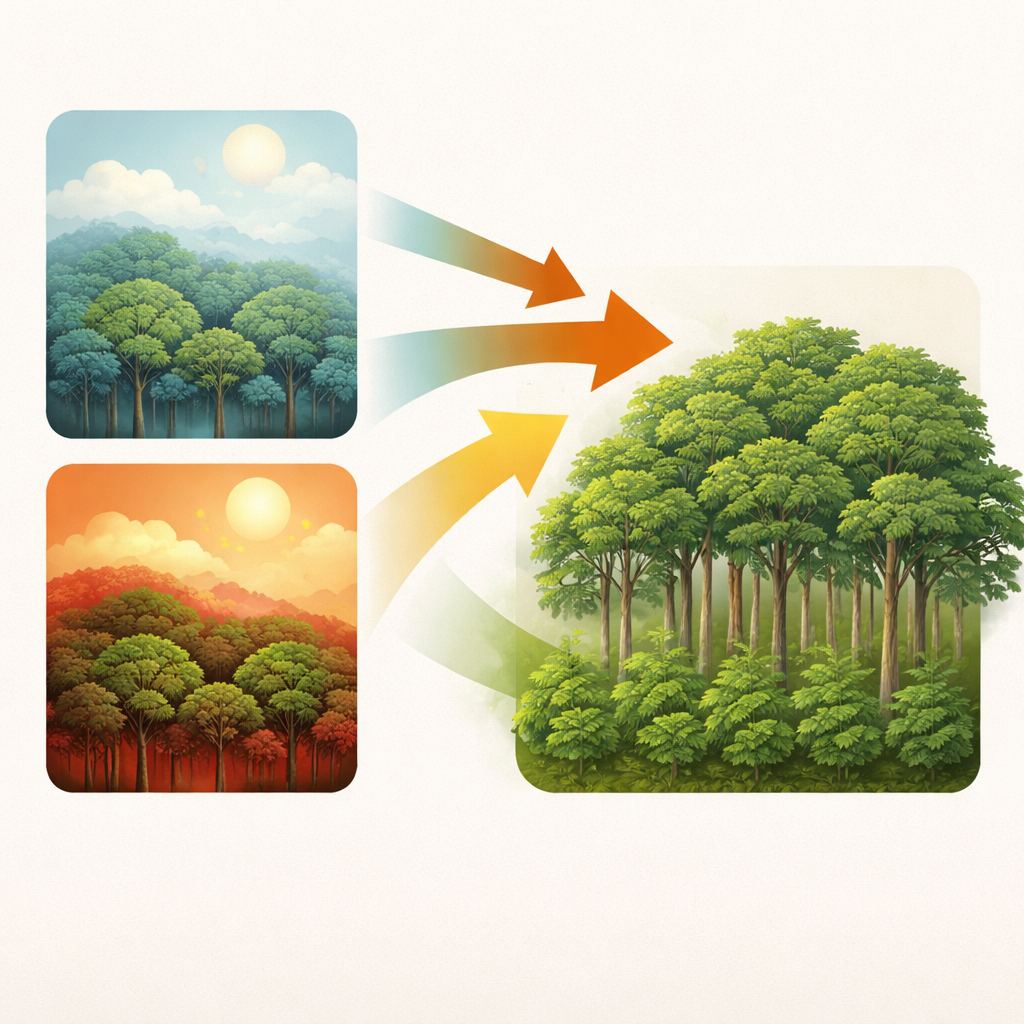
To understand why this convergence is happening, the team linked changes in leaf lifespans to shifts in temperature, sunlight, rainfall, and atmospheric dryness. In cooler or dimmer forests with short-lived leaves, slight warming and modest declines in light tended to favor longer lifespans—leaves could afford to stay on trees longer and keep working. In hotter, already bright forests with long-lived leaves, rising temperature and especially drier air increased stress on foliage, pushing trees toward faster turnover and shorter lifespans. Statistical models confirmed that changes in sunlight and air dryness were the dominant climate pathways governing these trends, with temperature playing opposite roles in cooler versus hotter regions.
Leaf lifespan, productivity, and who wins the competition
The consequences of this move to the middle are far-reaching. The authors show that many key leaf traits—such as size, thickness, and nutrient content—peak at intermediate lifespans. So do multiple independent estimates of photosynthesis, meaning forests with medium-lived leaves appear to capture the most carbon per unit area. Community structure also shifts: species with intermediate leaf lifespans tend to dominate, leading to more even shares among species but often fewer species overall in a given patch of forest. This rebalancing of traits and species composition feeds into how forests withstand climate extremes. Where leaves were originally short-lived, lengthening lifespans improved resistance mainly by boosting photosynthesis. Where leaves started out long-lived, modest shortening improved resistance by optimizing traits like leaf structure and nutrient use.
What this means for Earth’s green engine
In plain terms, the study suggests that tropical forests are quietly adjusting the “lifespan setting” of their leaves to cope with a changing climate. By converging on a middle-range leaf lifespan, these ecosystems appear to maximize photosynthesis and share resources more evenly among species, which can help them better ride out heatwaves and droughts. Yet this adaptation may come with trade-offs, such as reduced functional diversity. Recognizing and representing these shifts in leaf longevity will be crucial for predicting how well the world’s great rainforests can continue to stabilize climate, store carbon, and support rich webs of life in the decades ahead.
Citation: Xue, M., Yang, X., Chen, X. et al. Pantropical moist forests are converging towards a middle leaf longevity. Nat Commun 17, 2139 (2026). https://doi.org/10.1038/s41467-026-68989-x
Keywords: tropical forests, leaf lifespan, climate change, forest resilience, carbon cycle