Clear Sky Science · en
Environmental and societal costs of maize production decrease by addressing the uncertainty in nitrogen rate recommendations
Why Too Much Fertilizer Matters to Everyone
Modern corn farming depends heavily on nitrogen fertilizer to produce the grain that feeds people and livestock and supplies biofuels. But much of that nitrogen never makes it into the crop. Instead, it escapes into the air and water, driving climate change, polluting drinking water, and harming ecosystems. This study asks a deceptively simple question with huge consequences: how much nitrogen could U.S. corn farmers safely cut back, once we honestly account for the uncertainty in fertilizer recommendations?
The Problem with Wasted Nitrogen
Maize, or corn, is surprisingly poor at using nitrogen efficiently. In the U.S. Corn Belt, farmers apply large amounts of fertilizer, yet 50–70 percent of that nitrogen is lost from the field. Some is washed out as nitrate into rivers and groundwater, fueling algal blooms, dead zones, and drinking water contamination linked to cancers and birth defects. Some escapes as nitrous oxide, a powerful greenhouse gas that also damages the ozone layer, or as other nitrogen gases that worsen smog and fine‑particle air pollution. Making the fertilizer itself is energy‑hungry and usually powered by fossil fuels. At the same time, many fields still do not get exactly the right amount of nitrogen at the right time, so crops can be both over‑fertilized and under‑nourished. 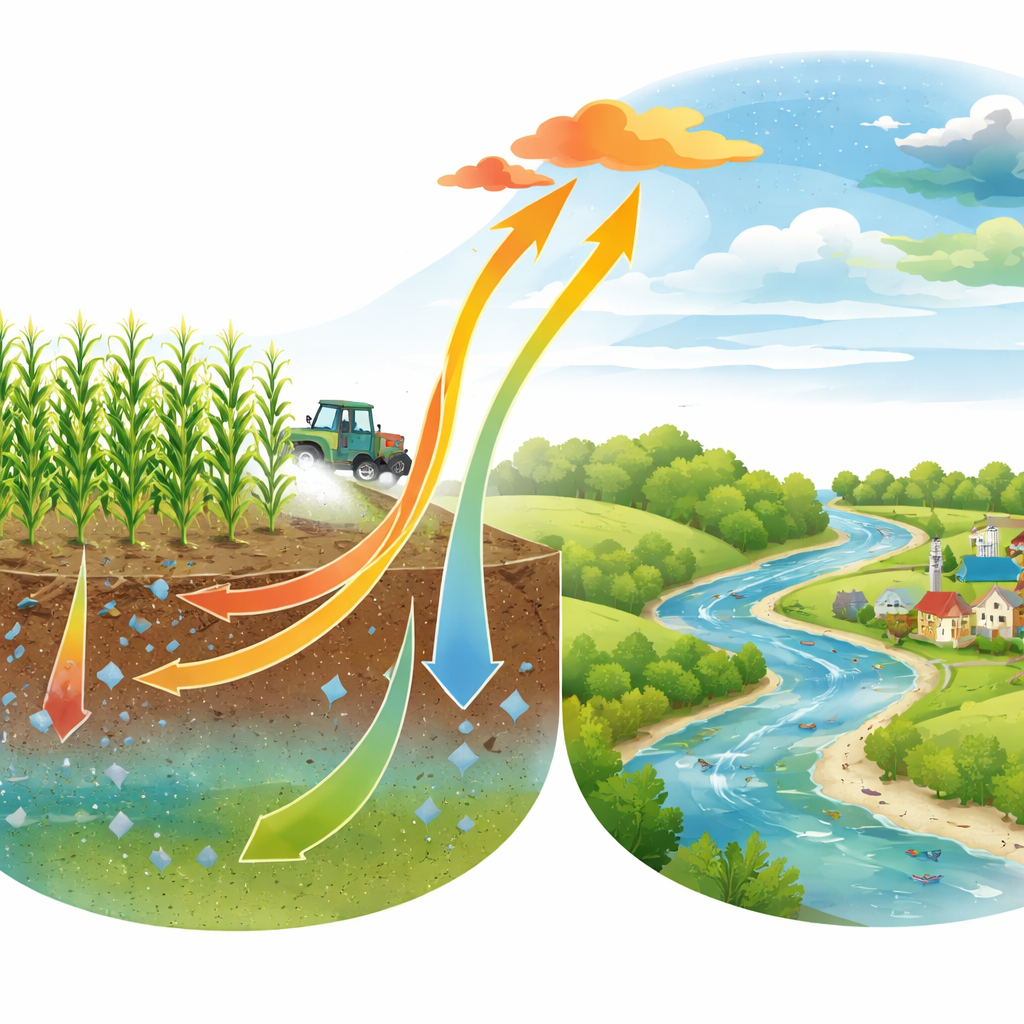
Rethinking “Optimal” Fertilizer Advice
Fertilizer guidelines usually offer a single “best” nitrogen rate that either maximizes yield (the agronomic optimum) or profit (the economic optimum). In reality, these numbers are uncertain because soil conditions, weather, and crop growth vary from year to year and place to place. Farmers know this and often add extra nitrogen as insurance against bad luck, pushing applications beyond official recommendations. The authors used detailed field trials at 49 locations across eight Corn Belt states to build statistical models of how corn yields respond to rising nitrogen doses. Instead of treating the optimum rate as a fixed value, they treated it as a probability distribution, capturing how likely different “best” rates are at each site.
Two Steps to Safer Nitrogen Use
With these probability distributions in hand, the team explored what would happen if farmers reduced fertilizer in two phases. In Phase I, nitrogen rates drop from the average yield‑maximizing level down to the average profit‑maximizing level. That change alone saves farmers money and trims fertilizer use by about 8 percent, while the expected yield loss is less than half a percent—too small to matter economically. In Phase II, they push a bit further, trimming rates down to a conservative point on the profit curve where the chance of yield loss is still low and the size of any loss remains under about 1 percent. Across all sites, combining both phases leads to a total fertilizer cut of roughly 12–16 percent, with only a 0.48–1.43 percent drop in yield, and even that small loss is not guaranteed in any given year. 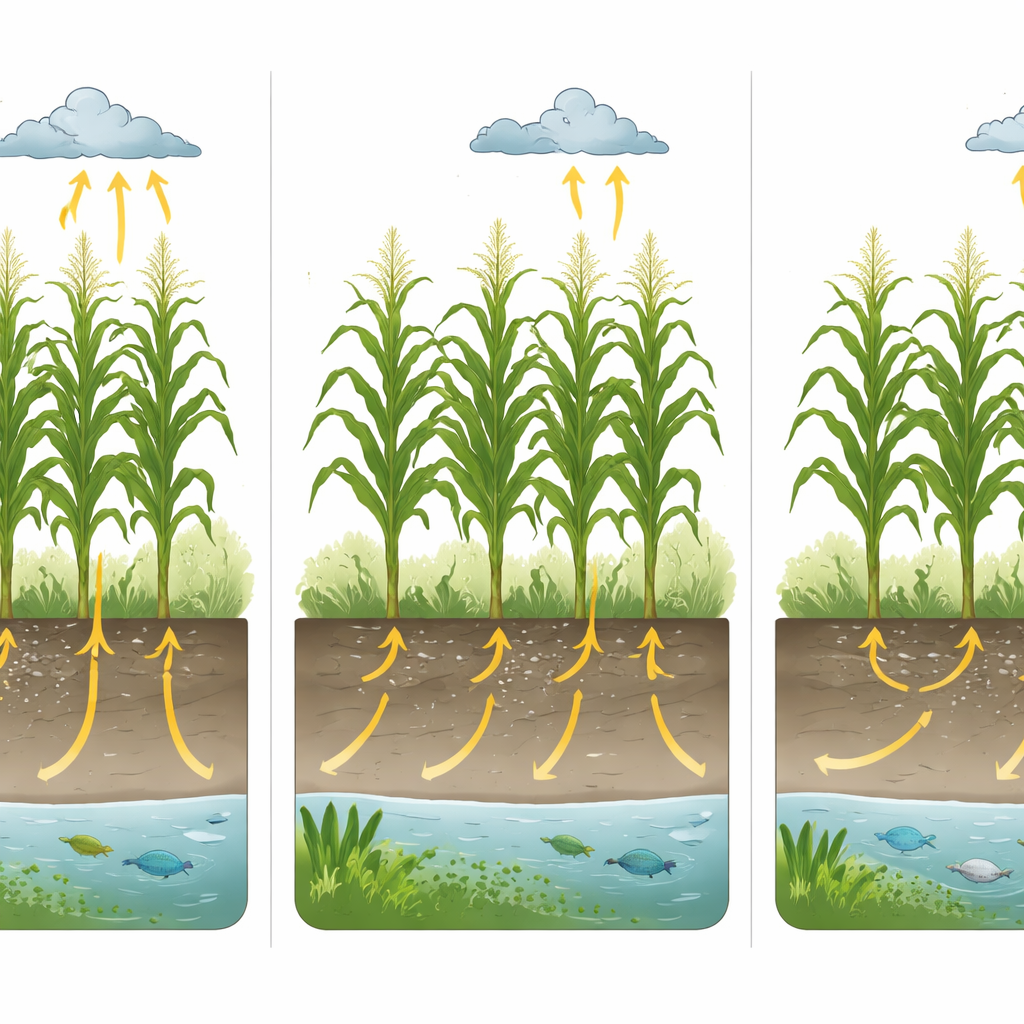
Cleaner Air, Safer Water, Real Money
To connect these modest rate cuts to real‑world outcomes, the authors translated reduced nitrogen use into changes in nitrate leaching, nitrous oxide emissions, and carbon dioxide released in fertilizer manufacture and transport. On average, a 12–16 percent fertilizer reduction lowered nitrous oxide emissions by about 10 percent, nitrate losses by about 13 percent, and fertilizer‑related carbon dioxide by up to 16 percent in the study scenarios. Scaling these changes across the Corn Belt, and using published estimates of the social costs of pollution, they estimate societal benefits of roughly 230 to 530 million dollars per year from cleaner air and water alone. These figures likely underestimate the full benefits because they do not include all nitrogen‑related pollutants or ecosystem impacts.
Sharing Risks and Rewards Along the Food Chain
While further nitrogen cuts beyond the 12–16 percent range would bring even larger environmental gains, the risk of noticeable yield loss rises sharply, making such reductions unattractive for farmers who already shoulder most of the production risk. The authors argue that realistic climate and water‑quality policy must recognize this imbalance. Tools such as nitrogen credit markets, group incentives, or nitrogen insurance could use part of the large public benefits to compensate farmers when rare yield losses occur. By treating fertilizer recommendations as uncertain ranges rather than magic numbers, and by sharing both risks and rewards across the food system, society can significantly curb nitrogen pollution without sacrificing food security.
Citation: Palmero, F., Davidson, E.A., Guan, K. et al. Environmental and societal costs of maize production decrease by addressing the uncertainty in nitrogen rate recommendations. Nat Commun 17, 2375 (2026). https://doi.org/10.1038/s41467-026-68988-y
Keywords: nitrogen fertilizer, maize production, Corn Belt, water quality, greenhouse gases