Clear Sky Science · en
Fast self-healing in a layered molecular crystal mediated by stress-induced symmetry breaking
Crystals That Fix Themselves
Imagine a phone screen or tiny medical sensor made from a material that can heal its own cracks in the blink of an eye. This study explores just such a possibility in a special organic crystal. The researchers show that a simple layered crystal can repair large cracks on its own, at room temperature, in just thousandths of a second—offering a glimpse of smarter, longer‑lasting materials for future technologies.
Layers That Behave Like Tiny Building Blocks
The material at the heart of this work is a crystal grown from a small organic molecule called 2‑methyl‑4‑nitroimidazole. When many of these molecules pack together, they form a neatly ordered, plate‑like crystal made of stacked layers, a bit like a molecular deck of cards. Within each layer the molecules are strongly linked, but the layers themselves are held together more weakly. This contrast turns out to be essential: it makes it easier to separate the layers under stress without destroying the entire structure, setting the stage for controlled cracking and repair.
Watching Cracks Open and Close in Real Time
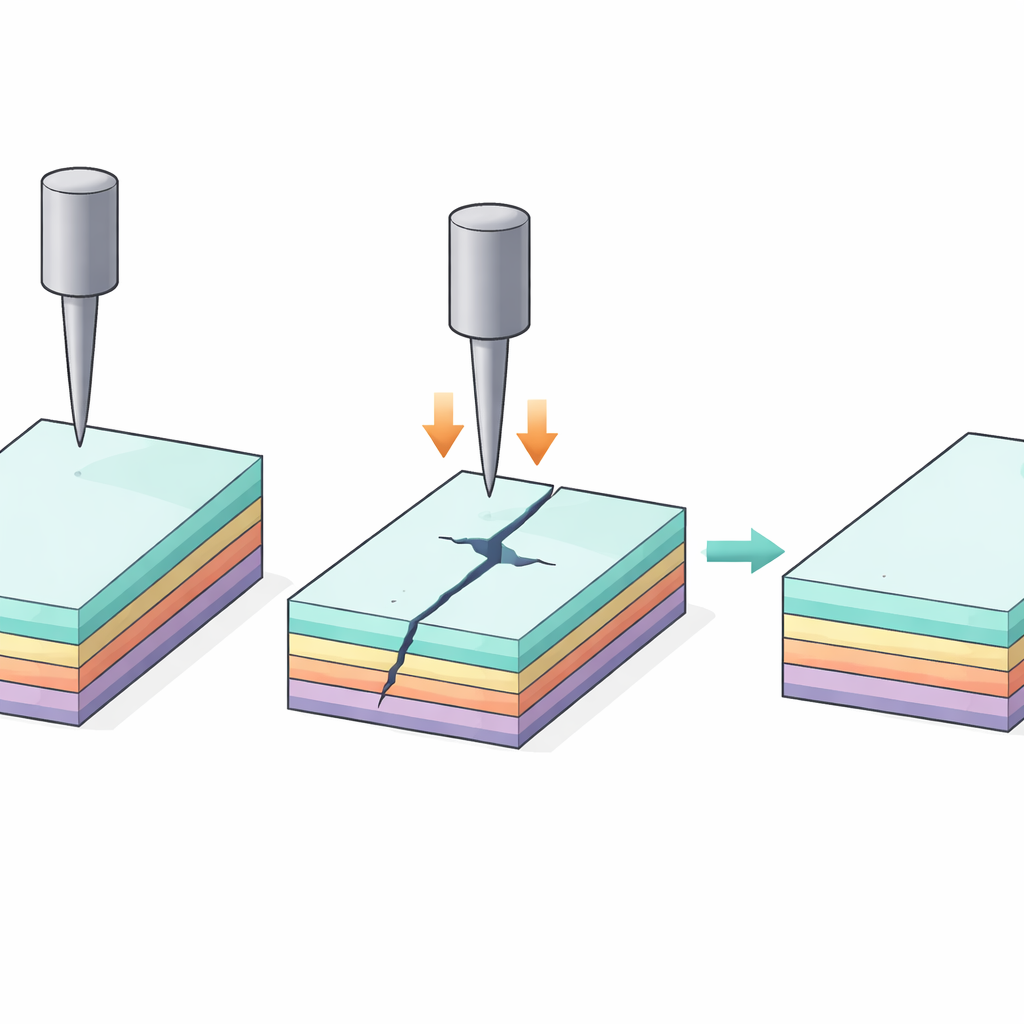
To test how these crystals respond to damage, the team pressed on them with fine metal pins and tweezers while recording ultra‑slow‑motion videos. A gentle push creates a thin, elliptical crack that runs parallel to the internal layers and can stretch across most of the crystal’s width. The moment the force is removed, the crack races backwards along its own path and snaps shut in about four thousandths of a second. High‑resolution imaging with electron microscopes and atomic force microscopes shows that, after healing, the crystal surface looks smooth and continuous, with scarcely a trace of the original damage. Even more impressively, X‑ray measurements confirm that the healed region recovers nearly the same orderly atomic arrangement as an untouched crystal.
How Stress Stops a Crack in Its Tracks
Behind this graceful behavior lies a delicate balance between stiffness and softness. Measurements reveal that the crystal is relatively rigid, yet it does not behave like a brittle piece of glass. As a crack spreads, the region right at its tip does not remain perfectly sharp; instead it becomes slightly deformed and rounded. This “plastic zone” blunts the crack, relieving the extreme stress that would otherwise cause the crystal to split completely. Because the crack follows the weak links between layers and keeps a smooth, curved shape, stored elastic energy and the tendency of the layers to re‑align help drive the two sides back together once the external force is gone.
A Momentary Loss of Balance in the Crystal
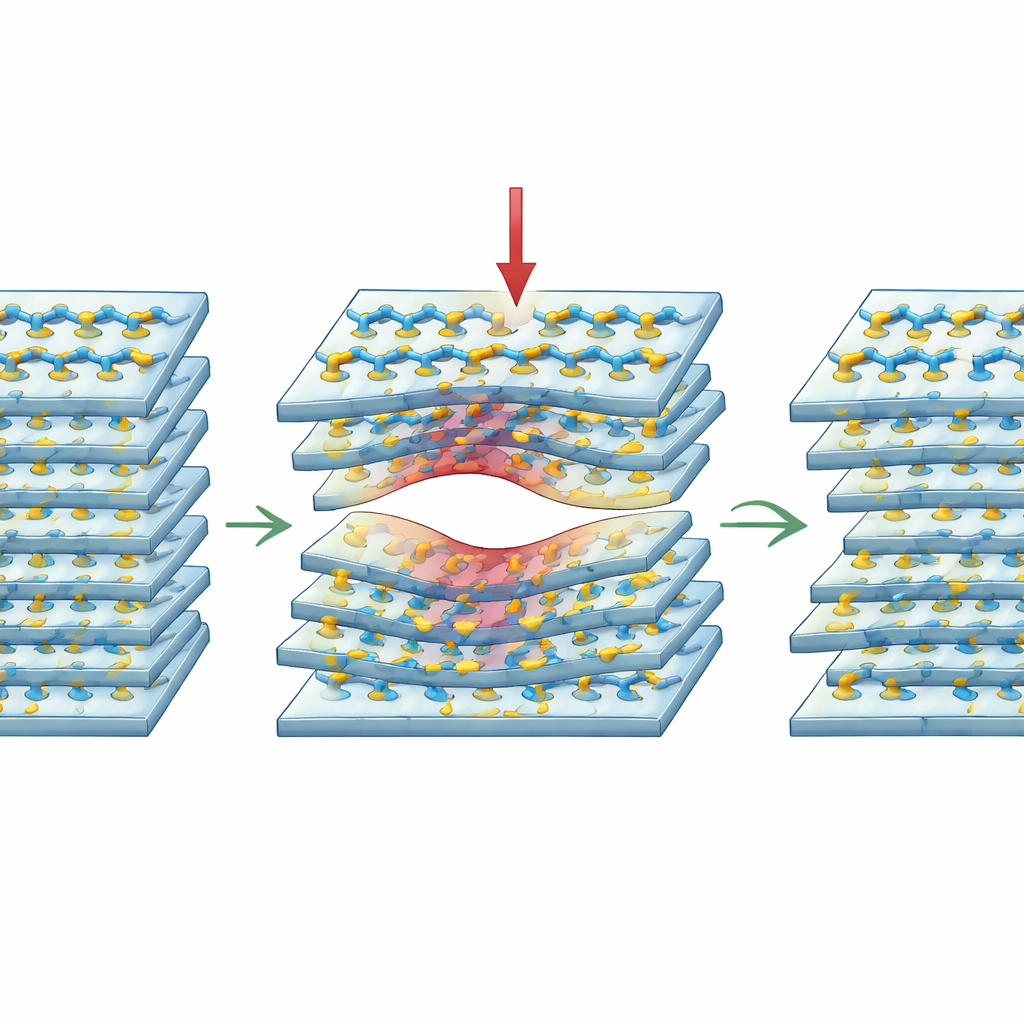
The researchers also probed what happens to the crystal’s internal order while it is cracked. In its normal state, the layered structure is highly symmetrical: for every part on one side, there is a mirror‑like partner on the other. Using Raman spectroscopy—light scattering that is sensitive to tiny vibrational changes—they found new signals appearing only near the crack tips, showing that the usual balance is locally disturbed there. A second technique, called second‑harmonic generation microscopy, is even more telling: it only lights up when this kind of symmetry is broken. In pristine regions, the signal is nearly absent, but around a crack it becomes several times stronger and takes on a distinct pattern. After the crack heals and the layers close, this signal fades again, indicating that the crystal’s orderly symmetry has been restored.
Toward Smarter, Self‑Healing Materials
Taken together, these observations reveal a new route to self‑healing in rigid, ordered materials. In this crystal, a brief, stress‑induced loss of symmetry at the crack interface creates charged, distorted layers that attract each other and encourage the crack to close, while the surrounding structure is strong enough to guide everything back into place. Unlike many existing self‑healing approaches that require heat, liquids, or added chemicals, this process occurs spontaneously under everyday conditions. By understanding how layering, bonding, and symmetry work together here, scientists gain valuable design rules for future materials that can quietly repair themselves, making devices more durable and reliable without anyone ever noticing the damage.
Citation: Ghosh, I., Biswas, R., Tanwar, M. et al. Fast self-healing in a layered molecular crystal mediated by stress-induced symmetry breaking. Nat Commun 17, 2525 (2026). https://doi.org/10.1038/s41467-026-68987-z
Keywords: self-healing crystals, layered molecular materials, stress-induced symmetry breaking, smart materials, crack repair